Why Smoke Smell Lingers Long After the Fire Is Out
If you have experienced a house fire — even a small one — you already know that the smoke smell does not disappear when the flames are extinguished. Weeks or even months later, the odor can still greet you every time you walk through the front door. That persistent smell is not just unpleasant. It is a sign that microscopic smoke particles have embedded themselves deep into your home’s materials, and no amount of air freshener, candles, or open windows will solve the problem.
Smoke odor persists because combustion produces gases and particulate matter that are incredibly small — often less than one micron in diameter. These particles penetrate porous materials such as drywall, wood framing, insulation, carpet, upholstery, clothing, and even concrete. In Southwest Florida’s humid climate, moisture in the air actually helps bond smoke residue to surfaces, making the problem worse over time rather than better.
Why DIY Smoke Odor Removal Usually Fails
Homeowners understandably want to tackle the smoke smell immediately. The internet is full of suggestions: bowls of vinegar, baking soda on carpets, charcoal briquettes in every room, boiling cinnamon on the stove. While some of these methods can temporarily mask light odors, they cannot address smoke that has penetrated beyond the surface.
Common DIY Approaches and Their Limitations
- Vinegar and baking soda: Effective for surface-level kitchen odors but cannot reach smoke particles embedded in drywall, insulation, or wall cavities
- Air purifiers with HEPA filters: Remove airborne particles but do nothing about smoke residue already bonded to solid materials
- Repainting walls: Temporarily seals in odor but without proper preparation and primer the smell bleeds through within weeks, especially in Florida’s heat
- Ozone generators (consumer-grade): Underpowered units sold at hardware stores rarely produce enough output to treat a full structure and can damage rubber and plastic materials if misused
- Essential oil diffusers and air fresheners: Mask the odor without addressing it — once the masking agent dissipates, the smoke smell returns
The fundamental problem is that DIY methods treat symptoms rather than the source. Smoke odor originates from residue that is physically embedded in materials throughout the structure. Effective treatment must reach those particles wherever they have traveled.
Where Smoke Odor Hides in Your Home
After a fire, smoke travels through the entire structure via air currents, HVAC ductwork, and pressure differentials. Even rooms that were far from the fire itself can develop severe odor problems. The most common places smoke odor hides include:
- HVAC ductwork and air handler: Your heating and cooling system circulates smoke throughout the house during and after the fire, coating the interior of every duct run
- Wall cavities: Smoke enters through electrical outlets, light switches, and gaps around plumbing penetrations and settles on framing and insulation inside the walls
- Attic insulation: Florida homes with blown-in insulation absorb enormous amounts of smoke residue that continuously off-gases back into the living space
- Carpet and pad: Both the carpet fibers and the pad beneath absorb smoke deeply — cleaning the carpet surface alone leaves the pad saturated
- Soft furnishings: Upholstered furniture, mattresses, drapes, and clothing all absorb and retain smoke particles
- Concrete and block: Many Florida homes are built on concrete slabs with concrete block walls. Both materials are porous and absorb smoke readily
Professional Smoke Odor Removal Methods That Work
Effective smoke odor removal requires professional-grade equipment and a systematic approach that treats every affected material. At WrightWay Emergency Services, we use multiple complementary technologies depending on the severity and type of smoke damage.
Thermal Fogging
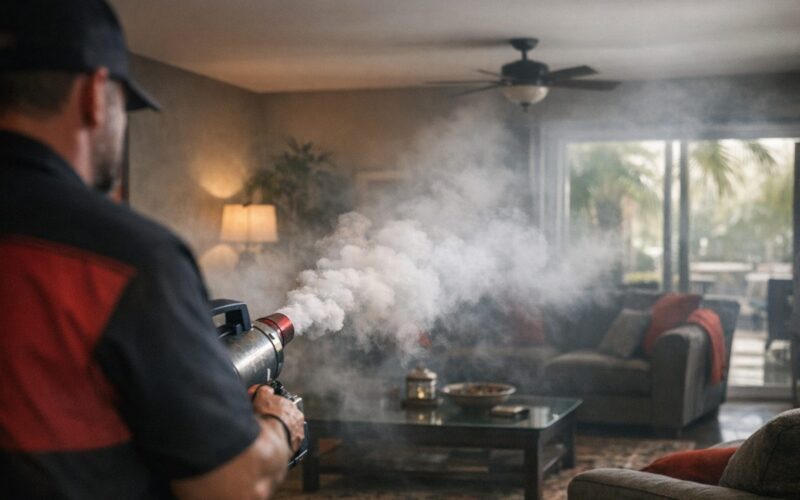
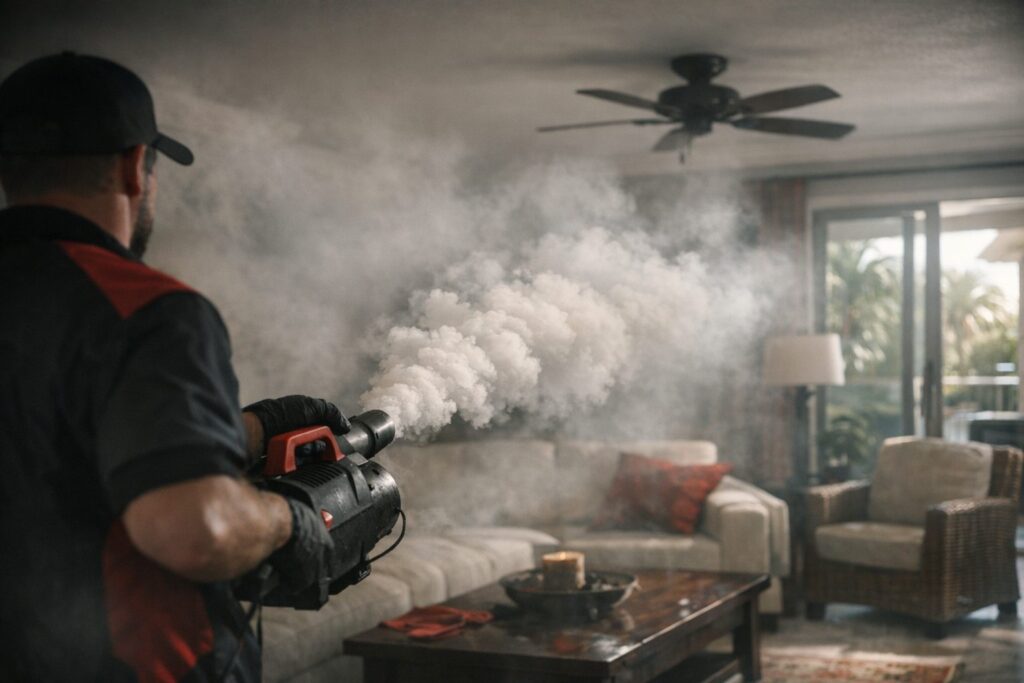
Thermal fogging uses heat to vaporize a deodorizing agent into an ultra-fine fog that mimics the behavior of smoke itself. The fog particles are small enough to penetrate the same cracks, crevices, and porous materials that smoke reached during the fire. This method is particularly effective for treating wall cavities, attic spaces, and other enclosed areas that cannot be physically scrubbed.
Hydroxyl Generators
Hydroxyl generators produce hydroxyl radicals — the same naturally occurring molecules that purify outdoor air — in high concentrations. These radicals break down odor-causing volatile organic compounds at the molecular level. Unlike ozone, hydroxyl treatment is safe to use in occupied spaces and will not damage sensitive materials. It is especially effective for ongoing treatment of contents and furnishings.
Ozone Treatment (Professional-Grade)
Professional ozone generators produce dramatically higher output than consumer units and are used under controlled conditions in unoccupied, sealed spaces. Ozone is a powerful oxidizer that destroys odor molecules on contact. It is most effective for treating structural components after contents have been removed. The space must be carefully ventilated after treatment before occupants return.
Surface Cleaning and Sealing
Before any deodorization treatment, all surfaces must be physically cleaned to remove visible smoke and soot residue. Walls, ceilings, and other hard surfaces are cleaned with specialized chemical sponges and cleaning agents. After cleaning and deodorization, surfaces are sealed with shellac-based or specialized smoke-sealing primers that permanently lock in any residual odor molecules before repainting.
HVAC Cleaning
If your HVAC system was running during or after the fire, it must be professionally cleaned. This includes the air handler, evaporator coil, supply and return ductwork, and all registers. Failing to address the HVAC system means contaminated air continues circulating through the home, recontaminating cleaned surfaces.
The Correct Sequence for Smoke Odor Elimination
Need restoration help in Southwest Florida right now? WrightWay is on site in under 2 hours from three Florida offices, and we answer with a live human.
Order matters when treating smoke odor. Performing steps out of sequence wastes time and money. The professional approach follows this sequence:
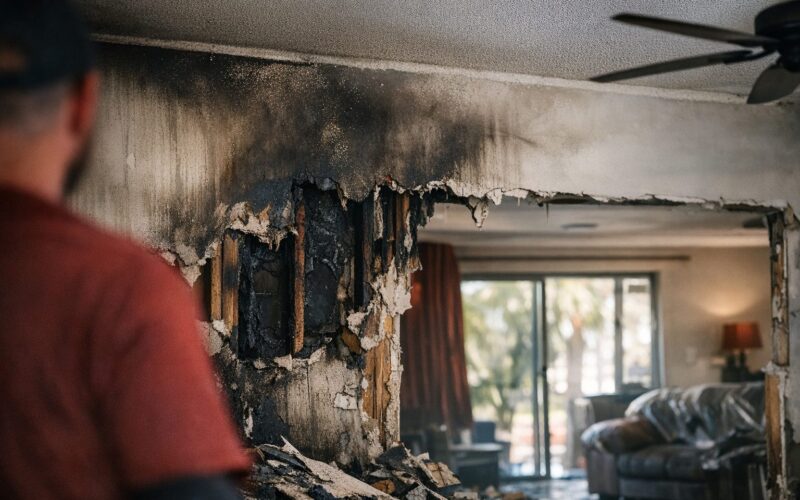
- Source removal: Remove fire-damaged materials that cannot be salvaged — charred framing, melted materials, and heavily saturated insulation
- Contents removal: Move salvageable contents to a contents cleaning facility for professional treatment
- Surface cleaning: Scrub all hard surfaces to remove soot and smoke residue
- HVAC cleaning: Clean the entire duct system and air handler
- Deodorization: Apply thermal fogging, hydroxyl, or ozone treatment to the empty, cleaned structure
- Sealing: Apply smoke-sealing primer to all surfaces
- Reconstruction: Replace drywall, insulation, flooring, and finishes as needed
- Final verification: Conduct air quality testing and sensory evaluation to confirm odor elimination
How Long Does Professional Smoke Odor Removal Take?
Treatment timelines depend on the severity of the fire and the size of the affected area:
| Scenario | Typical Timeline |
|---|---|
| Small kitchen fire, limited smoke spread | 3 to 5 days |
| Single-room fire with smoke throughout house | 1 to 2 weeks |
| Significant structural fire | 2 to 4 weeks for odor treatment alone |
| Severe fire with extensive smoke penetration | 4 to 6 weeks including multiple treatment cycles |
Florida’s high humidity can extend treatment times because moisture in the air slows the penetration of deodorizing agents and can reactivate odor molecules in porous materials. Professional restoration companies account for this by using commercial dehumidifiers alongside odor treatment equipment.
When Materials Must Be Replaced Instead of Treated
Not everything can be deodorized. Some materials absorb smoke so deeply that replacement is the only practical solution:
- Carpet and pad in rooms directly affected by fire almost always require replacement
- Insulation (fiberglass batt or blown-in) that was exposed to heavy smoke cannot be effectively cleaned
- Drywall that was directly exposed to heat and heavy smoke often must be removed and replaced
- Soft furnishings with severe smoke exposure may not be salvageable despite cleaning efforts
A professional assessment determines which materials can be treated and which must be replaced. This evaluation is critical for accurate insurance claims documentation because insurance adjusters want to see that the restoration plan is thorough but not excessive.
Take Action Now — Call WrightWay Emergency Services
Smoke odor does not improve with time. In Florida’s heat and humidity, it gets worse. The longer smoke residue remains in your home’s materials, the more deeply it bonds and the more difficult and expensive removal becomes. If your home has smoke odor from a recent fire or even an older incident that was never properly addressed, WrightWay Emergency Services can help.
We provide comprehensive fire damage restoration and odor removal services throughout Sarasota, Bradenton, Venice, Fort Myers, Naples, and all of Southwest Florida. Call us at (941) 379-8669 for a professional assessment. We respond 24/7 and work directly with your insurance company to streamline the claims process.
WrightWay handles every restoration job from emergency response through licensed reconstruction.
One IICRC-certified team, one project manager, one phone call. Available 24/7 across Sarasota, Manatee, Charlotte, Lee, and Collier counties.
Add us as a preferred source and our storm updates, claim guides and restoration answers show up higher when you search.