Why Closets and Cabinets Are Mold Magnets in Florida
Open any closet in a Florida home that has been closed for a few weeks, and there is a good chance you will notice that distinctive musty smell. Closets, cabinets, pantries, and enclosed storage areas are among the most common locations for mold growth in Florida homes — and the reasons are straightforward. These enclosed spaces have limited air circulation, are often located on exterior walls, and are typically cut off from the conditioned air your HVAC system circulates through the rest of the house.
The result is a microclimate inside these spaces where humidity levels can be 10 to 20 percent higher than in the adjacent room. In a state where indoor humidity is already challenging to control, that difference is often enough to push conditions above the 60 percent threshold where mold begins to grow.
Understanding the Problem
Several factors make enclosed spaces particularly vulnerable in Florida homes.
Limited HVAC Airflow
Most closets and cabinets do not have supply or return air registers. The conditioned, dehumidified air from your AC system circulates through rooms with registers but does not penetrate effectively into enclosed spaces with closed doors. The air inside a closed closet is essentially stagnant — it does not mix with the drier air in the room.
Exterior Wall Placement
Many closets are built against exterior walls. In Florida’s climate, the warm, humid outdoor air creates a vapor drive that pushes moisture through the exterior wall assembly toward the cooler interior. A closet on an exterior wall — especially one without insulation or with poor insulation — can experience condensation on the interior wall surface as the cooler conditioned air meets the warm, moist air migrating through the wall.
Contents That Trap Moisture
Tightly packed clothing, shoes, boxes, linens, and other stored items restrict what little air movement exists and create surfaces where moisture condenses and mold grows. Leather shoes, belts, and bags are particularly susceptible — leather is an organic material that mold feeds on readily. Cardboard boxes absorb humidity and provide an excellent substrate for mold colonization.
Hidden Moisture Sources
Cabinets under sinks, around dishwashers, and near refrigerators with water lines are vulnerable to slow leaks that introduce moisture into an enclosed space. These leaks may go unnoticed for weeks or months, creating ideal mold conditions in a hidden location.
Signs of Mold in Enclosed Spaces
- Musty odor when you open the door — the most common early indicator
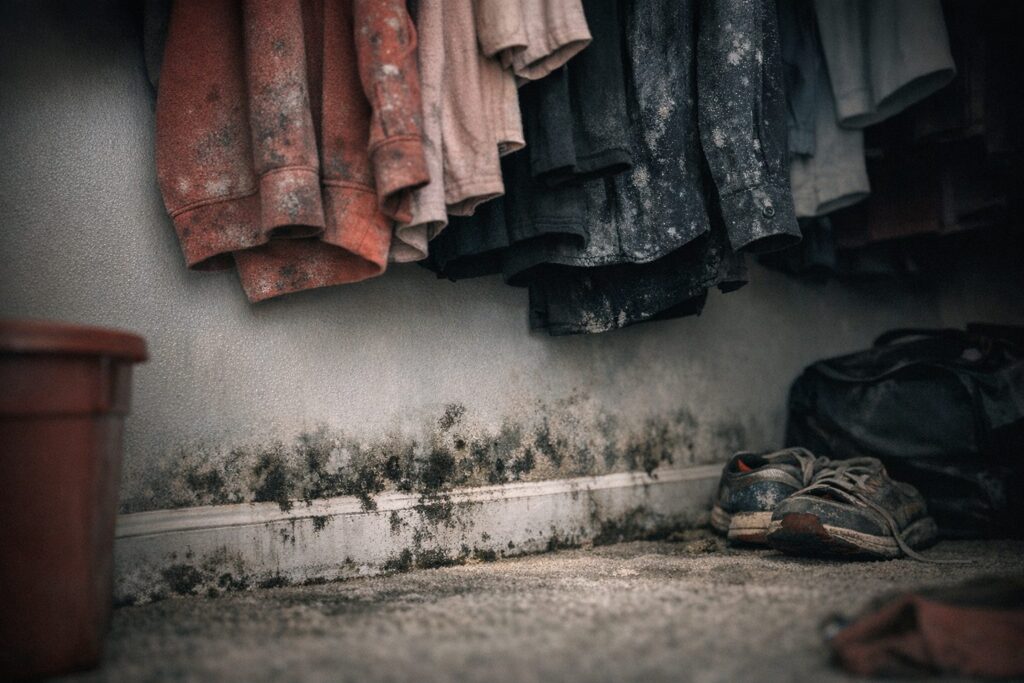
- Visible mold spots on walls, shelving, clothing, shoes, or bags
- Discoloration on the back wall, floor, or ceiling of the closet
- Warped or swollen shelving, especially particleboard or MDF shelves
- Damp-feeling clothing or linens that should be dry
- White, green, or black spots on leather goods
- Musty-smelling shoes or leather items
Prevention Strategies for Closets
Preventing mold in Florida closets requires improving air circulation and reducing humidity in these enclosed spaces.
Improve Air Circulation
- Leave closet doors open or ajar when possible to allow conditioned air to enter. Louvered closet doors are ideal because they allow continuous air exchange even when closed.
- Install louvered doors if your closets have solid doors. The cost of new louvered doors is minimal compared to mold remediation.
- Add a small fan to large walk-in closets. A low-wattage fan on a timer that runs for a few hours daily keeps air moving.
- Do not overfill closets. Leave space between items and between items and the wall to allow air to circulate.
- Consider a transfer grille. An HVAC technician can install a transfer grille or jump duct between the closet and the adjacent room, allowing conditioned air to flow into the closet when the door is closed.
Control Moisture
- Use moisture-absorbing products. Calcium chloride moisture absorbers (DampRid) or rechargeable silica gel dehumidifiers placed on closet shelves or floors absorb excess humidity from the enclosed air.
- Run a small dehumidifier in large walk-in closets with chronic humidity problems. Compact, low-energy dehumidifiers designed for closets are available and effective.
- Keep the home’s AC running. Even when away, maintain the thermostat at 78 degrees or lower to keep the whole house dehumidified. Closets benefit indirectly.
Protect Vulnerable Items
- Store clothing in breathable garment bags, not plastic. Plastic traps moisture against the fabric.
- Use cedar blocks or sachets — while not a humidity solution, cedar has natural antifungal properties that provide modest protection.
- Keep leather items conditioned and check them monthly during Florida’s humid months.
- Store off-season clothing in sealed plastic bins with desiccant packs rather than cardboard boxes.
Prevention Strategies for Kitchen and Bathroom Cabinets
Licensed mold remediation with containment, HEPA filtration, and clearance-ready documentation. Get a real price range before anyone starts cutting drywall.
Cabinets face the added risk of plumbing leaks in addition to humidity.
Under-Sink Cabinets
- Inspect plumbing connections monthly. Check supply lines, drain connections, garbage disposal mounting, and dishwasher hoses for drips or moisture.
- Use a leak detection mat or sensor. Inexpensive water sensors placed under the sink will alert you to leaks before they cause damage.
- Line cabinet bottoms with waterproof shelf liner or a plastic drip tray that catches small leaks.
- Keep under-sink areas clean and uncluttered so you can see the plumbing and spot leaks early.
All Kitchen and Bathroom Cabinets
- Leave cabinet doors open periodically to allow air exchange, especially in bathrooms after showers.
- Use the bathroom exhaust fan during and after showers to remove moisture before it migrates into cabinets.
- Check behind and beneath cabinets annually. Pull out bottom drawers and inspect the cabinet floor and wall behind for staining, moisture, or musty odors.
Storage Areas: Garages, Utility Rooms, and Spare Rooms
Florida homeowners often use garages, utility rooms, and spare bedrooms for long-term storage. These areas have their own mold risks.
Garage Storage
- Never store items directly on the concrete floor. Moisture migrates through concrete slabs. Use wire shelving or plastic pallets to elevate stored items off the floor.
- Use plastic bins with lids instead of cardboard boxes. Cardboard absorbs moisture, supports mold, and attracts pests.
- If the garage is air conditioned, keep it sealed and conditioned consistently.
- If the garage is not air conditioned, accept that it will experience Florida-level humidity and only store items that can tolerate it.
Spare Room Storage
- Keep the door open and ensure HVAC registers are not blocked by furniture or stored items
- Do not close off registers in unused rooms — this disrupts HVAC balance and can cause humidity problems in that room and others
- Avoid stacking items against exterior walls where moisture migration occurs
When Prevention Is Not Enough
If you have found mold in closets, cabinets, or storage areas despite preventive efforts, the problem may be deeper than surface humidity. Persistent mold in enclosed spaces often indicates:
- A hidden plumbing leak in the wall behind the space
- A building envelope failure allowing moisture intrusion
- Inadequate whole-house humidity control
- Slab moisture issues affecting ground-level spaces
Professional mold testing and a thorough moisture assessment can identify the root cause and guide the appropriate solution.
Get Expert Help — Call WrightWay
If mold in your Florida closets, cabinets, or storage areas keeps coming back despite your best prevention efforts, there may be an underlying moisture problem that requires professional investigation. WrightWay Emergency Services provides mold inspection, testing, and remediation services across Sarasota, Fort Myers, Naples, and all of Southwest Florida.
Call us at (941) 379-8669 to schedule an assessment. We will find the source of the moisture, eliminate the mold, and help you keep it from coming back.
WrightWay handles every restoration job from emergency response through licensed reconstruction.
One IICRC-certified team, one project manager, one phone call. Available 24/7 across Sarasota, Manatee, Charlotte, Lee, and Collier counties.
Add us as a preferred source and our storm updates, claim guides and restoration answers show up higher when you search.