

The Terminology Matters More Than You Think
When you discover mold in your Florida home and start looking for solutions, you will encounter two terms used almost interchangeably: mold removal and mold remediation. Most homeowners assume they mean the same thing. They do not — and the distinction has significant implications for the scope of work performed, the quality of the outcome, and critically, what your insurance company will pay for.
Understanding the difference between these terms helps you hire the right company, set appropriate expectations, and navigate the insurance claims process more effectively.
What Is Mold Removal?
Mold removal is exactly what it sounds like: physically removing mold from surfaces. A company that performs mold removal may wipe, scrub, sand, or chemically treat visible mold on walls, ceilings, and other surfaces. The focus is on eliminating the mold you can see.
Limitations of Mold Removal
The fundamental problem with mold removal as a standalone service is that it addresses the symptom without addressing the cause. Simply removing visible mold without addressing the underlying moisture source, airborne contamination, and affected materials behind surfaces leads to predictable results: the mold comes back.
- Does not address moisture source: If the water problem that caused the mold is not identified and repaired, mold will regrow on the cleaned surfaces
- Does not address hidden mold: Visible mold is often just the surface expression of much larger colonies growing behind walls, under floors, and in other concealed spaces
- No containment: Without proper containment and negative air pressure, cleaning visible mold releases spores into the air, potentially spreading contamination to clean areas of the home
- No verification: Without post-remediation testing, there is no objective confirmation that the problem has been resolved
What Is Mold Remediation?
Mold remediation is a comprehensive, multi-step process governed by industry standards (IICRC S520) that addresses the entire mold problem — not just the visible growth. Professional mold remediation includes:
The Remediation Process
- Assessment: Thorough inspection to determine the type, extent, and location of mold contamination, including hidden growth. This often includes air quality testing and moisture mapping.
- Source identification and correction: Finding and repairing the water or moisture source that caused the mold — a leak, condensation issue, humidity problem, or other moisture intrusion.
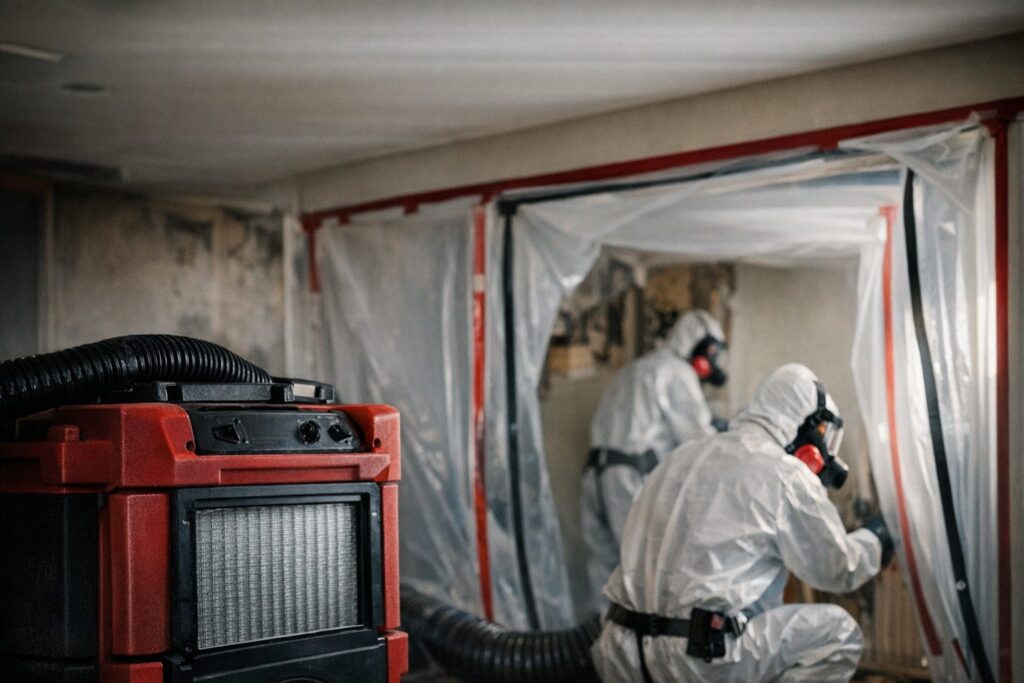
- Containment: Isolating the affected area with physical barriers (polyethylene sheeting) and establishing negative air pressure using HEPA-filtered air machines to prevent spore migration to clean areas.
- Air filtration: Running HEPA air scrubbers continuously during the project to capture airborne spores.
- Material removal: Removing porous materials that are contaminated beyond cleaning — drywall, insulation, carpet, and other materials where mold has penetrated below the surface.
- Cleaning and treatment: HEPA vacuuming all surfaces, then treating affected areas with EPA-registered antimicrobial products.
- Drying: Ensuring all materials are dried to acceptable moisture levels using professional drying equipment.
- Post-remediation verification: Independent air quality testing by a third party to confirm spore levels have returned to acceptable levels, providing objective proof that the remediation was successful.
Why the Difference Matters
Remediation treats the entire problem; removal treats only the visible symptom. The difference in outcome is significant:
| Factor | Mold Removal | Mold Remediation |
|---|---|---|
| Addresses moisture source | Usually no | Yes — required step |
| Addresses hidden mold | No | Yes — concealed areas investigated and treated |
| Containment used | Rarely | Always — per IICRC S520 standards |
| HEPA air filtration | Rarely | Always — continuous during project |
| Post-remediation testing | Usually not included | Standard practice — third-party verification |
| Recurrence likelihood | High | Low (if source is corrected) |
| Insurance acceptance | Often questioned or denied | Standard covered scope when cause is covered |
What Insurance Actually Covers
Florida homeowners insurance and mold coverage is governed by Florida Statute 627.706, which requires insurers to provide mold coverage but allows them to cap it — typically at $10,000. The critical factor is not whether you call it “removal” or “remediation” but whether the mold resulted from a covered cause of loss.
When Mold Is Covered
Insurance covers mold remediation when the mold results from a sudden and accidental covered peril:
- Burst pipe or sudden plumbing failure
- Appliance malfunction (water heater, washing machine, dishwasher)
- Wind-driven rain from a covered storm event
- Fire suppression water
- Accidental overflow
When Mold Is Not Covered
- Mold from neglect or lack of maintenance (slow, unrepaired leaks)
- Mold from humidity or condensation (maintenance/habitability issue)
- Mold from flooding (requires separate flood insurance)
- Pre-existing mold conditions
- Mold from construction defects
Why Remediation Gets Covered and Removal Often Does Not
Insurance adjusters are trained to evaluate whether the scope of work is reasonable, necessary, and performed to industry standards. A proper remediation protocol — with containment, HEPA filtration, documented scope of work, and post-remediation testing — aligns with what insurers expect. A “mold removal” proposal that involves wiping surfaces and spraying chemicals without containment, testing, or source correction raises red flags and may be denied or reduced.
Maximizing Your Mold Claim
- Report the water damage claim promptly. The mold coverage is tied to the underlying water damage event. Filing the water damage claim first establishes the covered cause.
- Document the connection between the water event and the mold. The mold must be a direct result of the covered water damage, not a pre-existing or unrelated condition.
- Hire a licensed remediation company that follows IICRC S520. Insurance companies are far more likely to approve and pay claims when the work is performed by certified professionals following recognized standards.
- Get pre-remediation testing. Air quality testing before remediation documents the scope of contamination and supports the necessity of the work.
- Get post-remediation testing. Clearance testing proves the remediation was effective, which supports the insurance claim and protects you from future disputes.
- Maintain detailed documentation. Photos, moisture readings, lab reports, containment verification, and a written scope of work all support your claim.
The $10,000 Cap: Making It Count
Licensed mold remediation with containment, HEPA filtration, and clearance-ready documentation. Get a real price range before anyone starts cutting drywall.
With most Florida policies capping mold coverage at $10,000, every dollar of that coverage matters. Professional remediation that follows proper protocols maximizes the value of your coverage because:
- The work is done right the first time — no repeat claims or out-of-pocket costs for recurrence
- Proper documentation supports every line item on the claim
- Post-remediation testing provides objective proof that the work was necessary and effective
- The scope of work aligns with what adjusters expect to see, reducing disputes and delays
WrightWay Handles It Right — Call Us
WrightWay Emergency Services performs mold remediation to IICRC S520 standards on every project — containment, HEPA filtration, proper material removal, antimicrobial treatment, and post-remediation verification. We also provide comprehensive insurance claims documentation that supports your claim and maximizes your coverage.
If you have discovered mold in your Florida home, call us at (941) 379-8669. We serve Sarasota, Fort Myers, Naples, and all of Southwest Florida. We will assess the situation, coordinate with your insurance company, and remediate the mold professionally and thoroughly.
WrightWay handles every restoration job from emergency response through licensed reconstruction.
One IICRC-certified team, one project manager, one phone call. Available 24/7 across Sarasota, Manatee, Charlotte, Lee, and Collier counties.
Add us as a preferred source and our storm updates, claim guides and restoration answers show up higher when you search.


