The Security Threat That Follows Every Disaster
When a hurricane, fire, or other disaster damages your property, the immediate threat from the event itself is only the first challenge. In the hours and days that follow, damaged properties face a second threat that many homeowners do not anticipate: criminal activity. Looting, theft, vandalism, and unauthorized entry are documented problems after every major disaster, and properties that are visibly damaged, unoccupied, or unsecured are the primary targets.
After Hurricane Ian devastated parts of Fort Myers, Cape Coral, and the barrier islands in 2022, law enforcement agencies across Southwest Florida reported significant increases in property crimes in affected areas. Copper theft from damaged HVAC systems, appliance theft from flood-damaged homes, and opportunistic burglary of evacuated properties were reported throughout Lee and Charlotte counties.
Protecting your property after a disaster requires a combination of physical securing, monitoring, documentation, and awareness. Here is how to reduce your risk.
Why Damaged Properties Attract Criminals
Understanding why criminals target disaster-damaged properties helps you plan your defense:
- Visible damage signals vacancy: Broken windows, missing doors, and tarped roofs tell criminals the property is likely unoccupied
- Disabled security systems: Power outages disable alarm systems, cameras, and motion lights
- Overwhelmed law enforcement: Police are stretched thin during disaster response, with longer response times and reduced patrols
- Easy access: Compromised doors, windows, and walls provide entry points that require no forced entry
- Valuable targets: HVAC equipment, copper plumbing and wiring, appliances, and personal belongings left behind during evacuation
- Reduced neighborhood surveillance: When multiple properties are damaged and residents are displaced, the normal neighborhood watch effect disappears
Physical Security Measures
Professional Board-Up
The most effective first step in securing a damaged property is professional board-up service. Properly installed plywood over windows, doors, and other openings does two things: it prevents weather from causing secondary damage, and it creates a physical barrier that deters casual criminals.
Professional board-up differs from a DIY approach in several important ways:
- Structural-grade plywood: Thick enough to resist prying and impact
- Screw fastening: Screws into framing members, not just nails that can be pulled
- Complete coverage: Every opening is secured, including those you might not think of (pet doors, crawl space access, utility openings)
- Tamper-resistant hardware: One-way screws or security bolts that cannot be removed with standard tools
Temporary Fencing
For properties with extensive damage, temporary chain-link or panel fencing around the perimeter adds another layer of security. This is particularly important for commercial properties where large areas may be exposed or where equipment and materials are staged for the restoration work.
Lighting
Criminals prefer darkness. If power is available (through utility restoration or a generator), exterior lighting is one of the most effective deterrents. Battery-powered or solar-powered motion-activated lights can be deployed even without utility power. Place lights at all entry points, along the sides of the building, and anywhere that materials or equipment are stored.
Signage
Visible signage that indicates the property is monitored, alarmed, or under surveillance acts as a deterrent. Even during a power outage when electronic systems may be offline, signage creates uncertainty for potential criminals. Post signs from your security company, “No Trespassing” notices, and any other warnings that suggest monitoring is in place.
Technology-Based Security During Outages
Modern security technology offers solutions that work even when utility power is unavailable:
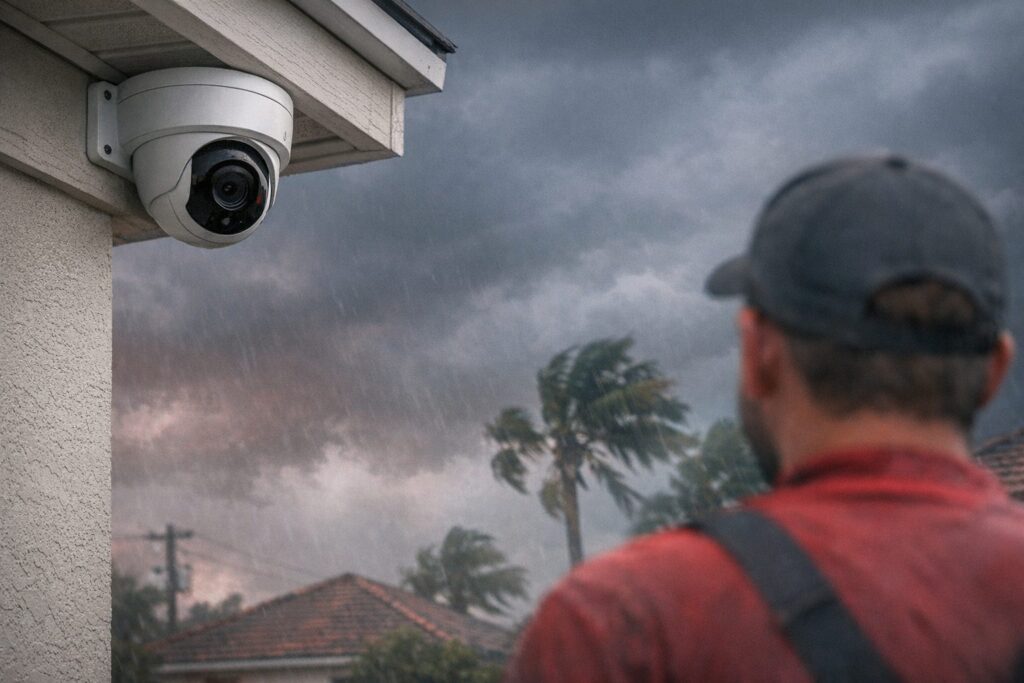
- Battery-backup security cameras: Cellular-connected cameras with battery backup can continue monitoring and sending alerts to your phone even without power or internet at the property
- Cellular alarm systems: If your alarm system has a cellular communicator and battery backup, it may continue functioning during a power outage. Verify this with your security provider before you need it.
- Smart locks with battery power: Battery-operated smart locks continue to function and log entry/exit events without power
- Trail cameras: Inexpensive motion-activated cameras designed for outdoor use can be placed at entry points to capture images of anyone approaching the property
- GPS trackers: Small GPS trackers placed on valuable equipment, HVAC units, or inside storage areas can help recover stolen items
Personal Safety During Property Checks
Need restoration help in Southwest Florida right now? WrightWay is on site in under 2 hours from three Florida offices, and we answer with a live human.
If you are visiting your damaged property to check on it or retrieve belongings, take these precautions:
- Go during daylight hours whenever possible
- Bring someone with you. Never check a damaged property alone.
- Carry a charged cell phone and ensure someone knows where you are and when you expect to return
- Do not confront trespassers. If you arrive and find someone on your property, do not engage. Leave and call law enforcement.
- Watch for structural hazards: Damaged properties may have weakened floors, unstable walls, or exposed nails and debris
- Document everything: Take photos and video of the property’s condition each time you visit. This creates a timeline of the property’s state and helps identify if theft or additional damage has occurred between visits.
Protecting Valuables Before and After a Disaster
The best time to protect your valuables is before a disaster strikes. If you are in an evacuation zone or anticipate significant storm damage:
- Take important documents with you: Passports, insurance policies, titles, birth certificates, financial records
- Remove or secure firearms: Firearms left in damaged homes are a significant theft target and public safety concern
- Photograph valuable items: Create a visual inventory for insurance purposes before you leave
- Move portable valuables to a safe location: Jewelry, electronics, family heirlooms
- Secure medications: Prescription medications, especially controlled substances, should not be left in an unsecured property
Working with Your Restoration Company on Security
Your restoration company plays a key role in property security. At WrightWay Emergency Services, securing the property is part of our standard emergency response. When we arrive at a damage scene, board-up and securing are among the first actions we take, not only to prevent weather damage but to protect the property from criminal activity during the restoration process.
During active restoration projects, we also:
- Secure the property at the end of each work day
- Maintain a log of all personnel who access the property
- Document the property’s condition at each visit
- Coordinate with property owners on access and key management
- Report any signs of unauthorized entry or tampering
Report Suspicious Activity
If you witness looting, theft, or suspicious activity at any property after a disaster, report it to local law enforcement. In Florida, looting during a declared state of emergency is a felony carrying enhanced penalties.
For immediate property securing, board-up services, or any emergency restoration need, call WrightWay Emergency Services at (941) 379-8669. We respond 24/7 across Sarasota, Manatee, Charlotte, Lee, and Collier counties to protect and restore your property.
WrightWay handles every restoration job from emergency response through licensed reconstruction.
One IICRC-certified team, one project manager, one phone call. Available 24/7 across Sarasota, Manatee, Charlotte, Lee, and Collier counties.
Add us as a preferred source and our storm updates, claim guides and restoration answers show up higher when you search.