The Invisible Killer After Every Florida Storm
When a hurricane or major storm knocks out power across Southwest Florida, generators become lifelines. They keep refrigerators running, charge phones, power medical equipment, and provide some semblance of normalcy during an extended outage. But every year, the aftermath of major storms brings a grim statistic: more people die from carbon monoxide (CO) poisoning caused by generator misuse than from the storm itself.
After Hurricane Ian in 2022, hospitals across Lee and Charlotte counties treated dozens of carbon monoxide poisoning cases, and several were fatal. After Hurricane Irma in 2017, the same pattern repeated. The tragedy is that every single one of these cases was preventable.
This guide covers everything you need to know about carbon monoxide risk, safe generator operation, and what to do if you suspect CO exposure in your home.
What Is Carbon Monoxide and Why Is It So Dangerous?
Carbon monoxide is a colorless, odorless, tasteless gas produced by the incomplete combustion of fuels including gasoline, propane, natural gas, and charcoal. Every internal combustion engine, including the one in your portable generator, produces carbon monoxide in its exhaust.
CO is dangerous because:
- You cannot detect it without a CO alarm. It has no smell, no color, and no taste.
- It displaces oxygen in your blood. CO binds to hemoglobin 200 times more effectively than oxygen, starving your organs of the oxygen they need to function.
- Symptoms mimic other conditions. Early symptoms include headache, dizziness, nausea, and fatigue, which are easily attributed to heat, stress, or dehydration during a post-storm situation.
- It accumulates quickly. A single portable generator running in a garage can produce lethal levels of CO within minutes.
Generator Placement: The Most Important Safety Rule
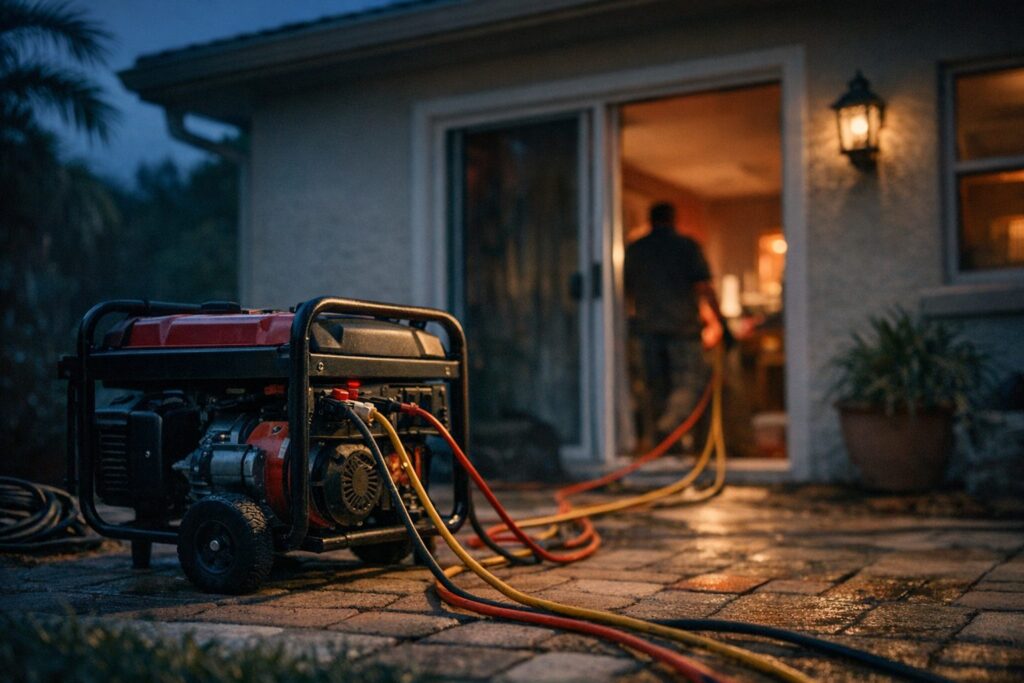
The single most important rule for generator safety is placement. The majority of fatal CO poisoning cases occur when generators are operated inside homes, garages, carports, or too close to windows and doors.
Where to Place Your Generator
- At least 20 feet from any window, door, or vent opening
- In an open area with good air circulation
- Downwind from your home if there is a prevailing breeze
- On a level, dry surface to prevent tipping and electrical hazards
- Under a canopy or tarp for rain protection, but never in an enclosed structure
Where NEVER to Place Your Generator
- Inside your home — not even for “just a minute”
- In the garage — even with the door open, CO accumulates rapidly
- Under a carport — these enclosed spaces trap exhaust
- On a screened porch or lanai — screens do not provide adequate ventilation
- Near air conditioning units or intake vents — CO can be pulled into the home through HVAC systems
Carbon Monoxide Detectors: Your Last Line of Defense
Every home should have battery-powered carbon monoxide detectors, and this is especially critical during power outages when generators are in use. CO detectors are your only way to know if dangerous levels of carbon monoxide are present in your home.
CO Detector Placement
- Install a CO detector on every level of your home
- Place detectors near sleeping areas so alarms wake occupants
- Install at approximately five feet above floor level (CO mixes with air rather than rising or sinking)
- Test detectors monthly and replace batteries annually
- Replace detectors every five to seven years per manufacturer recommendations
If Your CO Detector Alarms
- Evacuate immediately. Get everyone out of the home, including pets.
- Call 911 from outside the home.
- Do not re-enter until emergency services have tested the air and declared it safe.
- Account for all occupants, especially children, elderly, and anyone who was sleeping.
- Seek medical attention if anyone has symptoms (headache, nausea, dizziness, confusion).
Safe Generator Operating Practices
Beyond placement, follow these practices for safe generator operation:
Fueling Safety
- Never refuel a running generator. Shut it off and let it cool for at least five minutes before adding fuel.
- Store fuel in approved containers away from the generator and away from your home.
- Use fresh fuel. Gasoline degrades over time and can damage the engine. Use stabilizer if storing fuel for hurricane season.
- Do not overfill. Leave room for fuel expansion, especially in Florida heat.
Electrical Safety
- Never plug a generator directly into a wall outlet (called “backfeeding”). This sends power back through your home’s wiring and into the utility grid, creating a lethal hazard for utility workers and neighbors.
- Use a transfer switch installed by a licensed electrician if you want to power your home’s circuits.
- Use heavy-duty outdoor-rated extension cords to connect appliances directly to the generator.
- Do not exceed the generator’s rated capacity. Overloading can damage the generator and connected equipment.
- Keep the generator dry. Operating a generator in rain without protection creates electrocution risk. Use an open-sided canopy, not an enclosed shelter.
Symptoms of Carbon Monoxide Poisoning
WrightWay documents every loss to insurance standards, photos, moisture logs, and itemized scopes your adjuster can approve without back-and-forth.
Know these symptoms and take them seriously, especially during a power outage when generators are running:
| CO Level | Symptoms | Action Required |
|---|---|---|
| Low exposure | Mild headache, slight nausea | Get fresh air immediately, ventilate the area |
| Moderate exposure | Severe headache, dizziness, confusion, vomiting | Evacuate and call 911 |
| High exposure | Loss of consciousness, seizures, chest pain | Evacuate and call 911 immediately; life-threatening |
| Prolonged exposure | Brain damage, organ damage, death | Critical medical emergency |
Special risk groups: Infants, elderly, people with heart disease, and people with respiratory conditions are affected by lower concentrations of CO and show symptoms earlier.
Other Post-Storm CO Sources
Generators are not the only source of carbon monoxide risk after a storm. Be aware of these additional hazards:
- Charcoal grills used indoors for cooking or heat — never use a charcoal grill inside, in a garage, or on a screened porch
- Gas stoves used for heating — a gas stove should never be used as a space heater
- Camp stoves and lanterns — these produce CO and should only be used outdoors
- Vehicles running in attached garages — even with the garage door open, CO can accumulate and enter the home
- Pressure washers and other gas-powered tools — keep these outdoors and away from windows
Property Damage from CO Events
If a carbon monoxide event occurs in your home, beyond the critical medical concerns, there may be property considerations. High levels of CO can leave residue and odors that require professional cleaning. If the CO source caused a fire or damage, professional restoration may be needed.
For any post-storm property damage, CO-related incidents, or emergency restoration needs, contact WrightWay Emergency Services at (941) 379-8669. We are available 24/7 to help SW Florida homeowners and businesses recover safely from any emergency.
WrightWay handles every restoration job from emergency response through licensed reconstruction.
One IICRC-certified team, one project manager, one phone call. Available 24/7 across Sarasota, Manatee, Charlotte, Lee, and Collier counties.
Add us as a preferred source and our storm updates, claim guides and restoration answers show up higher when you search.