

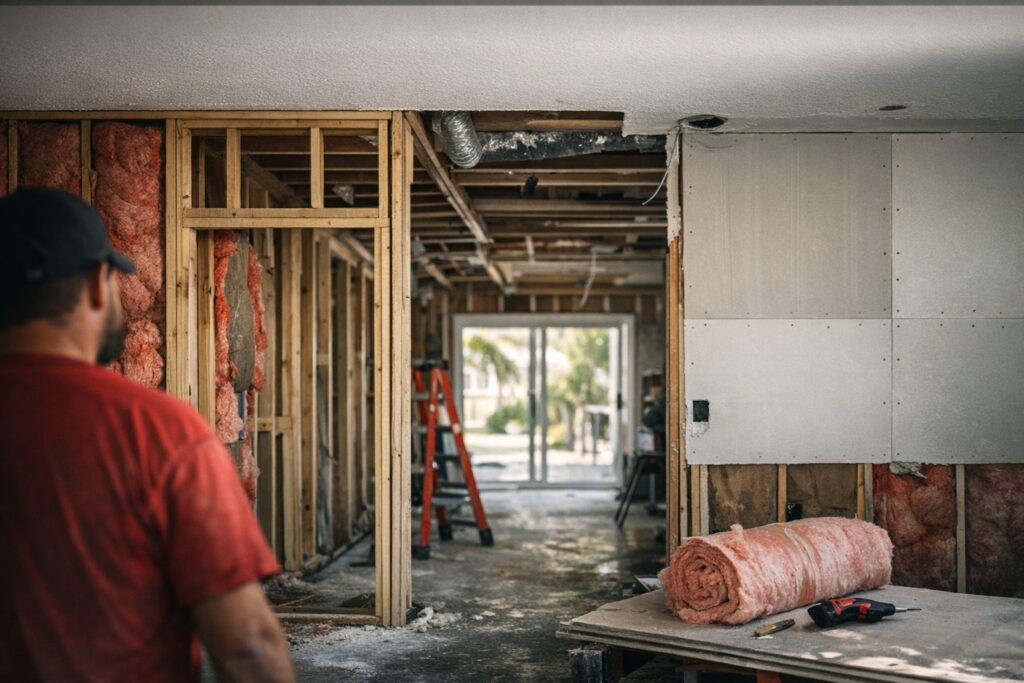
The Decision That Shapes Your Entire Reconstruction Experience
After fire, flood, or storm damage, you face a decision that will affect your reconstruction timeline, quality, cost, and stress level more than almost any other choice: who will handle the rebuild? You have two basic options:
- Keep the project with your restoration company — the same company that handled the emergency mitigation and drying continues through demolition, reconstruction, and final completion
- Hire a separate general contractor — the restoration company completes the mitigation, then you bring in a different company for the construction phase
Both approaches have advantages and drawbacks. This guide compares them honestly so you can make an informed decision for your project.
Option 1: Restoration Company Handles Both Mitigation and Reconstruction
Not all restoration companies offer reconstruction services — it requires a Florida building contractor’s license (CBC) in addition to restoration certifications. Companies that hold both provide a single-source solution from emergency call through move-in.
Advantages
Single Point of Accountability
When the same company handles mitigation and reconstruction, there is no finger-pointing between contractors. If a problem arises — mold is found behind new drywall, a drying issue affects reconstruction quality, or a scope item is missed — one company is responsible for the entire outcome. With two separate contractors, each will blame the other: the GC says the restoration company did not dry the structure properly, while the restoration company says the GC did not follow their drying documentation. The homeowner is caught in the middle.
Seamless Insurance Management
The restoration company that performed the mitigation already has a relationship with your adjuster, has documented the damage from day one, and uses Xactimate for their estimates. Continuing through reconstruction means the same team manages your insurance claim from first notice of loss through final payment — including all supplement claims for hidden damage discovered during reconstruction.
When a separate GC takes over, there is often a disconnect in the claims process. The GC may not be familiar with your adjuster, may not use Xactimate (using their own estimating format instead), and may not understand the specific documentation your carrier requires. This disconnect creates delays and sometimes results in underpayment.
Knowledge Continuity
The restoration crew knows your project intimately — where the water went, which walls were opened, what condition the framing was in, where moisture readings were elevated, and what areas received antimicrobial treatment. This institutional knowledge informs the reconstruction and prevents rework. A new GC starts without this history and must rely on the mitigation company’s documentation (which may or may not be complete) or discover conditions on their own.
Faster Timeline
The transition from mitigation to reconstruction is seamless with a single company. Demolition can begin during the final stages of drying. Permits can be submitted while the scope is being finalized. Material ordering can start based on the project manager’s direct knowledge of the scope. With a separate GC, the handoff process adds 2 to 6 weeks as the new contractor visits the property, develops their own estimate, negotiates with insurance, and mobilizes their crew.
Potential Concerns
- Scope of services: Not all restoration companies have the construction expertise or licensed trades to handle complex reconstruction. Verify that the company holds a CBC license, has a track record of completed reconstruction projects, and employs or contracts the necessary trades.
- Competitive pricing: Some homeowners worry that a single-source approach eliminates competitive bidding. However, insurance-covered reconstruction is priced using Xactimate line items at industry-standard rates — the pricing is standardized regardless of contractor.
Option 2: Separate General Contractor for Reconstruction
In this model, the restoration company completes the mitigation (water extraction, drying, board-up, smoke cleaning, mold remediation), and you hire a separate general contractor for the reconstruction phase.
When This Makes Sense
- Your restoration company does not offer reconstruction. Many smaller restoration firms focus exclusively on mitigation and do not hold a general contractor’s license.
- You have an existing relationship with a GC. If you trust a specific general contractor based on past experience, maintaining that relationship can be valuable.
- The reconstruction is primarily cosmetic. If the mitigation company has completed all structural drying and the reconstruction involves only finish work (drywall, paint, flooring, cabinets), a general contractor or even specialty contractors may be appropriate.
- Very large or complex projects. Major structural reconstruction (additions, significant layout changes, elevation projects) may benefit from a GC that specializes in new construction rather than restoration.
Risks and Drawbacks
The Handoff Gap
The transition between mitigation and construction is the most vulnerable point in the entire reconstruction process. Common problems during handoff include:
- Exposed structure sitting for weeks without protection while the GC is engaged and mobilized
- Moisture reintroduction in dried areas due to weather exposure during the gap
- Loss of documentation or institutional knowledge about the mitigation work
- Disagreements between the two contractors about the adequacy of the mitigation work
Insurance Coordination Challenges
With two contractors, the insurance process becomes more complex:
- Two separate estimates must be reconciled with the adjuster’s scope
- The GC may dispute the mitigation company’s line items (arguing they should have been included in the reconstruction scope) or vice versa
- Payment coordination becomes more complicated — the insurance company may issue checks naming both contractors, or the homeowner may need to manage payment allocation
- Supplement claims that bridge both phases (such as mold found during reconstruction that originated during the water event) can fall between the two contractors’ scopes
Accountability Gaps
If mold develops after reconstruction is complete, who is responsible? The mitigation company says they dried the structure to standard and have documentation to prove it. The GC says the structure was dry when they started. But something went wrong between the two phases. Without single-point accountability, resolving this dispute falls on the homeowner.
How to Evaluate a Restoration Company’s Reconstruction Capability
Need restoration help in Southwest Florida right now? WrightWay dispatches in 60 to 90 minutes from three Florida offices, and we answer with a live human.
If you are considering keeping the project with your restoration company, verify the following:
- Florida contractor license: The company must hold a certified building contractor (CBC) or certified general contractor (CGC) license to perform reconstruction work in Florida. Verify on the DBPR website.
- Completed reconstruction projects: Ask for references and photos from past reconstruction projects of similar scope. Restoration and reconstruction are different skill sets — being great at one does not guarantee competence in the other.
- In-house project management: Reconstruction requires dedicated project management — scheduling trades, coordinating inspections, managing material procurement, and maintaining communication with the homeowner and insurance company.
- Trade relationships: Licensed electricians, plumbers, HVAC contractors, roofers, and other specialty trades must be available. Ask whether these trades are employed in-house or subcontracted, and whether the company has established relationships that ensure priority scheduling.
- Insurance claims experience: The company should be proficient in Xactimate, experienced in supplement claims, and capable of managing the insurance process through final payment.
- Warranty: The company should provide a written warranty on reconstruction work — typically 1 to 2 years on workmanship.
The WrightWay Approach: One Company, Start to Finish
WrightWay Emergency Services is both an IICRC-certified restoration company and a licensed Florida general contractor. We handle every phase of your project — from the 2 AM emergency call through the final walkthrough of your completed home — with a single project manager, a single insurance claims file, and a single point of accountability.
Our approach eliminates the handoff gap, streamlines the insurance process, and ensures that the team rebuilding your home has intimate knowledge of the damage, the mitigation work, and the specific conditions of your structure. For homeowners across Sarasota, Bradenton, Fort Myers, Naples, and all of Southwest Florida, this single-source model consistently delivers faster timelines, fewer disputes, and better outcomes.
Call (941) 379-8669 for 24/7 emergency response and seamless reconstruction from one trusted team.
WrightWay handles every restoration job from emergency response through licensed reconstruction.
One IICRC-certified team, one project manager, one phone call. Available 24/7 across Sarasota, Manatee, Charlotte, Lee, and Collier counties.
Add us as a preferred source and our storm updates, claim guides and restoration answers show up higher when you search.


