

Your Pets Face Hidden Dangers During Home Restoration
When your home is being restored after water damage, fire, mold, or storm damage, your attention is understandably focused on protecting your property and managing the disruption to your family. But there are members of your household who are especially vulnerable during restoration work and often overlooked in the planning: your pets.
Dogs, cats, birds, reptiles, and other household animals face unique hazards during restoration projects. They cannot read warning signs, they do not understand why loud machines are running in their territory, and they are far more sensitive to airborne chemicals and contaminants than humans. At WrightWay Emergency Services, we work in homes with pets regularly, and we have seen firsthand how important it is for pet owners to plan ahead for their animals’ safety.
Chemical and Contaminant Hazards
Restoration work involves chemicals and substances that can be harmful or fatal to pets:
Antimicrobial Treatments
After water damage, affected materials are treated with antimicrobial solutions to prevent mold growth. These products are designed to be safe for humans once dry, but wet antimicrobial solutions can be dangerous to pets who walk through treated areas and then lick their paws. Cats are especially sensitive because they groom themselves frequently and because their smaller body weight means even small exposures can be significant.
Mold Spores
During mold remediation, disturbing contaminated materials releases mold spores into the air. While containment barriers and HEPA filtration are used to protect occupants, pets that get into the work area are exposed to concentrated spore levels. Pets with respiratory conditions or compromised immune systems are at particular risk.
Soot and Fire Residue
After a fire, soot contains a complex mixture of toxic chemicals including polycyclic aromatic hydrocarbons (PAHs), heavy metals, and acids. Pets that walk through soot-covered areas and then groom themselves ingest these toxins. Soot residue can also irritate paws, eyes, and nasal passages.
Construction Materials
During the reconstruction phase, materials like adhesives, paints, stains, and sealants release volatile organic compounds (VOCs) that can affect pets more severely than humans. Birds are extraordinarily sensitive to airborne chemicals and fumes — exposure that causes mild irritation in humans can be fatal to birds within minutes.
Physical Hazards in an Active Restoration Site
A home undergoing restoration is essentially a construction site, with all the physical dangers that implies:
- Exposed nails and screws: Demolition leaves sharp fasteners in framing, trim, and debris that can puncture paw pads
- Open walls and floors: Removed drywall and flooring expose wall cavities and subfloor gaps where small pets can become trapped
- Standing water and contaminated liquids: Pets may drink standing water that contains bacteria, chemicals, or sewage contamination
- Electrical hazards: Exposed wiring, extension cords, and equipment power cables create electrocution and chewing hazards, especially for puppies and kittens
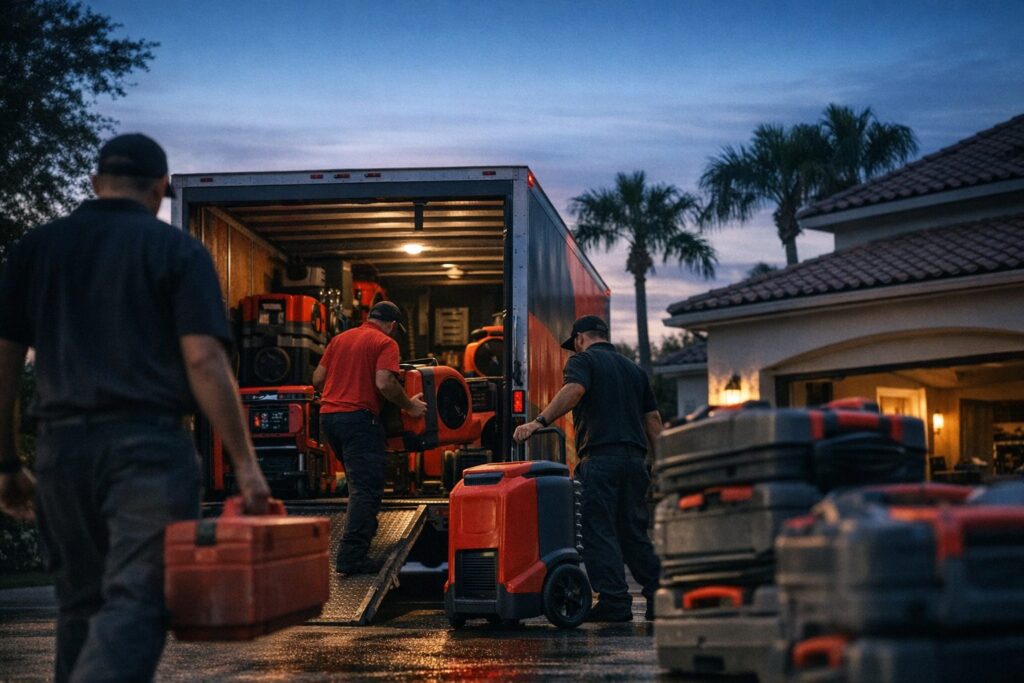
- Heavy equipment: Commercial dehumidifiers, air movers, and air scrubbers have intake vents, moving parts, and hot surfaces that can injure curious animals
- Open doors and exits: Restoration crews move in and out of the home frequently, and doors are often propped open for equipment access. This creates escape opportunities for indoor pets.
Stress and Behavioral Concerns
Beyond physical and chemical dangers, the restoration process is extremely stressful for pets:
- Noise: Commercial air movers and dehumidifiers run continuously and can produce 65 to 75 decibels of noise. Dogs and cats hear frequencies and volumes that humans do not, making the noise even more distressing for them.
- Strangers in the home: Restoration crews are unfamiliar people entering and working in your pet’s territory. This can trigger fear, aggression, or anxiety in dogs and stress-related behaviors in cats.
- Disrupted routines: Feeding, exercise, sleep, and social routines are all disrupted during restoration, which can cause behavioral problems and health issues in sensitive animals.
- Territory changes: Rooms being off-limits, furniture being moved, and unfamiliar equipment occupying living spaces changes the pet’s environment dramatically.
Best Practices for Keeping Pets Safe During Restoration
Option 1: Temporary Relocation (Recommended)
The safest option for pets during active restoration work is to relocate them to a safe environment. Consider these options:
- Stay with family or friends: The least stressful option for most pets, especially if they are familiar with the location
- Professional pet boarding: Boarding facilities provide supervised care, feeding, and exercise. Book early, as post-disaster demand for boarding can be high.
- Pet-friendly hotels: If you are staying in a hotel during restoration, many SW Florida hotels accept pets
- In-home pet sitters: A pet sitter who can take your animal to their home provides a home environment without restoration hazards
Option 2: Separation Within the Home
If relocation is not possible, create a safe zone within the home that is completely separated from the restoration work area:
- Choose a room far from the work area that has not been affected by the damage
- Seal the room with a solid door (not just a baby gate) to prevent escape and limit exposure to dust, fumes, and noise
- Provide everything the pet needs: Food, water, litter box, bedding, and comfort items
- Maintain the room’s climate: Ensure heating or cooling is available in the safe room
- Post signage: Alert restoration crews that a pet is in the room so the door is not accidentally opened
- Check on the pet regularly: Visit frequently to provide reassurance and monitor for stress
Communication with Your Restoration Team
Inform your restoration company about your pets at the start of the project. Professional companies like WrightWay take pet safety into account when planning the work. Important points to communicate:
- Number and types of pets in the home
- Where pets will be during work hours
- Any pets that may be aggressive or fearful of strangers
- Specific concerns (escape-prone cats, dogs that chew cords, etc.)
- Emergency veterinary contact information
Special Considerations by Pet Type
Need restoration help in Southwest Florida right now? WrightWay is on site in under 2 hours from three Florida offices, and we answer with a live human.
| Pet Type | Primary Risks | Key Precautions |
|---|---|---|
| Dogs | Ingestion of debris, escape through open doors, stress aggression | Relocate or confine; watch for paw injuries |
| Cats | Hiding in wall cavities, chemical grooming, escape | Relocate; never leave near open walls |
| Birds | Extreme sensitivity to fumes and airborne particles | Always relocate; fumes can be rapidly fatal |
| Fish/Reptiles | Water contamination, temperature changes, vibration | Move tanks away from work areas; maintain water quality |
| Small mammals | Escape into wall cavities, ingestion of materials | Relocate or secure enclosures in a safe room |
After Restoration: Reintroducing Pets to the Home
Once restoration and reconstruction are complete, take these steps before bringing pets back:
- Ensure all construction debris is removed, including small items that may have fallen into corners or under cabinets
- Verify that all chemicals have dried and off-gassed per manufacturer recommendations
- Check for exposed fasteners, sharp edges, or gaps where pets could be injured or trapped
- Run the HVAC system for 24 hours to cycle fresh air through the home and filter any remaining dust or particles
- Reintroduce pets gradually, allowing them to explore one room at a time to reduce stress
Questions About Pets and Restoration?
At WrightWay Emergency Services, we understand that pets are family. Our crews are experienced in working in homes with animals, and we coordinate with homeowners to ensure pet safety throughout every project. If you need emergency restoration and have concerns about your pets, we are happy to discuss accommodations.
Call us at (941) 379-8669 for any restoration need across SW Florida. We will take care of your home and help you plan for every member of your household, including the four-legged ones.
WrightWay handles every restoration job from emergency response through licensed reconstruction.
One IICRC-certified team, one project manager, one phone call. Available 24/7 across Sarasota, Manatee, Charlotte, Lee, and Collier counties.
Add us as a preferred source and our storm updates, claim guides and restoration answers show up higher when you search.


