Healthcare Restoration: Where Patient Safety Meets Emergency Response
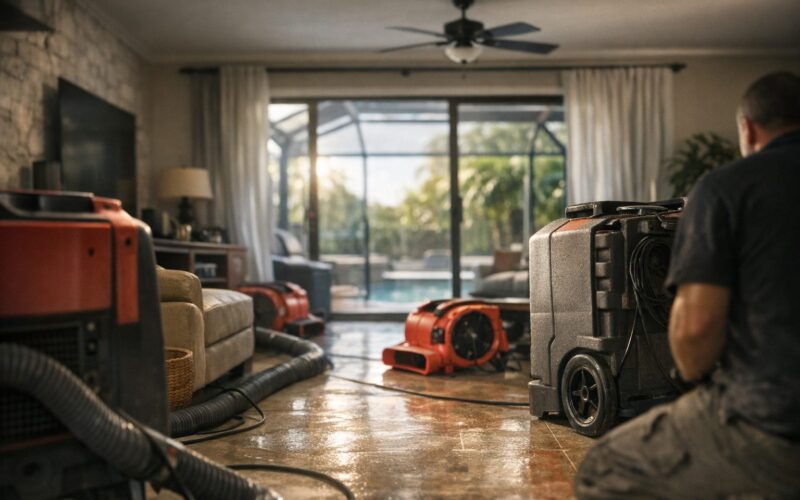
Southwest Florida’s healthcare infrastructure serves millions of residents and seasonal visitors across the region. Major healthcare systems including Sarasota Memorial Health Care System, Lee Health, NCH Healthcare System in Naples, HCA Florida facilities across Tampa Bay, and Manatee Memorial Hospital operate hospitals, surgical centers, physician offices, and urgent care clinics throughout the seven-county area. When water damage, fire, or storm damage affects a healthcare facility, the restoration requirements are dramatically more complex than standard commercial or residential restoration.
Healthcare facility restoration must simultaneously address structural damage recovery and patient safety, infection control, regulatory compliance, and continuity of critical medical services. A standard restoration approach that works well for an office building or retail space is dangerously inadequate for a hospital, surgical center, or medical office. This guide from WrightWay Emergency Services covers the specialized protocols required for healthcare facility restoration in Southwest Florida.
Why Healthcare Restoration Is Different
Infection Control Risk Assessment (ICRA)
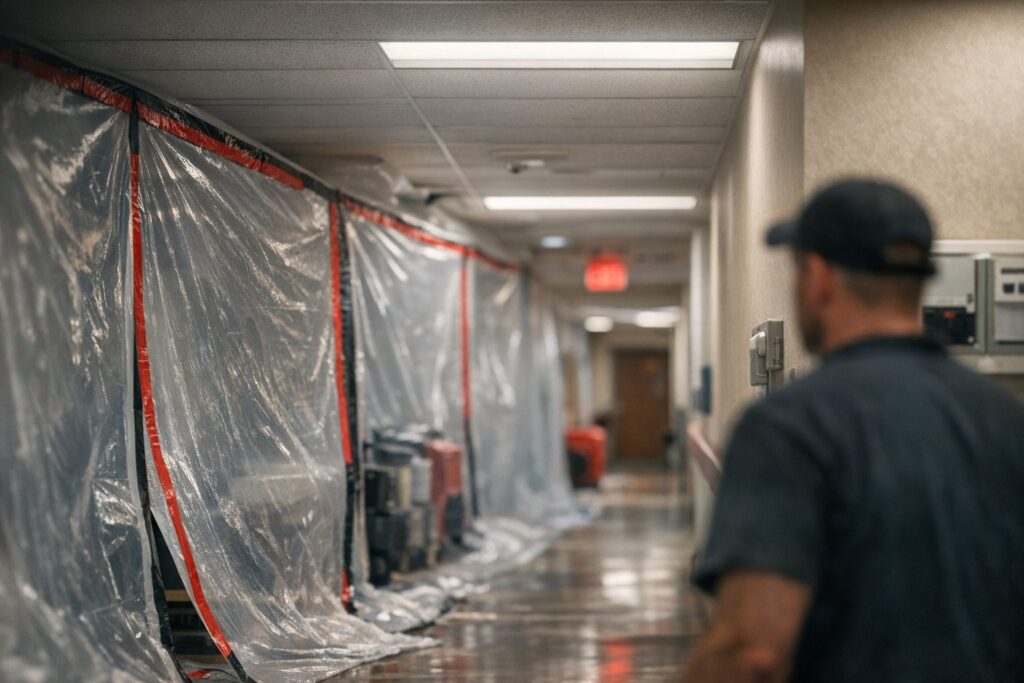
The single most important distinction between healthcare restoration and standard commercial restoration is the Infection Control Risk Assessment (ICRA) requirement. Before any restoration work begins in a healthcare facility, an ICRA must be completed to evaluate the risk of construction-related infections to patients. The ICRA classifies activities and patient populations into risk categories that determine the required containment and air quality control measures.
Standard restoration techniques — such as removing drywall, running air movers, and performing demolition — generate dust and airborne particles that can contain Aspergillus and other fungal spores. For immunocompromised patients, surgical patients, and ICU patients, exposure to these particles can cause life-threatening infections. The ICRA protocol requires:
- Negative pressure containment: The restoration work area must be maintained under negative air pressure relative to adjacent patient areas, preventing any airborne particles from migrating into clinical spaces.
- HEPA filtration: All air exhausted from the work area must pass through HEPA filtration to capture particles down to 0.3 microns.
- Anteroom construction: For high-risk restoration adjacent to patient areas, a constructed anteroom with separate entry provides a transition zone that further prevents contamination migration.
- Barrier walls: Full floor-to-ceiling hard barriers (not just plastic sheeting) are required for restoration adjacent to high-risk patient areas.
HIPAA Compliance During Restoration
Healthcare restoration crews work in environments containing protected health information (PHI). Patient records, charts, computer screens, and verbal communications are all present in healthcare facilities. Restoration companies working in healthcare settings must:
- Sign Business Associate Agreements (BAAs) with the facility
- Train all restoration personnel on HIPAA requirements before they enter the facility
- Handle water-damaged medical records according to HIPAA disposal and recovery protocols
- Maintain confidentiality of any patient information encountered during restoration activities
Continuity of Patient Care
Unlike a retail store or office that can close during restoration, healthcare facilities often cannot cease operations. Emergency departments, ICUs, surgical suites, and inpatient units must continue functioning while restoration occurs in adjacent or nearby areas. This requires:
- Phased restoration plans that allow sections of the facility to be restored while other sections remain operational
- Coordination with facility management and clinical leadership to schedule the most disruptive activities during lower-census periods
- Temporary relocation plans for clinical services displaced by the restoration work
- 24/7 restoration operations to minimize the duration of disruption to any given area
Common Healthcare Water Damage Scenarios in SW Florida
Healthcare facilities in our region experience specific water damage scenarios driven by the climate, aging infrastructure, and intensive building system usage:
- Chilled water system failures: Large hospitals use centralized chilled water systems for cooling. A pipe failure in the chilled water loop can release enormous volumes of water into ceiling plenums and patient areas.
- Medical gas system condensation: Medical air and oxygen piping can develop condensation in Florida’s humidity, causing dripping and moisture accumulation in wall cavities and ceiling spaces.
- Roof failures during storms: Healthcare facilities with flat roofs face the same membrane and drainage failures as other commercial buildings, but the consequences are far more severe due to the sensitive equipment and patient populations below.
- Sprinkler system discharges: Accidental sprinkler activation in patient areas creates both water damage and infection control emergencies simultaneously.
- Sewer backups: Healthcare facilities produce significant wastewater, and sewer line failures create Category 3 contaminated water events that require immediate containment and remediation.
Specialized Equipment and Materials in Healthcare Restoration
Need restoration help in Southwest Florida right now? WrightWay is on site in under 2 hours from three Florida offices, and we answer with a live human.
Healthcare restoration involves materials and equipment not found in standard restoration projects:
- Antimicrobial coatings: Healthcare-grade antimicrobial products used during and after restoration to reduce infection risk
- HEPA-equipped air scrubbers: Commercial air scrubbers with true HEPA filtration rated at 99.97% capture efficiency for particles 0.3 microns and larger
- Negative air machines: Specialized units that maintain negative pressure differential between the work zone and adjacent clinical areas
- Hospital-grade drying equipment: Low-decibel drying equipment that can operate in or adjacent to patient areas without creating excessive noise
- Fire-rated and antimicrobial replacement materials: All replacement drywall, insulation, and finish materials must meet the healthcare facility’s fire rating and infection control specifications
Regulatory Requirements
Healthcare facility restoration in Florida must comply with:
- AHCA (Agency for Health Care Administration) requirements for licensed healthcare facilities
- Joint Commission standards for accredited facilities, including Environment of Care requirements
- CMS (Centers for Medicare and Medicaid Services) Conditions of Participation, which include physical environment standards
- OSHA standards for worker safety in healthcare construction environments
- Local building codes and fire marshal requirements for all structural modifications
Healthcare Restoration Services in Southwest Florida
WrightWay Emergency Services provides specialized healthcare facility restoration across Southwest Florida. Our healthcare restoration teams are trained in ICRA protocols, HIPAA compliance, and the infection control requirements specific to hospital, surgical center, and clinical environments. We work with facility management, infection preventionists, and clinical leadership to develop restoration plans that maintain patient safety while restoring the facility as quickly as possible.
If your SW Florida healthcare facility has experienced water damage, fire, or storm damage, call (941) 379-8669 for immediate emergency response. We serve healthcare facilities across Sarasota, Lee, Collier, Manatee, Charlotte, Hillsborough, and Pinellas counties.
WrightWay handles every restoration job from emergency response through licensed reconstruction.
One IICRC-certified team, one project manager, one phone call. Available 24/7 across Sarasota, Manatee, Charlotte, Lee, and Collier counties.
Add us as a preferred source and our storm updates, claim guides and restoration answers show up higher when you search.