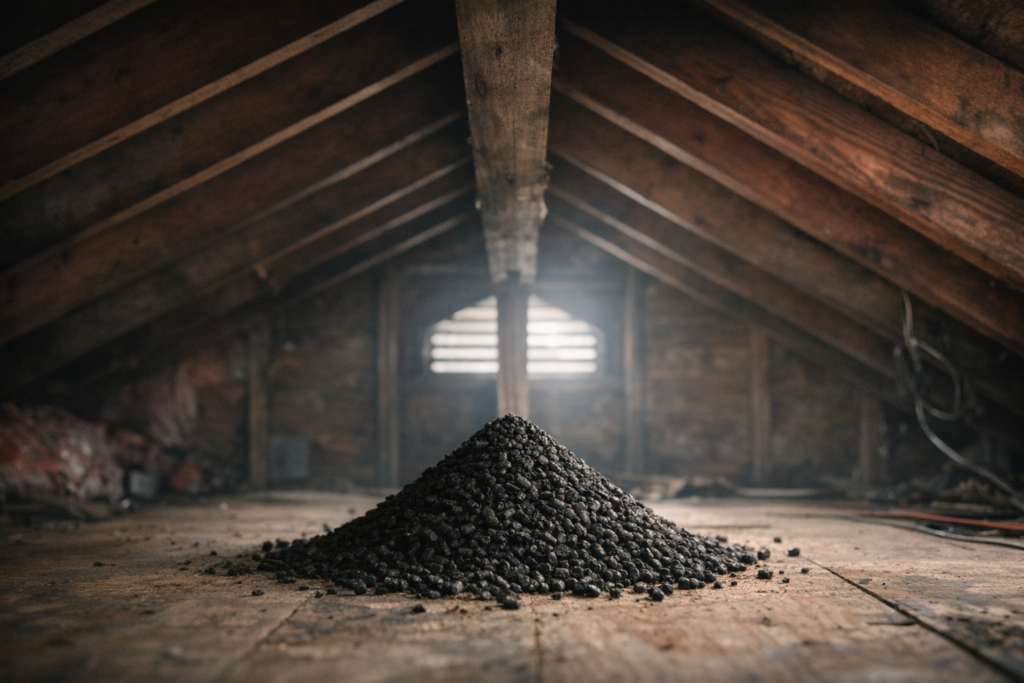
If you went into your attic and found a pile of small dark pellets that look like rat droppings but crumble to dust between your fingers, there is a good chance you have bat poop – also called bat guano or bat droppings. In Florida, an attic that already shows visible guano almost always indicates an active or recently active bat colony, not a one-time visitor. This guide walks through how to identify bat poop, what the health risks are, what Florida law allows you to do, and the right next step.
How to know it is bat poop and not rodent droppings
Bat guano looks superficially similar to rat or mouse droppings, but two things give it away:
- It crumbles to dust. Bat poop is mostly insect parts (chitin from beetles, moths, and flies) and dries into a brittle pellet. Rodent droppings are firm and hold their shape when crushed.
- It piles up directly under a roost. Bats roost in one or two spots and rain guano straight down. Look for cone-shaped piles under gable peaks, ridge beams, or attic decking. Rodents leave droppings scattered along travel paths and in food-storage areas.
You may also see dark grease stains on the attic decking near the roost (body oil from the bats), and there will almost certainly be an associated smell – ammonia from the urine, which is concentrated and unmistakable in an enclosed attic.
Is bat poop dangerous?
Yes, when it is disturbed. Bat guano can harbor Histoplasma capsulatum, a soil-dwelling fungus whose spores become airborne when guano is stepped on, brushed against, or vacuumed without proper filtration. Inhaling those spores can cause histoplasmosis, a respiratory infection that ranges from mild flu-like symptoms to severe lung disease, especially in immunocompromised people, the elderly, and young children. The CDC has documented histoplasmosis outbreaks tied to attic cleanouts and chicken-coop demolitions where guano or bird droppings were disturbed without containment.
This is the reason bat guano cleanup is not a DIY project. The risk is not the guano sitting there – it is the act of cleaning it without HEPA-filtered negative-air containment, P100 respirators, and full Tyvek PPE. Sweep up bat poop with a shop vacuum and a dust mask and you are aerosolizing the very spores you are trying to remove.
What you cannot do (the Florida bat law summary)
Florida is home to 13 native bat species, all protected. Killing or harming bats is illegal under Florida Administrative Code rule 68A-4.001. Even non-lethal exclusion has rules: FAC 68A-9.010 governs exclusion installation, and from April 16 through August 14 the maternity-season ban prohibits installing any exclusion device without a special permit. The reason is biological: flightless pups would be trapped inside the structure and die. The penalty is real – violations are misdemeanors with fines, and federal violations apply for endangered species like the Florida bonneted bat.
This means that if you discover bat guano in your attic between April 16 and August 14, you cannot evict the colony. What you can do during maternity season:
- Have the attic professionally inspected and quoted, so you are ready to act on August 15.
- Seal secondary (non-primary) entry points – work that does not affect the bats’ ability to come and go.
- Order materials and schedule the crew for the first available day after maternity season ends.
- Improve ventilation in the structure away from the attic if odor is bothersome (the attic itself must remain undisturbed).
What to do right now
- Do not touch the guano. Close the attic access and stay out.
- Do not vacuum or sweep it. See above on spore aerosolization.
- Call a licensed restoration contractor who specializes in biohazard work. In Southwest Florida, WrightWay performs the entire job – FWC-compliant exclusion, HEPA-vac guano removal, contaminated-insulation tear-out, EPA-registered antimicrobial decontamination, and final reconstruction – under one license.
- Ask for a written estimate. WrightWay provides itemized, not-to-exceed quotes after a free inspection. Be skeptical of any company that gives you a price over the phone without seeing the attic.
The cost question, briefly
Need restoration help in Southwest Florida right now? WrightWay dispatches in 60 to 90 minutes from three Florida offices, and we answer with a live human.
We wrote a full breakdown of pricing in How Much Does Bat Guano Cleanup Cost in Southwest Florida? The short version: typical Southwest Florida projects run $2,500 to $9,500, with larger jobs ($10K+) when the colony has been undetected for years and insulation needs full replacement. Most Florida homeowners policies exclude wildlife cleanup, so plan for an out-of-pocket project.
City & county service pages: Sarasota, Bradenton, Venice, Naples, Fort Myers, Punta Gorda, Sarasota County, Manatee County, Charlotte County, Lee County, Collier County.
Call (941) 379-8669 for a free, no-pressure attic inspection. WrightWay Emergency Services – Florida-licensed general contractor (CBC1253650), IICRC-certified biohazard remediation, headquartered in Nokomis with same-day response across Sarasota, Manatee, Charlotte, Lee, and Collier counties.
WrightWay handles every restoration job from emergency response through licensed reconstruction.
One IICRC-certified team, one project manager, one phone call. Available 24/7 across Sarasota, Manatee, Charlotte, Lee, and Collier counties.