

The Short Answer: It Depends
One of the first questions homeowners ask when they learn they need mold remediation is whether they can continue living in the home while the work is being done. The answer depends on several factors, including the size and location of the mold contamination, the health of household members, and the specifics of the remediation plan. In some cases, you can remain in the home safely. In others, temporary relocation is strongly recommended or even necessary.
At WrightWay Emergency Services, we assess every project individually and provide our honest recommendation about occupancy during remediation. Here is the information you need to make an informed decision.
When You Can Typically Stay
In certain situations, remaining in the home during mold remediation is feasible, provided the remediation company takes appropriate containment measures.
Small, Contained Projects
If the mold contamination is limited to a single room or a small area (typically less than 100 square feet) and the affected space can be fully isolated from the rest of the home, occupants can usually remain in unaffected areas. Examples include:
- Mold in a single bathroom that can be sealed off with containment barriers
- Mold in a guest bedroom that is not connected to the main HVAC system
- A small section of affected drywall in a utility room or laundry area
Containment Requirements for Continued Occupancy
For you to safely stay in the home, the remediation company must implement proper containment, including:
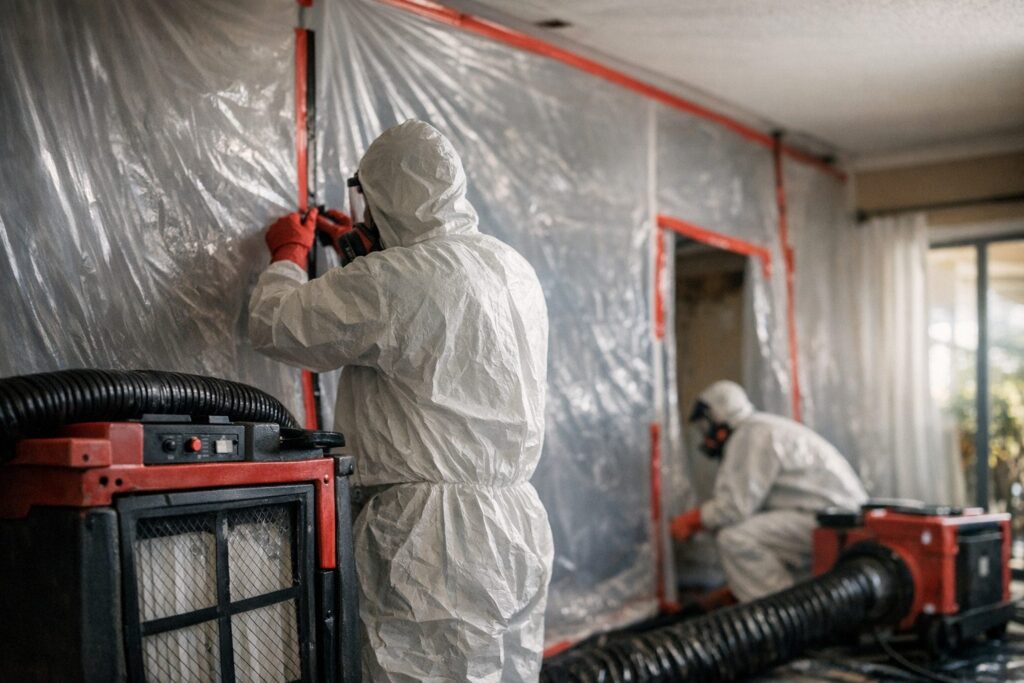
- Physical barriers: 6-mil polyethylene sheeting sealed around the work area to prevent spore migration
- Negative air pressure: HEPA-filtered negative air machines that pull air into the work area rather than pushing contaminated air out
- Separate HVAC zones: The HVAC registers in the work area must be sealed. If the home has a single-zone system, the ductwork serving the affected area must be isolated.
- Controlled access: A decontamination chamber or anteroom at the entry to the work area
- Air scrubbers: HEPA air scrubbers running in occupied areas to capture any stray spores
When You Should Relocate
Temporary relocation is recommended or required in several scenarios. Understanding these situations helps you plan ahead.
Large-Scale Contamination
When mold contamination exceeds 100 square feet, involves multiple rooms, or affects common areas like kitchens, living rooms, and hallways, isolating the work area while maintaining livable conditions in the rest of the home becomes impractical. Large-scale remediation projects often require:
- Shutting down the HVAC system entirely to prevent spore distribution
- Removing large sections of drywall, flooring, and insulation
- Running multiple air scrubbers and negative air machines that create noise and air movement throughout the home
- Accessing areas behind walls, under floors, and above ceilings that require extensive demolition
HVAC System Contamination
If mold has colonized the HVAC system — the air handler, evaporator coil, or ductwork — the entire home is being exposed to mold spores every time the system runs. Remediation requires shutting down and accessing the HVAC system, which means no air conditioning. In Florida, particularly during summer months, a home without AC is uninhabitable and will develop dangerously high humidity levels that can worsen the mold problem.
Health-Sensitive Occupants
Regardless of the project size, temporary relocation is strongly recommended if any household member has:
- Asthma or other chronic respiratory conditions
- Mold allergies or sensitivities
- Compromised immune system due to illness, medication, chemotherapy, or organ transplant
- Infants or young children whose developing respiratory systems are more vulnerable
- Elderly family members with respiratory or immune concerns
- Pregnancy
Even with proper containment, some level of spore exposure is possible during remediation. For vulnerable individuals, the safest option is to be out of the home entirely.
Structural Work Required
When remediation involves removing subfloor, opening wall cavities across multiple rooms, or accessing attic or crawl space areas that connect to living spaces, the disruption and dust generation make continued occupancy uncomfortable at best and unsafe at worst.
What About Pets?
Pets are also affected by mold exposure. Dogs, cats, and birds can experience respiratory symptoms from elevated mold spore levels. If you relocate, take your pets with you. If you remain in the home during a contained remediation project, keep pets out of the area near the containment barriers and ensure the HEPA air scrubbers in occupied areas are running continuously.
How Long Does Remediation Take?
Licensed mold remediation with containment, HEPA filtration, and clearance-ready documentation. Get a real price range before anyone starts cutting drywall.
The duration of remediation affects your planning for temporary relocation. Typical timelines for Southwest Florida projects:
| Project Scope | Typical Duration |
|---|---|
| Small area (under 50 sq ft) | 1-2 days |
| Single room (50-100 sq ft) | 2-3 days |
| Multiple rooms or large area | 3-5 days |
| Whole-house contamination | 5-10 days |
| HVAC system remediation | 2-4 days (plus duct cleaning) |
These timelines cover the remediation phase only. Post-remediation air quality testing adds 1-2 days for lab results. If reconstruction is needed (replacing drywall, flooring, tile), that is an additional phase with its own timeline.
Insurance and Temporary Housing
If your mold remediation is covered by homeowners insurance (typically when the mold resulted from a covered water damage event), your policy may include Additional Living Expenses (ALE) coverage. ALE pays for reasonable costs of temporary housing, including:
- Hotel or short-term rental accommodation
- Additional food costs above your normal expenses
- Pet boarding if necessary
- Storage for displaced contents
Check your policy’s ALE limits and contact your insurance adjuster to confirm coverage before incurring expenses. Professional claims assistance can help you navigate the ALE process and ensure you receive everything your policy provides.
Making the Decision
Here is a simple framework for deciding whether to stay or go:
- Get the remediation company’s recommendation. A professional assessment of the contamination scope should include a clear recommendation about occupancy. Ask for it directly.
- Consider your household’s health profile. If anyone in the home is in a vulnerable category, err on the side of caution and relocate.
- Evaluate the containment plan. Ask the remediation company to explain their containment strategy. If they cannot articulate how they will isolate the work area and prevent cross-contamination, that is a red flag about their competency.
- Think about comfort and practicality. Even when staying is technically safe, living in a home during active demolition and remediation is noisy, dusty, and disruptive. If you have the option to stay elsewhere, the remediation will be less stressful for you and more efficient for the crew.
WrightWay Puts Your Safety First
WrightWay Emergency Services provides honest, transparent guidance about occupancy during every mold remediation project. We never recommend unnecessary relocation to inflate a project’s scope, and we never downplay risks to avoid the conversation. Our containment protocols meet or exceed IICRC S520 standards, and we explain every aspect of the process so you can make an informed decision.
If you are facing a mold remediation project in Sarasota, Fort Myers, Naples, or anywhere in Southwest Florida, call us at (941) 379-8669. We will assess the situation, explain your options, and help you plan for a safe, efficient remediation.
WrightWay handles every restoration job from emergency response through licensed reconstruction.
One IICRC-certified team, one project manager, one phone call. Available 24/7 across Sarasota, Manatee, Charlotte, Lee, and Collier counties.


