

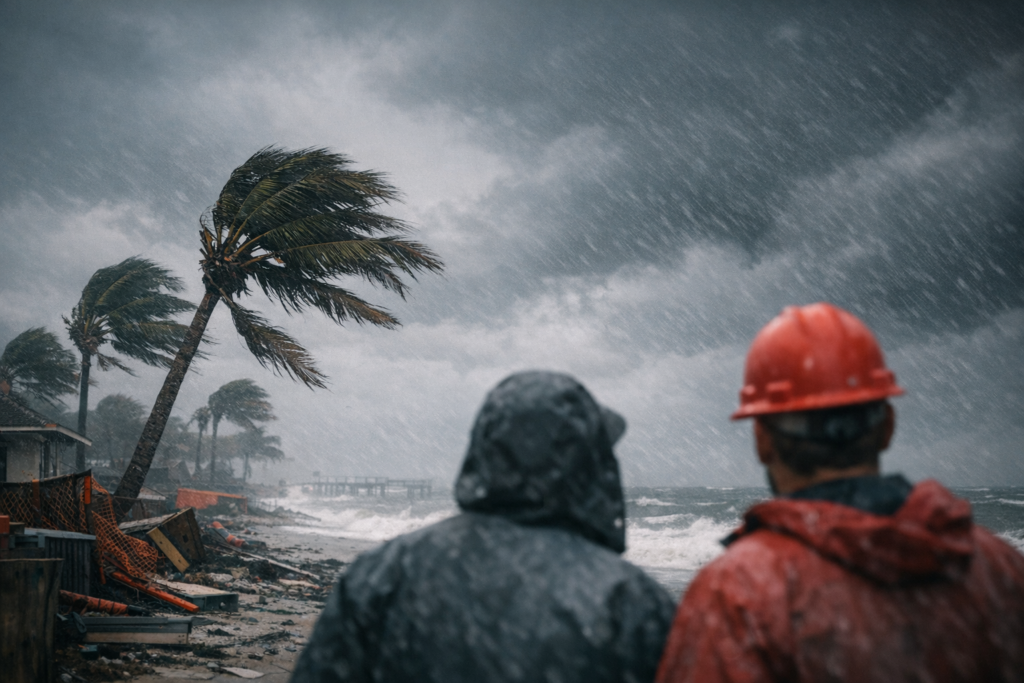
Florida’s unique climate and frequent hurricanes create the perfect conditions for mold growth. With year-round warmth and summer humidity levels often exceeding 90%, the state is especially vulnerable to mold infestations following hurricanes – and the health consequences for homeowners can persist for years. Understanding the risks and the remediation process is critical for homeowners and property managers across SW Florida.
Why Florida Is Uniquely Vulnerable to Post-Hurricane Mold
Florida is the most humid state in the nation. Its subtropical climate keeps temperatures above 60 degrees Fahrenheit year-round, removing one of the few natural brakes on mold growth. When a hurricane drives water into a home through a breached roof, storm surge, or window failures, that moisture meets an environment that is almost perfectly calibrated for fungal colonization. Unlike homes in drier climates, where aggressive dehumidification after a storm can halt mold in its tracks, Florida’s outdoor air is itself so moisture-laden that wet building materials stay within the mold-friendly humidity range far longer, even with fans and dehumidifiers running.
The combination of year-round warmth, perpetually high baseline humidity, and the frequency of storm events creates conditions that the EPA warns require immediate action after any water intrusion. For SW Florida homeowners in Sarasota, Charlotte, Lee, and Manatee counties, that window for action is even shorter than in most of the country.
The 24-48 Hour Mold Window – What the Science Says
This is not an industry estimate or a scare tactic. Mold spores are always present in the air inside and outside every Florida home. They need only one thing to begin germinating: moisture. Parham Azimi, a research associate at Harvard T.H. Chan School of Public Health who studies the link between mold exposure and respiratory health, put it plainly: “If any part of a home is exposed to flooding or leaks and is not fully dried within 24 to 48 hours, mold growth is almost certain.”
Once that 24 to 48 hour window closes, visible spotting can appear within 48 to 72 hours, and colonies spread well beyond the original wet area within 3 to 7 days. The CDC, EPA, FEMA, HUD, and NIH jointly recommend that mold cleanup be complete before reoccupying any flood-affected home. That guidance reflects how quickly the situation escalates after a storm passes.
Common molds that appear in Florida homes after hurricane flooding include Aspergillus, Penicillium, Cladosporium, and Stachybotrys chartarum (commonly called black mold). All of them find the post-hurricane environment ideal. All of them can affect air quality within the home before any visible growth is obvious to the occupants.
Health Risks Documented in Post-Hurricane Settings
After Hurricanes Ian (2022), Helene (2024), and Milton (2024), health officials and journalists documented a surge in mold-related complaints across Florida communities. Health risks from post-hurricane mold exposure documented after Helene and Milton include:
- Respiratory symptoms: Coughing, nasal congestion, asthma attacks, and wheezing are the most commonly reported effects. An Institute of Medicine expert panel concluded that an association exists between damp buildings and upper respiratory tract symptoms, wheeze, cough, and exacerbation of chronic lung diseases including asthma.
- Eye, nose, and throat irritation: Direct or airborne exposure causes irritation that can persist as long as mold remains in the home, even at concentrations too low to see or smell.
- Headaches, fatigue, and mood changes: Residents in heavily affected homes after Helene and Milton reported neurological symptoms including headaches, memory difficulties, and prolonged fatigue.
- Skin rashes and hives: Skin contact with mold-contaminated surfaces or airborne mycotoxin particles can trigger dermal reactions.
- Severe respiratory disease in high exposures: Hypersensitivity pneumonitis, a rare but serious lung inflammation, has been documented in cases of prolonged exposure to heavily contaminated environments.
- Vulnerability of children, the elderly, and immunocompromised individuals: These groups face disproportionately severe outcomes from the same exposures that produce only mild symptoms in healthy adults.
A Note on Stachybotrys (Black Mold) and Mycotoxins
Stachybotrys chartarum produces mycotoxins called satratoxins – macrocyclic trichothecenes that are potent inhibitors of protein translation and trigger both inflammatory responses and cell death in exposed tissue. Research published in the National Institutes of Health database found that satratoxin G from Stachybotrys caused olfactory sensory neuron loss and brain inflammation in animal models.
It is important to be accurate here: the scientific evidence on Stachybotrys in humans is real but more limited than popular coverage often suggests. The EPA’s own research on damp building illness and trichothecene mycotoxins notes that while laboratory and animal studies demonstrate serious toxic effects, establishing definitive causal links in specific human exposure cases is methodologically difficult. What is clear is this: Stachybotrys grows on the cellulose-rich materials common in Florida homes (drywall paper, wood framing, ceiling tiles), and any Stachybotrys contamination warrants professional remediation rather than DIY cleanup.
Post-Hurricane Mold Coverage: Ian, Helene, and Milton
The mold crisis following recent Florida hurricanes received significant national media attention. After Hurricane Ian devastated SW Florida in September 2022, restoration contractors across Lee, Charlotte, and Sarasota counties documented widespread mold infestations in homes where floodwaters sat for days before pumping operations could begin. After Helene and Milton struck in quick succession in September and October 2024, CBS News covered the mold health crisis as a direct and predictable consequence of extreme weather flooding – not an afterthought, but a primary public health event in its own right.
WUSF Public Media’s in-depth investigation into the hidden mold health crisis following Florida’s recent storms found that detection delays – often months or years – prolonged unknown exposure for many residents. Federal disaster aid averaged 20 months before distribution, leaving thousands of families in mold-contaminated homes while waiting for resources to begin remediation.
Why Bleach Does Not Solve a Mold Problem
This is one of the most persistent and damaging misconceptions that follows every Florida hurricane. Homeowners spray bleach on visible mold growth, see it disappear, and believe the problem is solved. It is not.
Bleach is a surface disinfectant. It works on non-porous materials like glass or tile. In a home, mold does not grow only on surfaces. It grows into the porous materials that make up your walls, floors, and ceilings: drywall paper, wood framing, insulation batts, and subfloor sheathing. The hyphae (root-like structures) of mold colonies penetrate those materials. Bleach applied to the surface kills what it contacts at the surface. The root structure survives, and regrowth often appears more rapidly than the original colony.
Beyond the ineffectiveness of bleach on porous materials, the EPA’s mold cleanup guidance emphasizes that the key to mold control is moisture control. Killing surface mold without removing the moisture source and the affected material does not resolve the contamination. Professional remediation physically removes contaminated material and verifies that moisture levels have returned to acceptable ranges before the structure is closed.
The IICRC S520 Standard for Professional Mold Remediation
The professional standard that governs mold remediation is the ANSI/IICRC S520 Standard for Professional Mold Remediation, now in its Fourth Edition (2024). This standard is the basis for how IICRC-certified firms like WrightWay Emergency Services approach every remediation project.
The S520 framework covers:
- Preliminary determination and inspection: Identifying the extent and classification of contamination (Condition 1, 2, or 3) before any work begins.
- Containment and negative air pressure: Isolating the work area to prevent cross-contamination of unaffected spaces. This requires physical barriers and air pressure differentials maintained throughout the project.
- HEPA filtration and air scrubbing: Continuous air scrubbing with HEPA-filtered equipment captures airborne spores during disturbance of contaminated materials.
- Physical removal of contaminated materials: Affected porous materials are removed and properly disposed of, not treated in place.
- Post-Remediation Verification (PRV): Clearance criteria require that the area be visually free of mold growth and that airborne spore concentrations be comparable to or lower than outdoor or unaffected indoor reference samples. Visual inspection alone is not sufficient – air sampling must confirm the remediation.
What a Certified Remediator Does That a General Contractor Cannot
After a major hurricane, the demand for contractors of every kind exceeds supply. Homeowners are approached by general contractors, handymen, and unlicensed crews offering quick fixes. The difference between a certified mold remediator and a general contractor on a mold job is not just training – it is the entire framework of how the work is scoped, executed, and verified.
A general contractor doing demo work in a moldy room will typically remove the visible material. Without containment and negative air pressure, that demolition releases millions of spores into the rest of the structure. Without HEPA-filtered equipment running during the work, those spores settle in previously uncontaminated areas. Without post-remediation air sampling, there is no objective verification that the contamination was resolved. The homeowner ends up with new drywall covering a problem that has now spread.
IICRC-certified remediators follow the S520 protocol not because it is required by law in Florida, but because it is the only approach that produces a verifiable outcome.
The Independent Testing Requirement
Licensed mold remediation with containment, HEPA filtration, and clearance-ready documentation. Get a real price range before anyone starts cutting drywall.
An important principle built into professional remediation is the separation between the company performing the remediation and the entity conducting clearance testing. When the same company that did the work also certifies that the work was successful, there is an inherent conflict of interest – one that may not reflect bad faith, but that objectively undermines the credibility of the clearance.
WrightWay Emergency Services coordinates clearance testing through independent Industrial Hygienists or Indoor Environmental Professionals (IEPs) who have no financial interest in the outcome. Their post-remediation air sampling and visual inspection results are what close a mold project. This is the standard homeowners and property managers should insist on from any firm they hire.
Florida Department of Health Guidance on Mold in Homes
The Florida Department of Health provides specific guidance on mold risks for state residents. Key recommendations align with federal guidance from the EPA and CDC: address water damage immediately, use professional remediation services for significant contamination, ensure proper ventilation, and do not reoccupy spaces until remediation is confirmed complete.
The DOH guidance is particularly relevant in the context of Florida’s rental and multi-family housing market. Property managers in Sarasota, Bradenton, Venice, Port Charlotte, and the greater SW Florida region have legal obligations that intersect with mold remediation following storm events. Documenting the timeline of response – when water intrusion was discovered, when mitigation began, when remediation was completed, and when clearance testing was performed – is essential for both insurance purposes and tenant relations.
Insurance Coverage for Hurricane-Related Mold
Whether mold damage is covered under a Florida homeowners policy following a hurricane depends heavily on how the water entered the structure and the specific policy language. In general:
- Mold that is a direct result of a covered storm event (wind-driven rain through a breached roof, storm surge, or hurricane damage) may be covered under the storm claim itself.
- Mold that results from long-term moisture problems, deferred maintenance, or pre-existing conditions is typically excluded.
- Florida policies often have separate mold sublimits that cap the coverage available for mold remediation even when the underlying event is covered.
Thorough documentation from the moment you discover water intrusion – photographs, moisture readings, dates, and contractor communications – is critical to supporting a claim. WrightWay provides detailed damage documentation as part of our response process, which gives your insurance adjuster the clear record they need to process the mold component of a storm claim.
WrightWay’s Mold Remediation Process
WrightWay Emergency Services is a licensed Florida contractor (CBC1253650) with IICRC certification in mold remediation. We follow the ANSI/IICRC S520 Fourth Edition standard on every project. Our process includes:
- Emergency moisture assessment and stabilization to stop active water intrusion
- Contamination scoping using moisture meters and thermal imaging to find hidden wet areas
- Containment installation with negative air pressure before any demolition begins
- HEPA air scrubbing throughout the remediation process
- Physical removal of contaminated porous materials with proper packaging and disposal
- Antimicrobial treatment of structural elements that remain in place
- Coordination of independent post-remediation clearance testing
- Detailed documentation for insurance claims and property records
We serve Sarasota, Manatee, Charlotte, Lee, and DeSoto counties with 24/7 emergency response. For immediate help after a hurricane or flood event, call WrightWay at (941) 379-8669.
Frequently Asked Questions
What makes Florida so prone to mold after hurricanes?
Florida’s subtropical climate keeps temperatures above 60 degrees year-round and maintains high baseline humidity even in dry seasons. When a hurricane introduces moisture into a home, that moisture encounters an environment where outdoor air provides no drying advantage. Mold spores already present in the air begin germinating on wet surfaces within 24 to 48 hours, and Florida’s climate means those surfaces stay wet longer than in most other states even with active drying efforts underway.
How quickly can mold grow after a hurricane?
Mold can begin germinating within 24 to 48 hours of water intrusion. Visible spotting can appear within 48 to 72 hours, and colonies spread significantly within 3 to 7 days. In SW Florida’s warm, humid conditions, growth tends toward the faster end of that range. The CDC recommends that mold cleanup be complete before reoccupying any storm-affected home – which underscores why immediate response after a hurricane is not optional.
Why is bleach not effective for mold removal?
Bleach kills surface mold on non-porous materials but does not penetrate the porous building materials where mold roots (hyphae) grow. Drywall, wood framing, and insulation all absorb mold below the surface. Bleach applied to those materials kills only what it contacts at the surface layer, while the root structure survives. Regrowth commonly follows, and the underlying contamination remains. Professional remediation physically removes contaminated material rather than attempting to treat it in place.
What should I look for in a mold remediation company?
Look for IICRC certification in mold remediation, adherence to the ANSI/IICRC S520 Standard, a licensed Florida contractor number, and a clear protocol for independent post-remediation clearance testing. The company performing the remediation should not also be the entity certifying its own work. Ask for a written scope of work before any project begins, and verify that clearance testing will be conducted by an independent Indoor Environmental Professional.
Does homeowners insurance cover mold damage after a hurricane?
Coverage depends on policy language and how the water entered your home. Mold resulting directly from a covered hurricane event may be covered under the storm claim, but Florida policies commonly include separate mold sublimits that cap that coverage. Mold from pre-existing conditions or long-term maintenance issues is typically excluded. Thorough documentation of the storm event, timeline, and remediation response is essential to supporting any mold-related claim. WrightWay Emergency Services is not a public adjuster or attorney – for coverage disputes, consult a licensed public adjuster or property insurance attorney.
Can I stay in my home during mold remediation?
In most cases, temporary relocation from the affected areas of the home is recommended during active remediation work. When contamination is extensive or involves the HVAC system, full relocation is necessary. The EPA advises against operating an HVAC system in a mold-contaminated home, as it can distribute spores throughout the entire structure. Your remediator will advise on the appropriate occupancy status for your specific project scope.
WrightWay handles every restoration job from emergency response through licensed reconstruction.
One IICRC-certified team, one project manager, one phone call. Available 24/7 across Sarasota, Manatee, Charlotte, Lee, and Collier counties.
Add us as a preferred source and our storm updates, claim guides and restoration answers show up higher when you search.


