Water Coming Through Your Condo Ceiling: Now What?
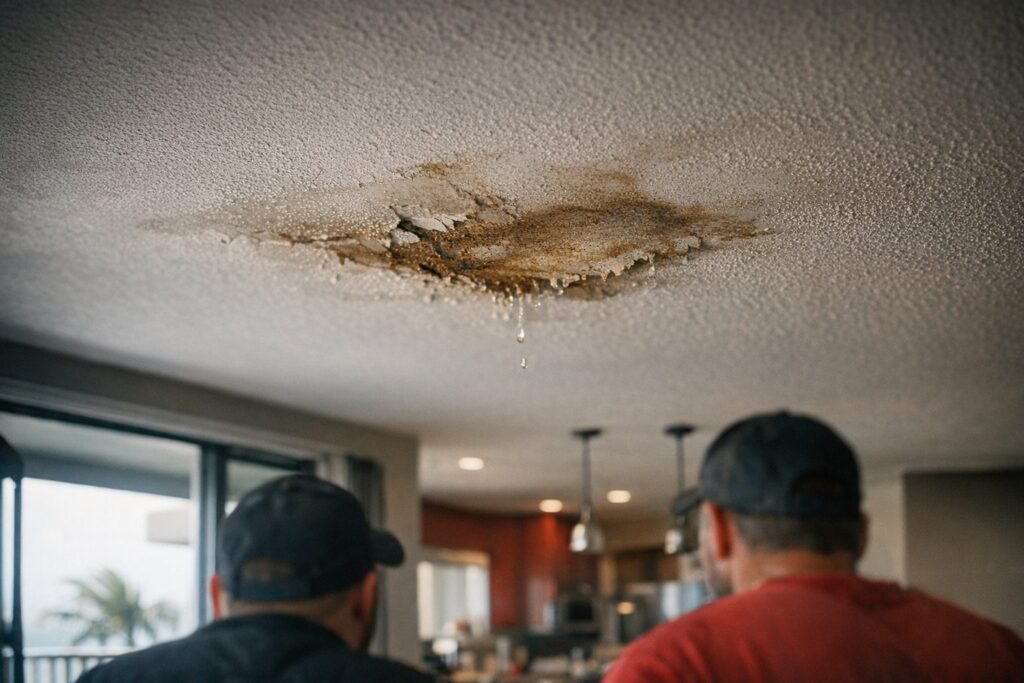
Few things are more frustrating than watching water drip — or pour — through your condo ceiling because of something happening in the unit above you. You did nothing wrong. Your plumbing is fine. Your appliances are working perfectly. But now your ceiling is stained, your carpet is soaked, and your belongings are at risk — all because of a failure in someone else’s unit.
In Southwest Florida’s condo-heavy communities — from Longboat Key and Siesta Key to Fort Myers Beach, Naples, and Marco Island — upstairs water damage is one of the most common and contentious property issues. The question everyone asks is the same: who pays for the damage to my unit?
The answer involves three potential insurance policies, your condo association’s governing documents, and Florida law. This guide breaks it all down.
Understanding Condo Insurance in Florida
Before we can answer who pays, you need to understand the three insurance policies that may come into play:
1. The HOA/Condo Association Master Policy
Every Florida condo association carries a master insurance policy that covers the common elements and, depending on the policy type, portions of individual units. Florida law (Chapter 718) recognizes two types:
- “Bare walls” or “studs out” policy: Covers the building structure from the exterior walls inward to the unfinished interior surfaces — framing, drywall (unfinished), exterior walls, roof, common plumbing, and common electrical. It does not cover your flooring, cabinets, fixtures, appliances, paint, or personal belongings.
- “All in” or “single entity” policy: Covers the building structure plus the interior finishes as they were originally installed by the developer — including original flooring, cabinetry, fixtures, and appliances. It does not cover upgrades you made after purchase or personal belongings.
2. Your HO-6 (Condo Owner’s) Policy
Your personal condo insurance — the HO-6 policy — covers your personal property (furniture, electronics, clothing), improvements and upgrades you made to the unit, loss of use (temporary living expenses if you cannot live in the unit during restoration), and liability if someone is injured in your unit. It also covers the “gap” between what the master policy covers and what you own inside the unit.
3. Your Upstairs Neighbor’s HO-6 Policy
Your neighbor’s condo insurance covers their personal property and improvements, and critically, it includes liability coverage. If the leak was caused by their negligence (failure to maintain their plumbing, ignored appliance leak, etc.), their liability coverage may be responsible for your damages.
Who Pays: The Three Scenarios
Scenario 1: The Leak Is from a Common Element
If the water comes from common plumbing — a shared drain stack, a roof leak, a common-area pipe — the condo association’s master policy typically covers the damage to the building structure and, depending on the policy type, original interior finishes. Your HO-6 policy would cover your personal property and any upgrades not covered by the master policy.
Scenario 2: The Leak Originated in Your Neighbor’s Unit
This is the most common and most complicated scenario. A burst pipe, overflowing toilet, washing machine failure, or water heater rupture in the unit above sends water into your unit.
In most cases, your own HO-6 policy is your first line of recovery. Florida follows a system where each unit owner’s insurance covers damage to their own unit, regardless of fault. You file a claim with your own insurance company, pay your deductible, and your insurer handles the rest.
Your insurance company may then pursue subrogation — a legal process where they seek reimbursement from your neighbor or your neighbor’s insurance company if the leak was caused by negligence. If subrogation is successful, you may even recover your deductible.
Scenario 3: The Cause Is Disputed or Unknown
Sometimes it is unclear whether the leak originated from a common element or a specific unit, or multiple units are involved. In these cases, the association’s master policy and the individual HO-6 policies may all come into play. A thorough investigation — including professional leak detection — is essential to determine the source and assign responsibility.
Practical Steps to Take Right Now
If water is coming into your condo from above, take these steps immediately:
- Protect your belongings. Move electronics, documents, and valuables away from the water. Place buckets under active drips. Put aluminum foil under furniture legs to prevent staining.
- Notify your upstairs neighbor. Knock on their door or call them. The water source may be a burst pipe or running appliance they do not know about. If they are not home, contact the condo management or security to attempt entry.
- Notify the condo association / management company. Report the incident immediately. They need to assess whether common elements are involved, dispatch maintenance if needed, and start their own claim process if the master policy applies.
- Document everything. Photograph and video all damage — ceiling stains, water on the floor, affected belongings. Document the time and date you discovered the damage and every communication with your neighbor and the association.
- Call a restoration company. Water damage must be addressed within 24 to 48 hours to prevent mold, regardless of the insurance or liability situation. A professional restoration company like WrightWay Emergency Services begins mitigation immediately and provides thorough documentation that supports your insurance claim. Do not wait for the insurance adjuster — your policy’s duty to mitigate requires prompt action.
- Call your insurance company. File a claim with your HO-6 carrier with the professional documentation your restoration company has gathered. Do not wait to determine fault — that is a process that can take weeks or months. Your policy covers you regardless of whose fault it is.
What About Your Deductible?
We handle both sides of condo losses, the association side and the unit-owner side, and document everything so responsibility is clear. Free damage assessment, live answer 24/7.
Under most scenarios, you will initially pay your HO-6 deductible. However, there are paths to recovery:
- Subrogation: Your insurance company pursues your neighbor’s insurer to recover costs, including your deductible.
- Direct claim against your neighbor: If your neighbor was clearly negligent (e.g., failed to maintain their water heater, ignored a known leak), you can make a direct claim against their liability insurance.
- Association responsibility: If the leak was from a common element, the association’s master policy covers building damage, potentially reducing or eliminating what your HO-6 needs to cover.
Florida-Specific Condo Considerations
- Check your condo declaration (CC&Rs). The governing documents often specify maintenance responsibilities for plumbing, HVAC, and other systems that cross between common elements and individual units. Some declarations hold unit owners responsible for all plumbing within their unit boundaries, while others assign main drain lines to the association.
- Florida Statute 718.111(11): This section of the Florida Condominium Act addresses insurance requirements and the allocation of responsibility between the association and unit owners. Review it or consult with a condo-savvy attorney if disputes arise.
- Aging buildings: Many Southwest Florida condos are 30 to 50+ years old with original plumbing. Cast iron drain stacks, copper supply lines, and polybutylene pipes in these buildings are reaching — or have exceeded — their useful life. If your building has known plumbing issues, ensure your HO-6 policy has adequate coverage.
The Restoration Is the Same Regardless of Who Pays
While the insurance and liability questions get sorted out (which can take weeks or months), the water damage in your unit needs immediate professional attention. Mold does not wait for insurance adjusters. Structural drying needs to begin within hours, not days.
WrightWay Emergency Services responds to condo water damage across Southwest Florida — from high-rise towers on Longboat Key to mid-rise communities in Fort Myers and Naples. We work with all insurance carriers, provide detailed claims documentation, and coordinate with condo associations and management companies throughout the process.
Call (941) 379-8669 for 24/7 emergency response. We will dry your unit, protect your belongings, and give you the documentation you need regardless of which policy ultimately pays.
WrightWay handles every restoration job from emergency response through licensed reconstruction.
One IICRC-certified team, one project manager, one phone call. Available 24/7 across Sarasota, Manatee, Charlotte, Lee, and Collier counties.
Add us as a preferred source and our storm updates, claim guides and restoration answers show up higher when you search.