
Hurricane Season is Active - Is Your Property Protected?

Crews Available Now - 24/7

Florida Water Damage Insurance Claim Timeline: What Happens Week by Week

June 13, 2026 10 min read Insurance

When water damage hits your home or commercial property in SW Florida, the insurance claim process can feel like a second disaster on top of the first. Between dealing with wet floors, displaced belongings, and the pressure to get repairs moving, the last thing you need is surprises from your insurance company. Understanding exactly what the law requires – and when – puts you in a far stronger position.

This guide walks you through the Florida water damage insurance claim timeline week by week, with the actual statutory deadlines your insurer is legally required to meet.

Important: WrightWay Emergency Services is a licensed restoration contractor (CBC1253650), not a public adjuster or attorney. We document damage and perform restoration work. For claim disputes or coverage advice, consult a licensed public adjuster or property insurance attorney.

Florida Water Damage Claim Timeline: Week by Week

Florida law sets hard deadlines for insurers at every stage of the claims process. The primary statute governing these timelines is Florida Statute 627.70131, which covers insurer duties from the moment you report a loss through final payment. Knowing these deadlines helps you recognize when your insurer is falling behind.

Timeframe Actions and Expectations
Day 1-3
  • First Notice of Loss: Report the damage to your insurance company immediately. The sooner you report, the sooner statutory deadlines begin running in your favor.
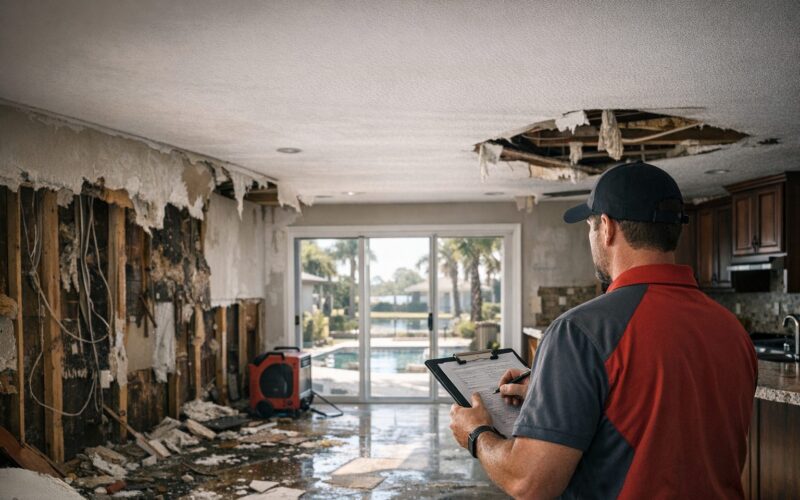
  • Emergency Mitigation: Florida law and most policies require you to take reasonable steps to prevent further damage. Engage a licensed restoration contractor like WrightWay (CBC1253650) to begin water extraction, drying equipment placement, and structural drying as quickly as possible.
  • Documentation: Photograph everything before mitigation begins. Capture water lines on walls, flooring damage, affected belongings, and any visible mold. Your contractor should generate moisture readings and a drying log that becomes part of your claim file.
Day 1-7
  • Insurer Acknowledgment Required: Under Florida Statute 627.70131(1), your insurer must acknowledge receipt of your claim notice within 7 calendar days. This acknowledgment must be responsive to your communication and include necessary claim forms and instructions. If you have not heard anything within 7 days, that is a statutory violation worth documenting.
  • Claim Number: Get a claim number in writing. All subsequent communication should reference this number.
Week 1-2
  • Investigation Begins: Once you submit your proof of loss documentation, your insurer must begin its investigation within 7 days per Fla. Stat. 627.70131(3)(a).
  • Adjuster Assignment: The insurer will assign a field adjuster to inspect the property. Start assembling your documentation packet now: photos, moisture logs, drying reports, and any contractor invoices for emergency mitigation work already completed.
Week 2-4
  • Physical Inspection Deadline: Florida law requires the insurer to conduct a physical inspection of your property within 30 days after receiving your proof of loss statement. This deadline has no “factors beyond our control” exception – it is a firm requirement.
  • What Adjusters Assess: The adjuster evaluates the cause of loss, extent of damage, necessary scope of repairs, and any code-upgrade requirements. Be present during this inspection and point out every affected area, including inside walls, under flooring, and in attic or crawl spaces.
  • Field Adjuster Estimate: Florida adjusters almost universally use Xactimate estimating software, the industry standard for property damage claims across North America. Every line item in the adjuster’s estimate is pulled from Xactimate’s regional pricing database. Understanding how Xactimate works helps you spot undercounts.
Week 3-5
  • Initial Estimate Delivered: Your insurer must send you a copy of the estimate within 7 days after their adjuster generates it. Review it carefully against your contractor’s scope of work. Common gaps include inadequate drying time line items, missing contents, and no allowance for code upgrades (such as current Florida Building Code requirements for insulation or vapor barriers).
  • Actual Cash Value vs. Replacement Cost: Initial payments are often based on Actual Cash Value (ACV), meaning depreciation is subtracted from the replacement cost. If your policy provides Replacement Cost Value (RCV) coverage, you can recover depreciation after repairs are completed. Do not accept an ACV check as final settlement if your policy provides RCV.
  • Partial Payment: You may receive a partial payment at this stage. Accepting a partial payment does not waive your right to additional amounts – but always read any check or settlement language carefully before signing.
Week 5-9
  • Mitigation Invoice Submission: Submit your complete emergency mitigation invoice, including all drying logs, moisture readings, and equipment placement records. IICRC S500 standards – followed by WrightWay and other certified contractors – specify exactly how many days of drying are appropriate for each moisture condition class. An insurer trying to cut drying time without documentation to support it is disputable.
  • Contractor Estimate: Your restoration contractor’s detailed repair estimate should be submitted to the insurer for review. Scope gaps between the adjuster’s Xactimate and your contractor’s estimate are common, particularly for hidden damage, mold remediation allowances, and finish work.
  • Scope Disputes: If there are disagreements about scope, your contractor can communicate directly with the adjuster or provide a written supplement request with supporting documentation. WrightWay prepares detailed scope supplements on behalf of the property owners we serve.
Week 9-13
  • 60-Day Pay or Deny Deadline: This is the most important statutory deadline. Under Florida Statute 627.70131(7)(a), your insurer must pay or deny your claim within 60 days of receiving notice. If they miss this deadline, statutory interest begins accruing on the unpaid amount from the date you filed. Note that the earlier “90-day” figures some older references cite do not reflect current Florida law – the correct statutory deadline is 60 days.
  • Supplemental Claims for Hidden Damage: Demo and drying often reveal damage that was not visible during the adjuster’s initial inspection – mold behind walls, rotted subfloor, or deteriorated structural members. Under Florida Statute 627.70132, supplemental claims must be submitted within 18 months of the original date of loss. Document hidden damage thoroughly with photos and moisture data before any repairs cover it.
  • Code Upgrade Claims: Current Florida Building Code may require upgrades beyond like-for-like replacement, particularly for insulation, electrical, or plumbing. These code-upgrade costs are often a separate line item that must be specifically requested and supported by a licensed contractor’s statement citing the applicable code section.
Week 13+
  • Final Settlement or Denial: You will receive a written coverage decision. If the claim is denied in whole or in part, the denial must state the specific policy language or exclusion being applied.
  • Recourse Options: If you disagree with a denial or partial payment, Florida law provides several avenues: appraisal (if your policy contains an appraisal clause), mediation through the Florida Department of Financial Services, or litigation. A licensed public adjuster or property insurance attorney can advise you on the strongest path given your specific policy language.
  • Recoverable Depreciation: Once repairs are complete, submit your final invoices to recover any withheld depreciation under your RCV policy within the timeframe specified in your policy (typically 180 days to 2 years from the date of loss).

Florida’s 60-Day Pay or Deny Rule (Not 90 Days)

One of the most common misunderstandings Florida property owners have about the claims process involves this deadline. Many older resources and even some contractor communications still reference a “90-day rule.” That figure is outdated. Current Florida Statute 627.70131(7)(a) requires your insurer to pay or deny your claim within 60 days of receiving notice of the claim.

If the insurer misses the 60-day deadline, statutory interest accrues on the amount owed from the original filing date. That interest provision is meaningful leverage if your insurer is dragging its feet. Keep a dated paper trail of every communication you send, and document when your insurer receives documents by using certified mail or email confirmation.

The Florida Homeowner Claims Bill of Rights, codified at Florida Statute 627.7142, gives residential policyholders additional protections including the right to receive written explanation of any covered or denied amounts within 30 days of submitting a complete proof of loss.

Proof of Loss: What It Is and When You Need to Submit It

A proof of loss is a formal, sworn statement you provide to your insurer documenting the extent of your loss and the amount you are claiming. It typically includes an itemized list of damaged property, contractor estimates, photos, and receipts for emergency expenses. Florida state law does not set a universal deadline for submitting proof of loss – the deadline is determined by your specific policy, commonly 60 days from when the insurer requests it in writing. Missing this deadline can complicate your claim significantly, though Florida courts look at whether the insurer suffered actual prejudice from a late submission.

Practical advice: submit your proof of loss as completely as possible and as early as possible. Every day your insurer has your complete documentation is another day closer to the 60-day pay/deny clock running out in your favor.

What to Do When the Adjuster’s Xactimate Estimate is Too Low

Xactimate is the industry-standard estimating platform used by virtually every Florida insurance adjuster. It generates line-item estimates using regional pricing data. The problem is that Xactimate estimates are only as complete as the adjuster’s inspection – if they missed damage, those items are simply not in the report.

When your restoration contractor’s scope differs significantly from the adjuster’s Xactimate estimate, you have several options:

  • Supplement request: Your contractor submits a written line-by-line supplement with supporting documentation (photos, moisture data, drying logs, manufacturer specs) explaining why additional scope is warranted.
  • Re-inspection: Request a re-inspection if hidden damage was uncovered after initial demo that the adjuster did not see.
  • Public adjuster: A licensed Florida public adjuster can prepare and negotiate a competing estimate on your behalf. They are paid a percentage of the settlement, so their financial interest aligns with maximizing your recovery.
  • Appraisal clause: Many Florida property policies contain an appraisal clause that allows each party to hire an independent appraiser, with a neutral umpire resolving any remaining disagreement. This is often faster and less expensive than litigation.

WrightWay documents every stage of mitigation and demolition with photos, moisture readings, and IICRC-compliant drying logs. That documentation package is specifically designed to support supplement requests and re-inspection demands when the initial Xactimate falls short.

Signs Your Claim May Be Heading Toward Dispute

Most Florida water damage claims are handled fairly and closed within the statutory timeframes. But certain patterns signal that a claim is heading toward a difficult settlement. Watch for:

  • No acknowledgment from your insurer within 7 days of reporting
  • Adjuster inspection delayed beyond 30 days after your proof of loss submission
  • Initial estimate that covers only surface repairs with no allowance for drying, demolition, or mold prevention
  • A written request for documentation the insurer already has
  • Blanket “pre-existing condition” or “maintenance issue” language in denial letters without specific evidence
  • A settlement offer arriving with a release or check that includes “full and final settlement” language before all damage is confirmed
  • No pay/deny decision after 60 days from your notice date

If you encounter any of these patterns, contact the Florida Department of Financial Services Consumer Helpline to file a complaint, and consider consulting a licensed public adjuster or property insurance attorney. The DFS also offers a free mediation program for policyholders in dispute with their insurer.

Note on Costs: Emergency restoration costs vary widely depending on property size, water category, and extent of affected materials. WrightWay provides detailed written estimates and works directly with insurance adjusters to document scope. For a no-obligation assessment, call (941) 379-8669.

For 24/7 emergency restoration across SW Florida – Sarasota, Manatee, Charlotte, Lee, and Collier counties – call WrightWay at (941) 379-8669. WrightWay Emergency Services is IICRC certified, licensed under CBC1253650, and has helped SW Florida property owners navigate insurance claims for years.

Frequently Asked Questions

What should I do immediately after discovering water damage?

Call your insurance company to report the loss, then immediately contact a licensed restoration contractor to begin emergency mitigation. Under most Florida policies you have a duty to mitigate, meaning you are required to take reasonable steps to prevent additional damage. Failing to mitigate can give the insurer grounds to reduce your claim. Document everything with photos and video before mitigation begins.

How long does an insurance company have to acknowledge my claim in Florida?

Under Florida Statute 627.70131(1), insurers must acknowledge receipt of your claim notice within 7 calendar days. If you do not receive acknowledgment within that window, document the failure in writing and consider filing a complaint with the Florida Department of Financial Services.

Does Florida have a 90-day rule for insurance claims?

No. That figure is outdated. Current Florida law under Fla. Stat. 627.70131(7)(a) requires your insurer to pay or deny your claim within 60 days of receiving notice. Missing this deadline triggers statutory interest on the amount owed.

What is a proof of loss and when do I need to submit it?

A proof of loss is a sworn, formal statement documenting the extent and value of your loss. Florida state law does not set a universal deadline – your policy sets the timeline, typically 60 days from a written request by the insurer. Submit it as promptly and completely as possible, since it starts the 7-day clock for the insurer to begin its investigation and the 30-day clock for a physical inspection.

What if I discover additional damage after the initial claim?

You can file a supplemental claim. Under Florida Statute 627.70132, supplemental claims generally must be submitted within 18 months of the original date of loss. Document hidden damage thoroughly with photos and moisture readings before repairs cover it. WrightWay preserves this documentation as a standard part of every job.

How can a restoration contractor support my insurance claim?

A licensed IICRC-certified contractor provides critical claim documentation: timestamped photos, moisture mapping logs, equipment placement records, and IICRC S500-compliant drying reports. This documentation supports your initial claim, validates mitigation invoices, and provides the evidence base for supplement requests when hidden damage is uncovered. WrightWay coordinates directly with adjusters and can prepare written supplement packages when scope gaps arise.

See WrightWay first on Google

Add us as a preferred source and our storm updates, claim guides and restoration answers show up higher when you search.
Share:

Related Articles

Serving All of Southwest Florida

What Our Customers Say

Google Reviews
4.7

Excellent Based on 435 reviews

Common Questions

Restoration Questions

Common timing, documentation, and service questions answered in a clearer format so owners and managers can make confident decisions faster.

Fast response guidance Insurance-aware answers Local service expectations

Yes. WrightWay works with virtually every major homeowner’s and commercial insurance carrier. Our team prepares thorough documentation including photo evidence, moisture readings, and detailed estimates to support your claims process. We provide all the documentation your adjuster needs so you can focus on your family or business instead of paperwork.

In most cases, our crews arrive on site within 2 hours of your call anywhere in our Southwest Florida service area. Rapid response is critical because water damage, smoke residue, and mold growth worsen with every passing hour. Contact us at (941) 379-8669 for immediate dispatch.

The WrightWay Emergency Response Program (ERP) is a free program designed for property managers, commercial facilities, and healthcare organizations that want a pre-arranged emergency plan in place before disaster strikes. ERP members receive priority dispatching, a customized response plan for their property, and dedicated account coordination so there is zero confusion when an emergency occurs.

Yes, WrightWay Emergency Services provides free on-site inspections for all restoration and reconstruction projects. One of our trained project managers will evaluate the damage, explain the scope of work, and provide a transparent written assessment before any work begins. Call (941) 379-8669 to schedule yours today.

WrightWay Emergency Services is a full-service property restoration company headquartered at 300 Triple Diamond Blvd, Nokomis, FL 34275. We specialize in water damage restoration, fire and smoke damage cleanup, mold remediation, storm damage repair, and complete reconstruction for residential and commercial properties throughout Southwest Florida. Our IICRC-certified technicians and Florida-licensed contractors deliver 24/7 emergency response so you can get back to normal as quickly as possible.

Emergency Response

Need Emergency Restoration?

Our team is standing by 24/7 to help stabilize the property, document the loss, and move the job forward fast.

  • 24/7 live dispatch and emergency response
  • Insurance-ready documentation and coordination
  • Mitigation, contents, and rebuild under one roof