The Matching Challenge in Partial Reconstruction
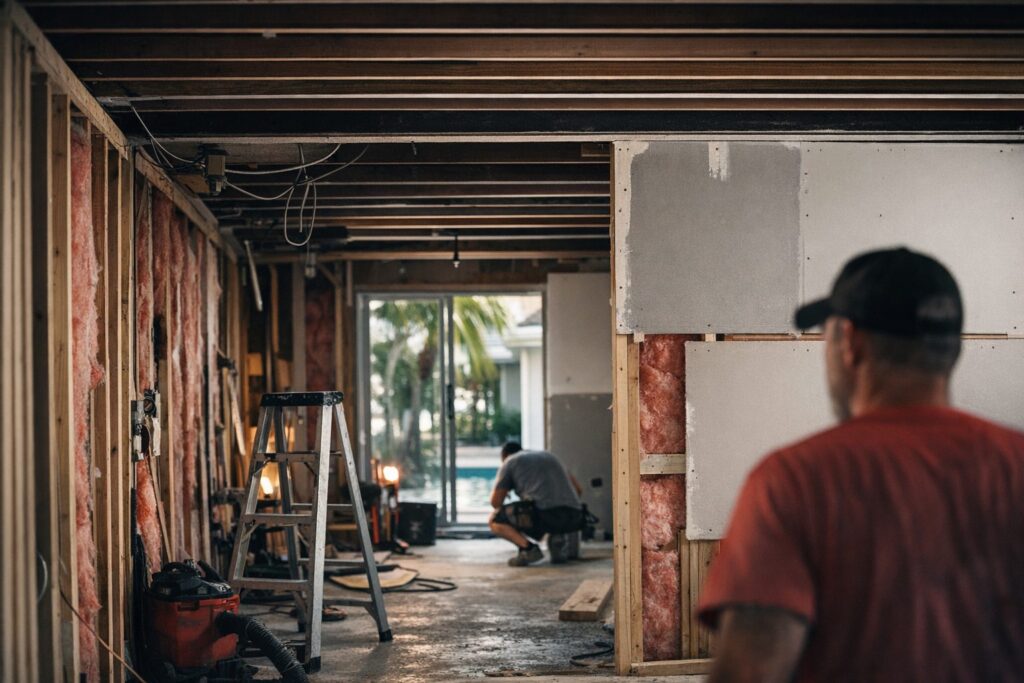
When fire, water, or storm damage affects part of your home, the reconstruction process creates a unique challenge: the rebuilt section must seamlessly blend with the undamaged portions. New drywall must match existing textures. New flooring must match existing flooring. New paint must match walls that may have faded over years of sun exposure. New cabinets must coordinate with existing ones in an adjacent room.
Achieving these matches is both an art and a science — and when matches fail, the result looks obviously patched together rather than professionally restored. This guide covers the common matching challenges, how professional reconstruction teams address them, and what your insurance should cover.
Why Perfect Matches Are So Difficult
Paint
Paint matching seems like it should be simple — just use the same color. But several factors make it one of the trickiest aspects of partial reconstruction:
- Fading: Florida’s intense UV exposure fades painted surfaces significantly. A wall that was painted Sherwin-Williams “Agreeable Gray” five years ago may now be a noticeably different shade than a freshly painted wall in the same color.
- Sheen differences: Even when the color matches, sheen (flat, eggshell, satin, semi-gloss) must also match. Different sheens reflect light differently and create visible boundaries between old and new paint.
- Texture: If the new drywall texture does not perfectly match the existing texture (orange peel, knockdown, smooth, skip trowel), the paint will appear different even if the color is identical because the texture catches light differently.
- Paint formulation changes: Manufacturers reformulate paint products over time. The “same” color in the current formulation may not match paint applied from the old formulation.
Professional Solution
Experienced reconstruction teams address paint matching by:
- Using spectrophotometer color-matching technology to analyze the faded existing color (not the original color code)
- Painting entire walls or rooms rather than patching sections — paint applied to the same surface under the same conditions matches across the full wall
- Matching the drywall texture precisely before any paint is applied
- Applying the same number of coats and the same sheen as the existing surfaces
Flooring
Flooring matching is often the most visible and most frustrating challenge in partial reconstruction:
Hardwood
- Discontinued species or styles: The specific hardwood product installed in your home may no longer be manufactured. Even if the species (oak, maple, cherry) matches, the grade, width, and finish must also match.
- Patina and aging: Wood floors darken or shift in color over time from UV exposure and oxidation. New planks of the same species will look noticeably different from planks that have been in place for years.
- Finish matching: Factory-finished hardwood uses proprietary finishes that are difficult to replicate. Site-finished hardwood can be sanded and refinished to match, but the entire connected area typically must be refinished together.
Tile
- Lot variations: Tile manufactured in different lots (batches) can vary in color, size, and texture. Even the “same” tile purchased a year apart may not match.
- Discontinued products: Tile manufacturers frequently discontinue patterns and styles. If your tile is more than a few years old, finding an exact match may be impossible.
- Grout color: Grout darkens with age and cleaning. New grout will not match existing grout without color-matching products or full regrout of transition areas.
LVP and Laminate
- Better matchability: LVP and laminate products are manufactured with consistent patterns, so matching is easier than natural materials — if the product is still available
- Same risk of discontinuation: Products are updated and discontinued regularly
- Expansion gap challenges: Connecting new floating floor to existing floating floor requires careful transition strip placement
Professional Solution
The best approach to flooring matching depends on the situation:
- If the same product is available: Purchase from the same manufacturer and lot if possible. Install carefully to create seamless transitions.
- If the product is discontinued: Check specialty suppliers, salvage yards, and online marketplaces. For hardwood, sand and refinish the entire connected floor area to create a uniform appearance.
- If no match exists: Install new flooring throughout the entire connected area. This is where insurance coverage for matching becomes critical.
Drywall Texture
Florida homes feature a range of drywall textures, and the most common — knockdown and orange peel — require skill to replicate:
- Knockdown texture: Created by spraying drywall compound and then flattening (“knocking down”) the peaks. The pattern density, splatter size, and flatten pressure all affect the final appearance. Matching existing knockdown requires practice and an experienced hand.
- Orange peel texture: Created by spraying at specific pressure and distance. The “bump” size and density must match the existing pattern.
- Smooth walls: Ironically, smooth walls are the hardest to patch because any imperfection is visible. New drywall sections on smooth walls require extensive finish work (Level 5 finish) to avoid visible joints.
What Insurance Should Cover for Matching
If water reached walls, flooring seams, or sat overnight, fans alone rarely save the materials. A free moisture inspection tells you exactly what is wet and what it costs to fix.
This is where many homeowners run into disputes with their insurance company. The concept is called “matching” or “like kind and quality”:
Your Policy Language
Most Florida homeowners policies require the insurer to restore your home to its pre-loss condition using materials of “like kind and quality.” This means the replacement materials should match the existing materials in type, quality, and appearance.
When Matching Requires Replacing Undamaged Materials
If your home has continuous flooring from the living room through the hallway and into the bedrooms, and only the living room floor was damaged, replacing just the living room creates a visible mismatch at the transition to the undamaged hallway. The insurance principle of “like kind and quality” restoration should cover replacing the flooring in the entire connected area to achieve a uniform result.
However, insurance adjusters frequently push back on matching claims, arguing that only the directly damaged area should be covered. This is where professional documentation and advocacy matter. Your restoration company should:
- Document that the existing material cannot be matched (with samples, manufacturer correspondence, and photographic evidence)
- Show that a partial replacement creates a visible mismatch that does not meet the “like kind and quality” standard
- Cite policy language and Florida insurance regulations supporting the matching requirement
Supplement Claims for Matching
If the initial insurance payout does not cover matching, a supplement claim can be filed specifically for the additional cost of matching materials throughout connected areas. WrightWay files matching supplements as a standard part of our claims management process.
Tips for Homeowners During Partial Reconstruction
- Keep samples of your materials. When you install new flooring, keep a few spare planks or tiles. When you paint, record the exact color code, sheen, and brand. These records are invaluable when matching is needed later.
- Do not accept “close enough.” A visible mismatch in your own home is something you will notice every day. Insist on proper matching — it is what your policy promises.
- Understand the scope before work begins. Ask your reconstruction contractor specifically how they plan to handle matching in areas where new work meets existing work.
- Document everything. Photograph existing materials, the transition areas, and any visible differences between samples or test applications before committing to a full installation.
WrightWay’s Approach to Material Matching
WrightWay Emergency Services understands that the success of a partial reconstruction is judged by the transitions — the places where new meets old. Our project managers source matching materials from multiple suppliers, use color-matching technology for paint, and employ experienced tradespeople who can replicate drywall textures and create seamless flooring transitions. When a match cannot be achieved, we document the discrepancy and work with your insurer to cover the additional scope.
Call (941) 379-8669 to discuss your reconstruction project. We serve all of Southwest Florida with meticulous, detail-oriented reconstruction work.
WrightWay handles every restoration job from emergency response through licensed reconstruction.
One IICRC-certified team, one project manager, one phone call. Available 24/7 across Sarasota, Manatee, Charlotte, Lee, and Collier counties.
Add us as a preferred source and our storm updates, claim guides and restoration answers show up higher when you search.