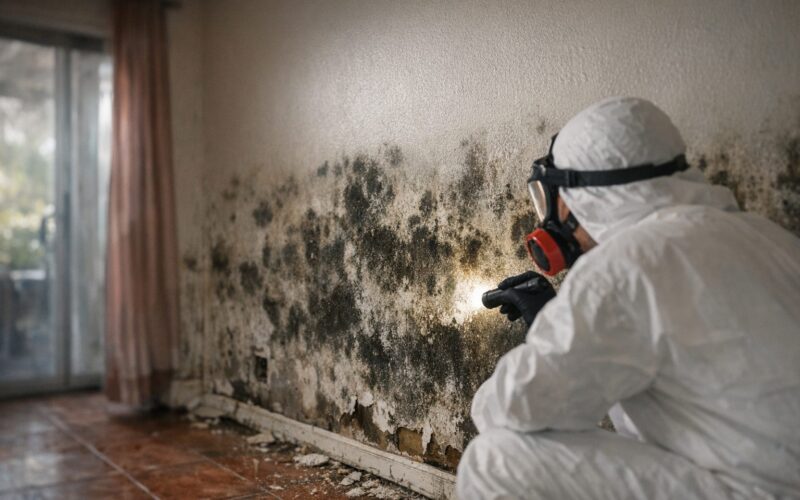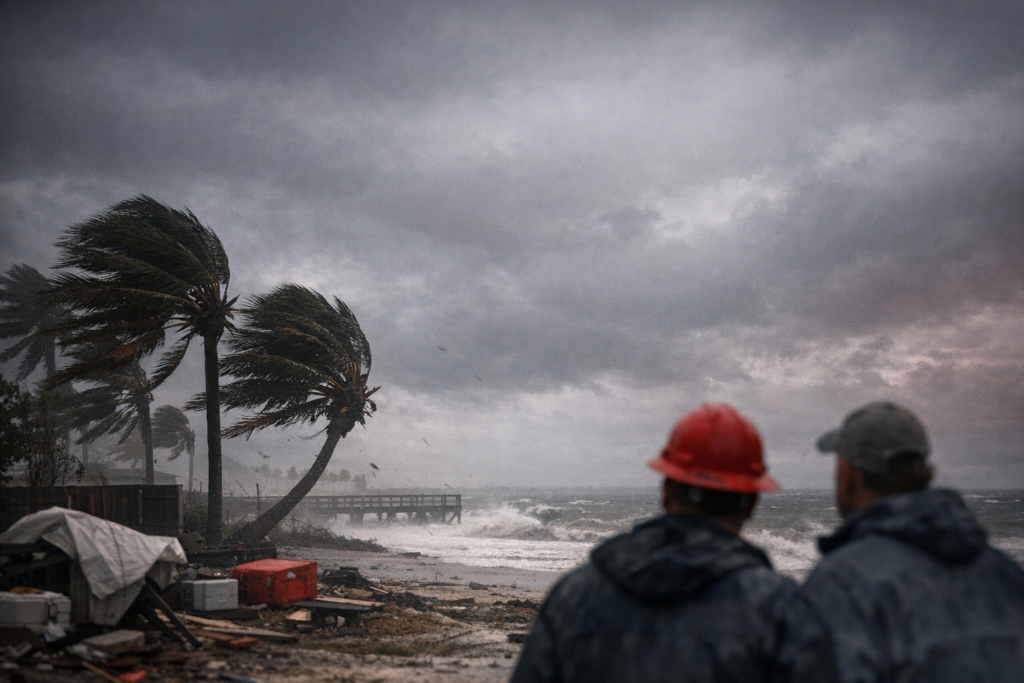
In the days after a hurricane makes landfall across Southwest Florida, most homeowners focus on visible damage: the missing roof shingles, the flooded garage, the fallen fence. What few people address quickly enough is what cannot be seen – the airborne health hazards developing inside the home. Mold spores multiply, smoke particles settle into ductwork, and sewage off-gassing spreads through living areas. Understanding what those hazards are and when your home is genuinely safe for your family is the difference between a smooth recovery and a prolonged health crisis. WrightWay Emergency Services, a licensed Florida restoration contractor (CBC1253650), has guided hundreds of SW Florida families through this process. This guide covers everything you need to know.
How Hurricane Damage Creates Indoor Air Quality Hazards
Hurricanes introduce several overlapping air quality threats simultaneously. The moment floodwater or rain intrusion saturates drywall, insulation, or subflooring, the clock starts. According to the U.S. Environmental Protection Agency, the key to mold control is moisture control – and mold can begin colonizing porous surfaces in as little as 24 to 48 hours after water exposure. In Florida’s climate, that window is even shorter because the ambient humidity that already saturates outdoor air gives mold spores the head start they need.
Beyond mold, post-hurricane air quality threats include:
- Sewage contamination and off-gassing – Floodwaters frequently carry Category 3 (black water) contamination from overflowing sewage systems. As this water soaks into building materials, it off-gasses hydrogen sulfide and other volatile organic compounds (VOCs) that make the indoor air acutely hazardous.
- Smoke infiltration – Post-storm fires ignited by downed power lines, ruptured gas lines, or electrical shorts send fine particulate matter into homes through broken windows and compromised weatherproofing. These particles, smaller than 2.5 microns, penetrate deep into lung tissue.
- Disturbed building materials – Homes built before 1980 may contain asbestos in floor tiles, pipe insulation, and roofing materials. Wind and structural damage can release asbestos fibers and fiberglass insulation particles into the air where they become respiratory hazards.
- Chemical contamination – Floodwaters that cross industrial areas, gas stations, or agricultural land carry pesticides, fuel products, and industrial solvents that volatilize as they dry inside a structure.
Understanding Mold Spore Counts in Florida’s Climate
Florida is one of the most challenging environments in the country for mold management. Florida’s outdoor mold spore baseline typically ranges from 500 to 5,000 spores per cubic meter, varying by season and proximity to water. This is significantly higher than the national average because the state’s average relative humidity of 74% consistently exceeds the 60% threshold at which mold growth accelerates. Following a hurricane, outdoor counts can spike dramatically as storm-disturbed organic debris releases massive quantities of spores.
The key benchmark for indoor air quality is not a specific number – it is the relationship between indoor and outdoor counts. Indoor spore concentrations should always be lower than the outdoor baseline when a home is properly maintained. When indoor counts are significantly higher than outdoor levels, that indicates active mold colonization inside the structure requiring professional remediation. Counts above 1,000 spores per cubic meter indoors, paired with indoor-to-outdoor ratios greater than 1:1, are a recognized signal for professional intervention. Certain mold species – such as Stachybotrys (often called black mold) and Chaetomium – are cause for concern even at counts as low as 40 spores per cubic meter, because these types are not normally airborne and their presence indicates severe ongoing moisture damage.
The Centers for Disease Control and Prevention note that the CDC does not recommend routine home mold testing because no universally accepted safe exposure threshold has been established. Instead, the presence of visible mold or musty odors combined with moisture sources is treated as sufficient grounds for professional remediation. This is consistent with what professional restorers observe in the field: by the time spore counts test high, visible colonization has typically been underway for days.
Why HVAC Systems Spread Spores Through the Entire Home
One of the most damaging mistakes SW Florida homeowners make after a hurricane is turning the air conditioner back on before confirming the structure is dry. HVAC systems are extraordinarily efficient at distributing whatever is in the air – including mold spores – to every room in the house. A single mold colony in a flooded utility closet can seed every bedroom, living area, and closet through the ductwork within hours of the system running.
Spores drawn into return air vents settle on evaporator coils and in duct interiors, where the combination of trapped moisture and organic debris from normal household air creates a secondary growth environment. Professional restoration requires HVAC systems to remain off and sealed during active remediation, with duct cleaning and coil inspection performed as part of the final clearance process before the system is returned to service.
Health Symptoms That Signal Poor Indoor Air Quality
The EPA’s mold resource center identifies a range of health effects from mold exposure, including sneezing, runny nose, red eyes, and skin rash in allergic individuals. Both mold-allergic and non-allergic people can experience irritation of the eyes, skin, nose, throat, and lungs. For those with asthma, mold exposure frequently triggers acute episodes requiring medical attention.
Watch for these specific patterns in your family following a hurricane:
- Respiratory symptoms (coughing, wheezing, shortness of breath) that improve when family members leave the home and worsen on return
- Headaches that develop within an hour of re-entering the property
- Eye irritation and burning that clears outdoors
- Fatigue and cognitive fog that are disproportionate to the stress of storm recovery
- Children or elderly family members showing symptoms before adults – these groups are more susceptible to airborne contaminants
- Pets exhibiting unusual lethargy or respiratory distress indoors
If household members show these patterns, stop sleeping in the home immediately and arrange alternative accommodations until professional testing confirms safe air quality. This is not overcaution – it is the medically appropriate response.
What Professional Air Quality Testing Involves
Professional indoor air quality testing after a hurricane goes well beyond a single air sample. A qualified Industrial Hygienist or Certified Indoor Environmentalist (CIE) will typically conduct:
- Air cassette sampling – Spore trap cassettes draw a measured volume of air through a sticky collection surface. Lab analysis identifies mold species and counts spores per cubic meter, compared against simultaneously collected outdoor reference samples.
- Viable surface sampling – Swab or tape-lift samples from suspected growth areas confirm species and contamination levels on specific surfaces, guiding the scope of remediation.
- ERMI testing (Environmental Relative Moldiness Index) – A dust sampling method developed by the EPA that tests for 36 specific mold species, producing a composite score that correlates with health risk. ERMI is particularly useful for post-remediation confirmation in heavily contaminated homes.
- VOC and particulate testing – After hurricanes involving sewage intrusion or fire smoke, air sampling for volatile organic compounds and fine particulate matter (PM2.5) documents chemical hazards beyond mold.
- Moisture mapping – Thermal imaging and pin-type moisture meters identify wet building cavities that have not yet produced visible mold but will do so within days if untreated.
Results from certified labs typically return within 24 to 72 hours. The inspector compares indoor counts to the concurrent outdoor baseline and to industry benchmarks to generate a remediation scope that addresses the actual contamination found – not a one-size-fits-all assumption.
HEPA Air Scrubbers: What They Do and How They Are Sized
HEPA air scrubbers are the workhorses of indoor air quality restoration. A true HEPA filter captures 99.97% of particles 0.3 microns or larger, which includes mold spores (typically 2-40 microns), smoke particles, fiberglass fibers, and fine construction dust. The machines draw contaminated room air through progressively finer pre-filters and then through the HEPA membrane, discharging cleaned air back into the space or exhausting it outside under negative pressure.
Sizing and placement matter enormously. Per IICRC S520 guidance, restoration contractors target 4 to 6 air changes per hour (ACH) within the containment zone or affected area. An air change means turning over the entire cubic footage of air in the space once through the scrubber. A 1,000 square foot area with 9-foot ceilings contains 9,000 cubic feet of air. At 6 ACH, that requires equipment delivering 54,000 cubic feet per hour – or 900 CFM – of filtered air capacity. Contractors add 25% to calculated CFM to compensate for filter loading and efficiency losses as filters accumulate particulates over time.
The 72-hour guideline commonly cited for air scrubber run time reflects practical field experience: achieving the necessary ACH across multiple air changes while also allowing HEPA filtration to address spores released during demolition and material removal. However, the actual run time is determined by clearance testing results, not a fixed clock. Scrubbers continue running until post-remediation air samples confirm that indoor counts have returned to or below the outdoor baseline. In heavy contamination scenarios following major hurricanes, that process can take several days beyond the initial 72-hour window.
Post-Remediation Clearance Testing: The IICRC S520 Standard
The IICRC S520 Standard for Professional Mold Remediation establishes the framework for confirming that remediation has succeeded. Post-Remediation Verification (PRV) is the formal process and it has specific requirements that distinguish legitimate clearance from a contractor simply declaring their own work complete.
Key requirements under S520 PRV:
- Independent third party – PRV must be conducted by an Indoor Environmental Professional (IEP) who was not involved in the remediation work itself. This independence is what gives clearance reports their validity for insurance purposes and real estate transactions.
- Visual inspection first – The space must be visibly free of mold growth and debris before air sampling begins. A space can pass air sampling while harboring visible mold behind a wall cavity or under flooring – visual inspection catches what air samples miss.
- Air sampling with concurrent outdoor baseline – Indoor samples are compared against outdoor samples taken the same day under similar weather conditions. Clearance is achieved when indoor concentrations are at or below the outdoor baseline for the same mold species.
- Moisture verification – Building materials must be confirmed dry (typically below 16% moisture content in wood, below 1% in concrete) before the area is cleared for rebuilding. Clearing a space that is still wet guarantees mold recurrence.
- Written clearance report – The IEP documents all findings, lab results, and a formal clearance statement or a list of items requiring additional work before clearance can be granted.
For SW Florida homeowners dealing with insurance claims, this documentation is not optional. Insurance carriers increasingly require S520-compliant clearance reports before approving reconstruction expenses. Having a credentialed third-party clearance report protects your claim and provides legal protection in any future property transactions.
What Professional Restoration Includes for Air Quality
Licensed mold remediation with containment, HEPA filtration, and clearance-ready documentation. Get a real price range before anyone starts cutting drywall.
When WrightWay Emergency Services responds to a post-hurricane air quality call in SW Florida, the process follows a systematic sequence that addresses contamination at every level:
- Assessment and moisture mapping – Thermal imaging and moisture meters identify all wet areas, including hidden cavities behind walls and under flooring, before any demolition begins.
- Containment setup – 6-mil polyethylene barriers isolate the work zone from living areas. Negative air pressure (typically -5 to -10 Pascals relative to adjacent spaces) ensures that air flows from clean areas into the contaminated zone, not the reverse. HEPA-filtered negative air machines exhaust contaminated air outside the structure.
- Controlled demolition – Wet and mold-colonized materials are removed under containment to prevent cross-contamination. HEPA vacuums collect demolition debris and spores before they can spread.
- Antimicrobial treatment – Remaining structural surfaces receive EPA-registered antimicrobial treatment. This does not replace physical removal of colonized materials but suppresses residual spore loads on treated surfaces.
- HEPA air scrubbing – Scrubbers run continuously through the active work phase and post-work cleaning phase, targeting the ACH levels required by the scope.
- Drying to goal – Commercial dehumidifiers and air movers reduce structural moisture to pre-loss dry standards before containment comes down.
- Third-party clearance testing – An independent IEP conducts PRV before reconstruction begins. The clearance report documents that the home meets the IICRC S520 standard.
DIY Air Quality Mistakes That Make Things Worse
The instinct to act fast after a hurricane is understandable. Unfortunately, several common DIY responses to air quality concerns actively worsen the situation:
- Running box fans through the house – Fans create turbulent air movement that aerosolizes settled spores and distributes them to unaffected areas. If mold has begun growing in a wet corner of the garage, a box fan pointed at it can seed every room within hours.
- Using bleach on porous surfaces – Bleach kills surface mold cells on hard, non-porous surfaces like tile. On drywall, wood studs, or concrete block, bleach’s water carrier penetrates the porous material and feeds the mold roots deeper in the substrate. The CDC’s mold remediation guidance limits bleach to hard surfaces only and recommends professional evaluation for porous material contamination.
- Opening windows to air out the home – In SW Florida’s post-storm climate, outdoor air in August or September carries 80-90% relative humidity. Opening windows to “dry out” a wet home introduces the very moisture that accelerates mold growth. The Florida Department of Health recommends keeping indoor humidity below 60% (ideally below 50%) to prevent mold proliferation – a target that is impossible with windows open during summer months.
- Assuming visible mold is the full extent of the problem – What you see on a wall surface is typically the fruiting body of a colony that has been growing inside the wall cavity for days. Cleaning the visible surface without addressing the source guarantees rapid recurrence.
- Waiting too long to call professionals – Every day of delay after hurricane water intrusion multiplies the remediation scope and cost. Mold colonies that could have been addressed in an afternoon on day one require full containment demolition and clearance testing by day five.
For 24/7 emergency restoration across SW Florida, call WrightWay at (941) 379-8669. Our IICRC-certified technicians respond rapidly to minimize the window between water intrusion and professional intervention, protecting both your home and your family’s health.
Insurance Coverage Notice: WrightWay Emergency Services works with all major insurance carriers and can assist with documentation for post-hurricane restoration claims. Coverage for mold remediation, air quality testing, and restoration varies by policy. We are not public adjusters and cannot provide coverage opinions – consult your insurance carrier or a licensed public adjuster for specific coverage questions regarding your claim.
Cost Notice: Post-hurricane restoration costs vary based on contamination type, affected area, required testing, and scope of remediation. We provide detailed written estimates following our initial assessment. Contact us at (941) 379-8669 for a no-obligation evaluation.
Frequently Asked Questions
What are the signs of poor indoor air quality after a hurricane?
The most telling sign is symptoms that improve when household members leave the home and worsen on return: respiratory issues, headaches, eye irritation, and unusual fatigue. Musty odors that were not present before the storm are a direct indicator of mold growth. Visible discoloration on walls, ceilings, or flooring – particularly in areas that experienced moisture intrusion – confirms that mold colonization has begun. If any family member shows these patterns, err on the side of caution and arrange alternative accommodations until professional testing confirms safety.
How quickly can mold grow after a hurricane?
Mold can begin colonizing moist surfaces within 24 to 48 hours of water intrusion. In SW Florida’s humid climate, active visible growth is frequently observed within 48 to 72 hours of a hurricane event in areas that did not receive prompt drying. The longer the delay between water intrusion and professional intervention, the greater the scope and cost of remediation required.
What does professional air quality testing involve?
Professional testing involves air cassette sampling (spore trap analysis comparing indoor counts to a concurrent outdoor baseline), viable surface sampling from suspected growth areas, moisture mapping of all structural assemblies, and – where sewage or fire smoke is present – VOC and particulate testing. Results from certified labs typically return within 24 to 72 hours and guide the remediation scope.
How long should HEPA air scrubbers be run?
Per IICRC S520 guidance, air scrubbers are sized to achieve 4 to 6 air changes per hour within the affected containment area. The 72-hour minimum commonly cited reflects typical field experience for initial air quality restoration, but actual run time is governed by clearance testing results. Scrubbers continue operating until post-remediation air samples confirm indoor spore counts have returned to or below the outdoor baseline. In heavily contaminated post-hurricane scenarios, this may extend beyond 72 hours.
When is it safe to return home after a hurricane?
Safe reoccupancy requires passing formal Post-Remediation Verification (PRV) under the IICRC S520 standard: visual confirmation of no remaining mold growth, air sampling results at or below the concurrent outdoor baseline, and moisture readings confirming structural materials have dried to pre-loss standards. This verification must be conducted by an independent Indoor Environmental Professional, not the remediation contractor. WrightWay coordinates third-party clearance testing as part of our complete restoration service.
For expert assistance with post-hurricane restoration in SW Florida, trust WrightWay Emergency Services, a licensed Florida restoration contractor (CBC1253650) and IICRC certified firm serving Sarasota, Manatee, Charlotte, Lee, and Collier counties. Call (941) 379-8669 any time – we respond 24 hours a day, 7 days a week.
WrightWay handles every restoration job from emergency response through licensed reconstruction.
One IICRC-certified team, one project manager, one phone call. Available 24/7 across Sarasota, Manatee, Charlotte, Lee, and Collier counties.
Add us as a preferred source and our storm updates, claim guides and restoration answers show up higher when you search.