

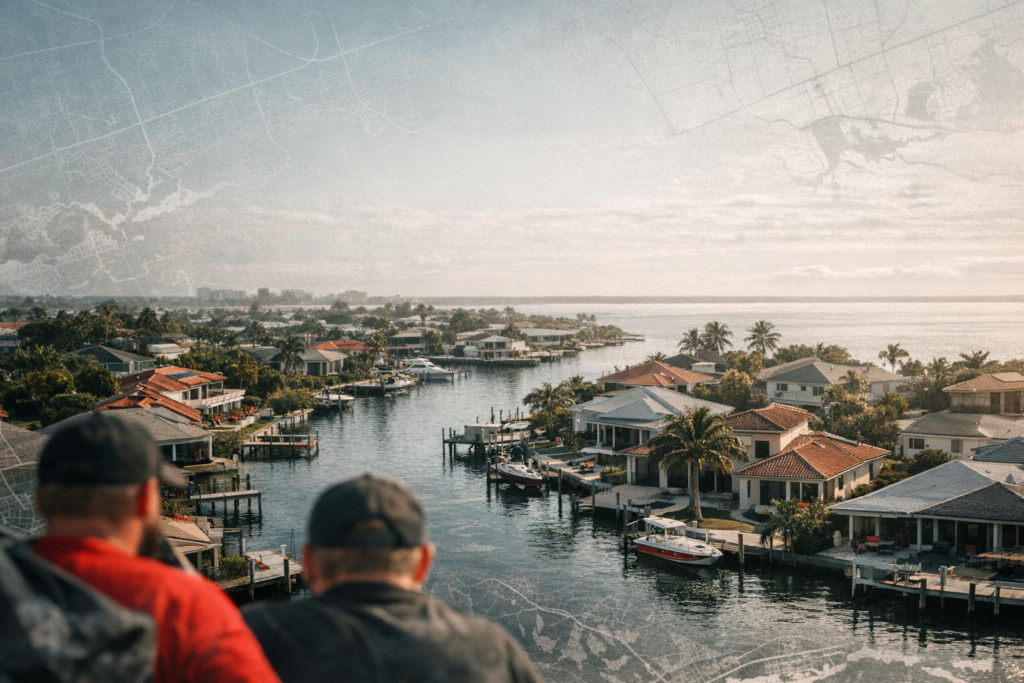
Understanding Lee County Flood Zones: A Guide for Cape Coral and Fort Myers Homeowners
Flooding is one of the most serious threats facing homeowners and property managers in Lee County, Florida. With its coastal geography, extensive canal systems, and barrier islands, the region carries some of the highest flood exposure in the entire country. Whether you own property in Cape Coral, Fort Myers, Fort Myers Beach, Estero, Bonita Springs, or Lehigh Acres, understanding your flood zone designation is essential for insurance planning, mortgage compliance, and making informed decisions about your property.
This guide covers FEMA flood zone categories, how to look up your specific risk, what Hurricane Ian revealed about map accuracy, and what the latest map revisions mean for SW Florida homeowners in 2025 and 2026.
FEMA Flood Zone Categories in Lee County
The Federal Emergency Management Agency (FEMA) categorizes flood zones based on the statistical probability of flooding. Flood Insurance Rate Maps (FIRMs) assign each parcel a zone designation that drives insurance requirements, building codes, and mortgage terms. Here are the key designations relevant to Lee County:
- Zone X: Areas of minimal flood risk, outside the 500-year floodplain. Flood insurance is not required by lenders but is still recommended, since nearly half of all NFIP claims come from properties outside high-risk zones.
- Zone AE: High-risk areas where base flood elevations (BFEs) have been calculated. There is a 1% annual chance of flooding – often called the “100-year flood.” Flood insurance is mandatory for properties with federally backed mortgages. This is the most common high-risk designation in Cape Coral and Fort Myers.
- Zone VE: Coastal areas subject to wave action in addition to flooding. These carry the highest risk and the highest insurance costs, and are common on Fort Myers Beach and other barrier island communities. Mandatory flood insurance applies.
- Zone A: High-risk areas where a 1% annual flood chance exists but where base flood elevations have not been determined. Flood insurance is required for federally backed mortgages.
- Zone D: Areas with undetermined flood risk where FEMA has not yet completed a flood study. Flood insurance is optional but advisable given the unknown exposure.
Lee County’s Unique Geography and Flood Exposure
Lee County’s physical geography creates flood risk that goes well beyond what any single map can fully capture. Cape Coral sits on more than 400 miles of canals – the most extensive canal network of any city in the world – which can rapidly exceed capacity during heavy rainfall events or storm surges. Fort Myers Beach, positioned on Estero Island, is a low-lying barrier island directly exposed to Gulf storm surges. The Caloosahatchee River, which bisects Fort Myers and Cape Coral, can back up and overflow during sustained rainfall, threatening communities well inland from the coast.
What Hurricane Ian made plain in September 2022 is that conventional flood maps do not always predict where water actually goes. Areas in Iona, McGregor, and San Carlos Park that carried lower-risk designations were inundated with several feet of water. As Dr. Donald Duke of Florida Gulf Coast University explained after Ian, FEMA flood maps should be understood as probabilistic estimates based on historical data, not as guaranteed boundaries between “safe” and “flooded.” Understanding that limitation is part of being a prepared SW Florida property owner.
How to Look Up Your Flood Zone
Every Lee County homeowner should know their property’s flood zone designation before the next storm season. The process is straightforward:
- Visit the FEMA Flood Map Service Center at msc.fema.gov, the official public source for flood hazard information under the National Flood Insurance Program.
- Enter your street address in the search bar.
- Review the Flood Insurance Rate Map displayed for your property and note your zone designation and base flood elevation if applicable.
- Download or print the map panel for your insurance agent or mortgage company.
You can also contact the Lee County Division of Community Development’s Flood Information Center for assistance interpreting your map designation or for help understanding how recent revisions affect your parcel.
For an additional risk assessment tool, FloodSmart.gov, FEMA’s official NFIP consumer site, provides educational resources to help you understand your flood risk and compare insurance options.
Lee County’s Updated Flood Maps After Hurricane Ian
The claim you may have heard that Lee County’s flood maps were “finalized” in 2024 or 2025 is not accurate. The revision process has been ongoing since Ian, and it is not yet complete for all areas.
Here is the actual timeline: Lee County has had flood maps since 1984, with major revisions in 2008, 2018, and 2022. After Hurricane Ian revealed significant gaps in the existing maps, FEMA launched additional studies. A revised preliminary FIRM was issued on December 4, 2025, covering portions of Lee County. Separately, FEMA updated emergency flood maps for communities around Mullock Creek Preserve in south Lee County – an area that was submerged in more than 8 feet of water during Ian – with those map changes scheduled to take effect in summer 2026.
For properties in Iona, McGregor, Estero, San Carlos Park, and other areas that flooded unexpectedly during Ian, it is worth checking whether a new map revision affects your parcel and whether your current insurance reflects the updated risk classification. Your Lee County floodplain administrator can confirm whether a Letter of Map Revision (LOMR) has been issued for your area.
Mandatory Flood Insurance Requirements
If your property sits in Zone AE, Zone VE, or Zone A, and you carry a federally backed mortgage (including loans from Fannie Mae, Freddie Mac, FHA, or VA programs), flood insurance is legally required. This requirement exists because standard homeowner’s insurance policies do not cover flood damage.
Even for properties outside mandatory flood zones, lenders may still require or strongly recommend coverage, and FEMA’s own data shows that a significant share of flood insurance claims are paid on properties outside the high-risk zones. In Lee County, where Ian produced flooding in places few expected, this point carries real weight.
NFIP vs. Private Flood Insurance
The National Flood Insurance Program (NFIP), administered by FEMA, is the primary source of flood coverage for most Lee County homeowners. Key features include:
- Residential coverage limits: Up to $250,000 for the building structure and up to $100,000 for personal contents.
- Waiting period: Coverage typically does not take effect for 30 days after purchase, so buying during an active storm watch provides no protection.
- Contents coverage: Paid at actual cash value (depreciated), not replacement cost.
- What is not covered: NFIP does not cover temporary housing, vehicles, or most outdoor property.
Private flood insurance is available from licensed carriers and can offer higher building limits (sometimes exceeding $1 million), broader contents coverage, replacement cost for contents, and shorter waiting periods. For high-value properties in Cape Coral and Fort Myers – where the NFIP’s $250,000 building cap may fall far short of full replacement cost – comparing private market options is worth doing before your next renewal.
What Hurricane Ian and the Community Rating System Discount Revealed
Hurricane Ian in September 2022 created a secondary insurance crisis in Lee County that is still playing out in 2025 and 2026. FEMA found widespread evidence that homeowners and some municipalities failed to properly document and elevate substantially damaged properties after the storm. Under the NFIP’s rules, when repair costs exceed 50% of a building’s pre-damage value, the structure must be brought up to current floodplain standards – which usually means elevating it.
In April 2024, FEMA stripped Lee County, Cape Coral, Fort Myers Beach, Bonita Springs, and Estero of their Community Rating System (CRS) discounts, citing “unpermitted work, lack of documentation,” and inadequate monitoring of the special flood hazard area. The CRS is a voluntary FEMA program that rewards communities with strong floodplain management with premium discounts of 5% to 45%. Losing those discounts meant a roughly $300 annual premium increase for each of the approximately 115,000 policyholders in the affected areas.
The situation has since partially resolved. Unincorporated Lee County retained its 25% CRS discount as of November 2024 after demonstrating compliance. Fort Myers Beach earned a Class 5 CRS rating by late 2025 – a better rating than it had before Ian – and 25% premium discounts for most Fort Myers Beach NFIP policyholders took effect April 1, 2026. Homeowners in Cape Coral and Bonita Springs should verify their current discount status directly with their insurance agent, as reinstatement timelines varied by community.
How FEMA’s Risk Rating 2.0 Is Changing Flood Insurance Costs
Prior to October 2021, NFIP flood insurance premiums were primarily based on a property’s flood zone designation and elevation relative to the base flood elevation. This meant neighboring properties could pay dramatically different premiums for similar actual risk. FEMA’s Risk Rating 2.0 program, which began rolling out for new policies in October 2021 and renewals in October 2022, fundamentally changed how premiums are calculated.
Under Risk Rating 2.0, FEMA uses individual property-level factors: distance from the nearest water source, foundation type, first-floor height, and the full range of flood hazards the property faces (riverine, coastal, and surface flooding). This approach is more accurate, but for many SW Florida homeowners, it has meant higher premiums.
In Lee County, analyses have projected that Risk Rating 2.0 will significantly increase average NFIP premiums over time as the program phases in rate changes. Some properties in Cape Coral and Fort Myers Beach with historically low premiums – often subsidized under the old system – are seeing substantial increases on renewal. Florida overall is among the states where 80% or more of NFIP policies are projected to see premium increases under the new methodology.
If your renewal premium has increased sharply, contact your agent to review whether a private flood insurance policy offers comparable coverage at a lower cost, or to explore whether an elevation certificate could document a higher first-floor elevation and reduce your assessed risk.
Letters of Map Amendment (LOMA): If Your Designation Seems Wrong
WrightWay documents every loss to insurance standards, photos, moisture logs, and itemized scopes your adjuster can approve without back-and-forth.
Sometimes FEMA’s flood maps place a property in a high-risk zone based on general area data, when the actual elevation of the building is above the base flood elevation. In this case, a Letter of Map Amendment (LOMA) can formally remove the property from the Special Flood Hazard Area designation, potentially eliminating the mandatory flood insurance requirement.
To pursue a LOMA, you will need a licensed surveyor to prepare an elevation certificate documenting your finished first-floor elevation and lowest adjacent grade. If the data supports it, FEMA will issue the LOMA and notify your lender. Many Cape Coral and Fort Myers homeowners have successfully used this process to reduce or eliminate their mandatory coverage requirement.
Post-Flood Restoration Regulations in Lee County
If your property sustains flood damage, the restoration work is not simply a matter of repairs – it involves regulatory requirements that affect cost, scope, and timeline significantly.
- The FEMA 50% Rule (Substantial Damage): If your local floodplain administrator determines that repair costs exceed 50% of the building’s pre-damage market value, the structure is considered “substantially damaged” and must be brought into full compliance with current floodplain regulations. For homes in Zone AE, this typically means elevating the lowest floor to or above the base flood elevation plus any local freeboard requirement.
- Elevation Certificates: After repairs or elevation work is complete, an updated elevation certificate documents the new first-floor height and is essential for your insurer to recalculate your premium.
- Permitting: All structural repair work in the special flood hazard area requires permits. The CRS compliance issues Lee County faced after Ian were directly tied to unpermitted repairs. Avoid the temptation to skip permits for water damage work.
- Documentation: For insurance claims and regulatory compliance, photograph all damage before any remediation begins and retain all contractor invoices, scopes of work, and material receipts.
Specific Neighborhoods and Flood Risk in Lee County
Flood risk varies significantly even within individual ZIP codes in SW Florida. Here is a broad overview of patterns relevant to major communities:
- Cape Coral: The NW and SE canal districts carry Zone AE designations along most waterways. Properties on the larger saltwater canals near the Caloosahatchee also carry some VE exposure. The inland grid streets away from canals are more commonly Zone X.
- Fort Myers Beach: Most of Estero Island carries VE or AE designations given its barrier island position. Post-Ian rebuilding here is subject to strict elevation requirements, and Fort Myers Beach’s newly restored CRS Class 5 rating is a meaningful discount for residents who stay in the NFIP.
- Estero and San Carlos Park: The Mullock Creek corridor saw unexpected flooding during Ian. Revised FEMA maps taking effect in summer 2026 will update risk designations in portions of these communities.
- Lehigh Acres: Primarily Zone X but not immune – heavy rainfall events cause sheet-flow flooding across the flat terrain, and the extensive canal network can back up during sustained storms.
- Bonita Springs and North Naples border: The Imperial River corridor carries significant AE risk. Bonita Springs has experienced repeated flooding in low-lying neighborhoods downstream of the Spring Creek watershed.
What WrightWay Does After a Flood
WrightWay Emergency Services (license CBC1253650) is an IICRC-certified restoration contractor serving all of SW Florida, from Sarasota County through Lee County and into Collier County. When flooding affects your home or commercial property, our team responds 24 hours a day, 7 days a week with water extraction equipment, industrial drying systems, and moisture documentation tools that produce the detailed reports your insurance adjuster needs.
We work with all major insurance carriers and are experienced in the documentation requirements specific to Lee County, including the evidence needed for substantial damage determinations and FEMA flood claim submissions. Our technicians are trained to the IICRC S500 standard for water damage restoration.
For 24/7 emergency response across SW Florida, call WrightWay at (941) 379-8669.
Frequently Asked Questions
What are the main flood zones in Lee County?
Lee County includes Zone X (minimal risk, outside 500-year floodplain), Zone AE (1% annual chance of flooding with calculated base flood elevations, the most common high-risk designation), Zone VE (coastal areas with wave action hazard, concentrated on barrier islands), Zone A (high risk without calculated base flood elevations), and Zone D (undetermined risk). You can look up any parcel’s designation using the FEMA Flood Map Service Center.
How can I find out my property’s flood zone?
Visit the FEMA Flood Map Service Center at msc.fema.gov and enter your address. The resulting map will show your flood zone designation. You can also contact Lee County’s floodplain management office at leegov.com/dcd/flood for additional guidance.
Is flood insurance mandatory in Lee County?
Flood insurance is mandatory for properties in Zone AE, VE, or A that carry federally backed mortgages. It is strongly recommended for all zones, including Zone X, given that Hurricane Ian produced significant flooding in areas that were not mapped as high-risk. A standard homeowner’s policy does not cover flood damage under any zone designation.
What are the differences between NFIP and private flood insurance?
The NFIP offers coverage limits of $250,000 for building structures and $100,000 for residential contents, with a standard 30-day waiting period and contents paid at actual cash value. Private flood insurance may offer higher building limits (sometimes exceeding $1 million), replacement cost contents coverage, and shorter waiting periods. For properties worth more than $250,000 to rebuild, private market comparison shopping is worthwhile at every renewal.
How does FEMA’s Risk Rating 2.0 affect my insurance premiums?
Risk Rating 2.0, which took effect for NFIP renewals beginning October 2022, prices flood insurance based on individual property characteristics – distance from water, foundation type, first-floor elevation, and the types of flooding a property faces. This is more accurate than the old zone-based system but has resulted in significant premium increases for many SW Florida properties. Florida is among the states where the majority of NFIP policies are projected to see higher premiums under the new methodology. If your premium has increased substantially, consult your agent about private market alternatives or an elevation certificate review.
What should I do immediately after a flood?
Prioritize safety first – do not enter a flooded building until utilities have been shut off and structural safety is confirmed. Then document all visible damage with photos and video before any cleanup begins. Contact your insurance carrier to report the claim, and call WrightWay Emergency Services at (941) 379-8669 for 24/7 professional water extraction and drying. Fast response is critical: mold growth can begin within 24 to 48 hours of water intrusion, and delays in professional drying can substantially increase both repair costs and health risks.
WrightWay handles every restoration job from emergency response through licensed reconstruction.
One IICRC-certified team, one project manager, one phone call. Available 24/7 across Sarasota, Manatee, Charlotte, Lee, and Collier counties.


