

Climate Control Is Not Optional in Florida Restoration
When a home or building in Southwest Florida suffers water damage, fire damage, or storm damage, one of the most critical and most misunderstood aspects of the restoration process is temporary climate control. Many property owners assume that running a few fans and opening windows will handle the drying. In a northern state with low humidity, that might work. In Florida, it is a recipe for mold, failed drying, and a restoration that takes weeks longer than it should.
Florida’s subtropical climate means outdoor air is often more humid than the air inside a damaged building. Bringing that air in through open windows does not dry anything. It adds moisture. Professional restoration companies like WrightWay Emergency Services understand this, which is why temporary climate control is built into every restoration project we manage.
What Temporary Climate Control Means in Restoration
Temporary climate control refers to the equipment and strategies used to manage temperature, humidity, and air movement inside a building during the restoration process. The goal is to create an environment where wet materials dry efficiently, mold cannot grow, and the work can proceed on schedule.
The three components of climate control during restoration are:
Temperature Management
Warm air holds more moisture than cold air, which means it can absorb more moisture from wet materials. The ideal temperature range for structural drying is 70 to 85 degrees Fahrenheit. In Florida, outdoor temperatures often exceed this range, and direct sunlight on a damaged building with compromised insulation can drive interior temperatures well above 100 degrees. Temporary cooling units maintain temperatures within the optimal range for drying.
Humidity Control
This is the most critical component. Commercial-grade dehumidifiers remove moisture from the air, which allows wet materials to release their moisture through evaporation. The target relative humidity for structural drying is typically 30 to 50 percent. Without mechanical dehumidification in Florida, indoor humidity in a damaged building can sit at 80 to 90 percent indefinitely, and materials will never dry.
The two main types of dehumidifiers used in restoration are:
- Refrigerant (conventional) dehumidifiers: These work by cooling air below its dew point, causing moisture to condense on coils. They are most efficient in warm environments (above 70 degrees F), making them well-suited for Florida.
- Desiccant dehumidifiers: These pass air over a desiccant material that absorbs moisture. They are effective across a wider temperature range and are used when deep drying is required or when specialty materials are involved.
Air Movement
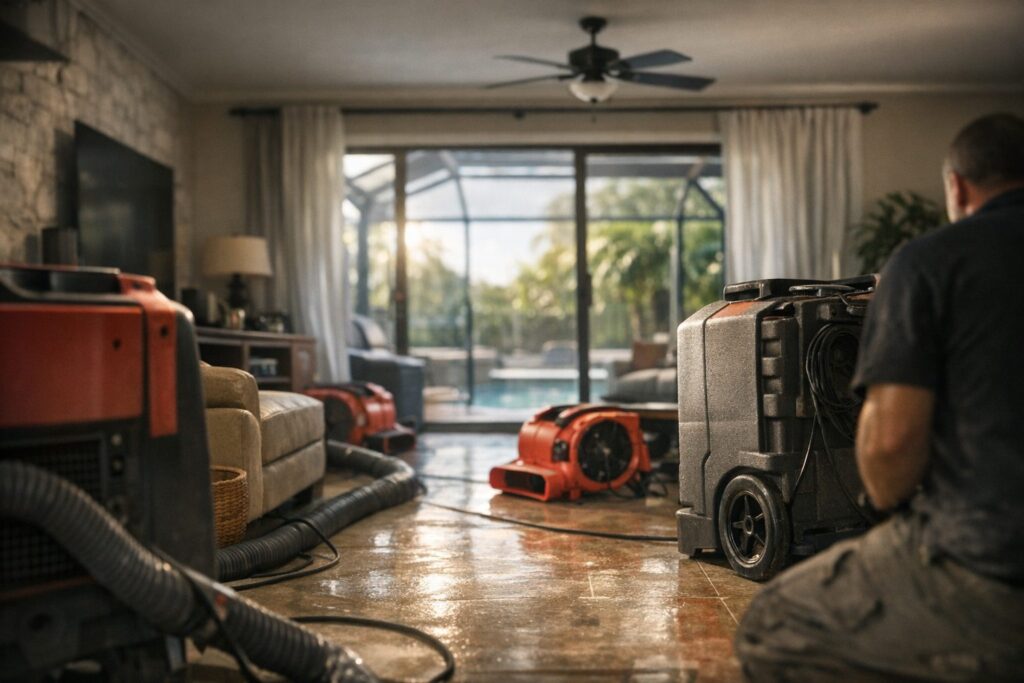
High-velocity air movers create airflow across wet surfaces, accelerating the rate of evaporation. The moving air carries moisture away from the surface of wet materials and into the surrounding air, where dehumidifiers capture it. Proper air mover placement is a science. The goal is to create a “drying chamber” effect where every wet surface receives directed airflow.
Why Opening Windows Does Not Work in Florida
This is worth emphasizing because it is the most common mistake homeowners make. In many parts of the country, opening windows and running fans can help dry a building. In Florida, it usually makes things worse. Here is why:
- Outdoor dew point: Florida’s outdoor dew point frequently exceeds 70 degrees, meaning outdoor air is carrying a tremendous amount of moisture. Introducing that air into a building adds moisture rather than removing it.
- No vapor pressure differential: Drying requires the air surrounding wet materials to be drier than the materials themselves. When outdoor humidity matches or exceeds the moisture content of wet building materials, no drying occurs.
- Condensation risk: If cooler surfaces exist inside the building (cold water pipes, slab floors, metal framing), introducing warm humid outdoor air causes condensation on those surfaces, creating new wet spots.
Professional restoration creates a sealed, controlled environment where humidity is mechanically reduced and maintained at levels that promote efficient drying.
How Climate Control Prevents Mold During Restoration
Mold requires three things to grow: moisture, a food source (organic materials like wood, drywall paper, carpet), and temperatures between 60 and 80 degrees. In a damaged Florida building, two of those three conditions are always present. The only variable you can control is moisture.
By maintaining relative humidity below 60 percent through mechanical dehumidification, you eliminate the moisture condition that mold needs to colonize. This is why IICRC S520 standards require environmental controls during mold remediation and why every professional restoration project should include climate management from day one.
Equipment Used for Temporary Climate Control
Professional restoration companies deploy a range of equipment depending on the size and nature of the project:
| Equipment | Capacity | Typical Use |
|---|---|---|
| LGR Dehumidifier | Removes 15-30 gallons/day | Residential rooms, standard drying |
| Desiccant Dehumidifier | Removes 20-60 gallons/day | Deep drying, specialty materials, large spaces |
| Axial Air Mover | 2,500-3,500 CFM | Surface drying, general air circulation |
| Centrifugal Air Mover | 1,000-1,500 CFM focused | Directed drying of walls, cabinets, tight spaces |
| Portable AC Unit | 1-5 ton cooling | Temperature control when HVAC is offline |
| HEPA Air Scrubber | 500-2,000 CFM filtered | Air quality management, mold spore capture |
The Cost of Skipping Climate Control
Need restoration help in Southwest Florida right now? WrightWay is on site in under 2 hours from three Florida offices, and we answer with a live human.
Some restoration companies and property owners try to cut costs by reducing the amount of drying equipment or shortening the drying period. In Florida, this false economy almost always backfires:
- Extended drying times: Without adequate dehumidification, drying that should take 3 to 5 days stretches to 7 to 14 days, increasing equipment rental costs and labor
- Mold development: Insufficient climate control allows mold to develop during the drying period, adding remediation costs of $5,000 to $25,000 or more
- Material failure: Materials that do not dry properly may appear dry on the surface but retain moisture internally, leading to warping, buckling, delamination, or mold months after the restoration is “complete”
- Failed clearance testing: If post-restoration moisture testing reveals materials are not at dry standard, the drying process must be extended or restarted
How WrightWay Manages Climate Control
At WrightWay Emergency Services, climate control is integrated into every restoration project from the initial response. Our approach includes:
- Psychrometric analysis: We calculate the specific drying requirements based on the volume of the affected space, the types and amounts of wet materials, and current environmental conditions
- Equipment sizing: Based on the analysis, we deploy the right number and type of dehumidifiers and air movers, not a one-size-fits-all approach
- Daily monitoring: Technicians take moisture readings and environmental measurements every day, adjusting equipment placement and settings as conditions change
- Containment when needed: For large buildings or multi-story losses, we create containment zones to focus drying resources where they are needed most
- Documentation: Every reading, adjustment, and decision is logged and becomes part of the project record for insurance purposes
Questions About Your Restoration? Call Us
Whether you are in the middle of a restoration project and concerned about drying progress, or you need emergency water cleanup and want to make sure it is done right from the start, WrightWay is here to help. We serve homeowners and businesses across Sarasota, Fort Myers, Naples, and all of SW Florida.
Call (941) 379-8669 to speak with our team. Proper climate control is the difference between a restoration done right and a restoration you have to do twice.
WrightWay handles every restoration job from emergency response through licensed reconstruction.
One IICRC-certified team, one project manager, one phone call. Available 24/7 across Sarasota, Manatee, Charlotte, Lee, and Collier counties.
Add us as a preferred source and our storm updates, claim guides and restoration answers show up higher when you search.


