Vinyl Plank Is Waterproof — But Your Subfloor Is Not
Luxury vinyl plank (LVP) flooring has become the most popular flooring choice in Florida homes, and for good reason: it looks like hardwood, handles foot traffic well, and the material itself is completely waterproof. This waterproof marketing has led many homeowners to believe their floors are immune to water damage. They are not.
The vinyl planks themselves will not absorb water, warp, or deteriorate when wet. But the subfloor beneath them — whether it is plywood, OSB (oriented strand board), or concrete — absolutely will. And because vinyl plank creates a near-impermeable barrier on top, water that gets underneath becomes trapped in the worst possible way: sealed in a dark, warm space with no airflow, sitting directly on organic material. In Florida’s climate, this is a recipe for rapid mold growth and subfloor deterioration.
How Water Gets Under Vinyl Plank Flooring
If the planks are waterproof, how does water get underneath? Several common pathways:
- Seams between planks: Click-lock vinyl plank joints are tight but not watertight. During a flood, standing water seeps through the seams by capillary action and gravity, pooling on the underlayment and subfloor beneath.
- Edges at walls and transitions: The expansion gap between vinyl plank and the wall (covered by baseboards) provides a direct path for water to flow under the floor from the edges, especially during significant flooding.
- Subfloor moisture from below: On concrete slabs without a proper moisture barrier, groundwater and humidity migrate upward through the concrete and condense under the vinyl. This is especially common in older Florida homes without modern vapor barriers.
- Plumbing leaks beneath the floor: A slab leak or a drain line failure introduces water under the flooring from below, bypassing the vinyl surface entirely.
- Appliance leaks: Slow leaks from dishwashers, refrigerator lines, or washing machines seep under the vinyl at the appliance footprint and spread outward for weeks before being detected.
Warning Signs of Water Under Vinyl Plank
Because the vinyl surface looks perfectly fine, you need to watch for indirect signs:
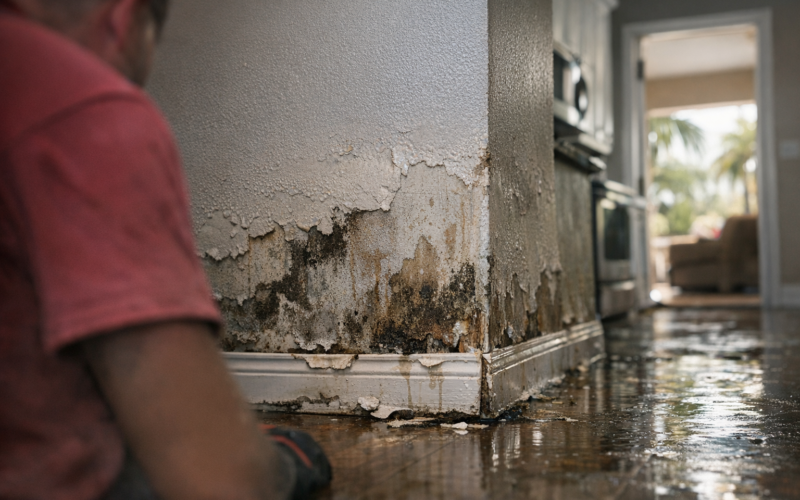
- Musty or moldy odor: The trapped moisture creates ideal mold conditions. A musty smell near the floor, particularly in corners or near appliances, is a red flag.
- Planks feeling soft or spongy when walked on: If the subfloor beneath has absorbed water and begun to swell or deteriorate, you will feel a slight give or sponginess underfoot that was not there before.
- Planks popping or clicking: Water-swollen subfloor material pushes up on the vinyl, causing planks to lose their flat profile. You may hear clicking or see slight lifting at plank edges.
- Visible moisture at seams or edges: During or after a water event, moisture may be visible between plank seams or seeping out from under baseboards.
- Discoloration or dark spots visible through the vinyl: Some lighter-colored vinyl planks may show darkened areas where mold or moisture is present on the subfloor beneath.
- Baseboards showing moisture damage: Swollen, warped, or stained baseboards indicate water has been present at the floor level, and if it reached the baseboards, it is almost certainly under the vinyl as well.
Can the Vinyl Plank Flooring Be Saved?
This is the question every homeowner asks, and the answer depends on several factors:
The Vinyl Planks Themselves: Usually Yes
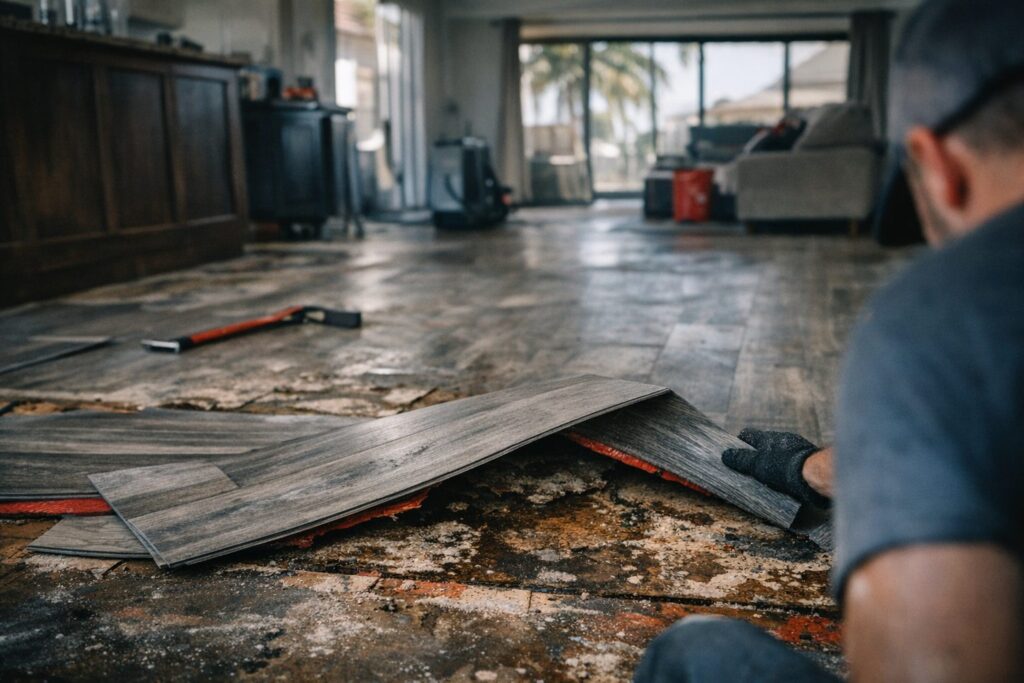
Because the planks are waterproof, they are not damaged by water exposure. If removed carefully, cleaned, dried, and reinstalled, most vinyl plank flooring can be reused. The key word is “carefully” — click-lock planks need to be disassembled in order (starting from the last row installed) to avoid breaking the locking mechanisms.
The Underlayment: Usually No
Most vinyl plank installations include a thin foam or cork underlayment. This porous material absorbs water and becomes a mold host. In nearly all cases, wet underlayment must be removed and replaced.
The Subfloor: It Depends
- Concrete slab: Concrete can be dried and treated with antimicrobials. It is porous and absorbs significant moisture, but professional structural drying with commercial dehumidifiers can bring it back to acceptable moisture levels. Concrete subfloors are almost always salvageable.
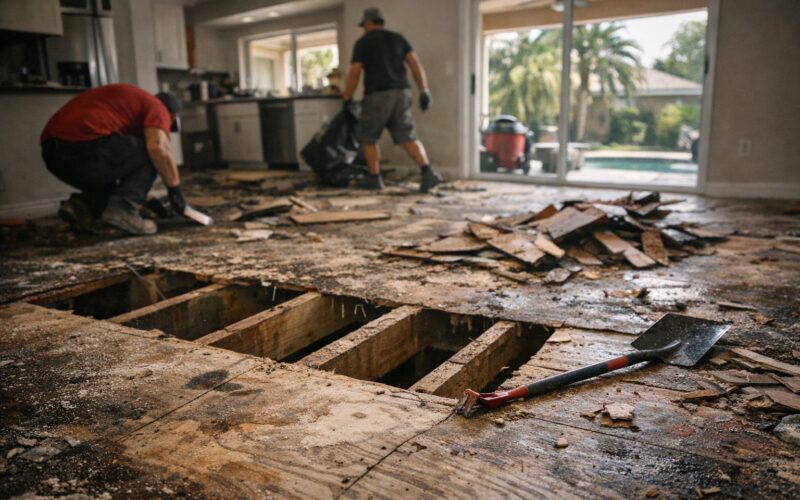
- Plywood subfloor: If the plywood has been wet for less than 48 to 72 hours, professional drying can typically save it. If it has been wet longer, or if mold is visible on the surface, the affected sections may need to be cut out and replaced.
- OSB subfloor: OSB is more vulnerable to water than plywood. It swells quickly when wet, and the swelling is often permanent — the board does not return to its original dimensions when dried. OSB that has visibly swollen will likely need replacement.
The Professional Restoration Process
If water reached walls, flooring seams, or sat overnight, fans alone rarely save the materials. A free moisture inspection tells you exactly what is wet and what it costs to fix.
When WrightWay Emergency Services responds to water damage under vinyl plank flooring, the process typically involves:
- Moisture assessment: Non-penetrating meters and thermal imaging determine the extent of moisture under the flooring without removing it first. This tells us exactly how much floor needs to be addressed.
- Targeted vinyl removal: Planks are carefully removed in the affected area, starting from the nearest wall and working inward. Planks are numbered and stacked for potential reinstallation.
- Underlayment removal: Wet underlayment is removed and discarded.
- Subfloor drying: Commercial air movers and dehumidifiers dry the exposed subfloor. For concrete slabs, this typically takes 3 to 5 days. For plywood, 2 to 4 days. Daily moisture readings confirm progress.
- Antimicrobial treatment: The subfloor is treated with EPA-registered antimicrobial to eliminate mold spores and prevent growth.
- Mold assessment: If the moisture was present for an extended period, mold testing confirms whether remediation is needed before new flooring is installed.
- Reinstallation: New underlayment is installed, and the vinyl planks — original or replacement — are reinstalled. If the original planks are discontinued or damaged during removal, our reconstruction team sources matching material.
Prevention Tips for Vinyl Plank Floors
- Clean up spills immediately. While the surface is waterproof, prolonged standing water finds seams.
- Install water sensors near appliances (dishwasher, washing machine, refrigerator) that sit on vinyl flooring.
- Use a moisture barrier underlayment on concrete slabs. Products with built-in vapor barriers prevent moisture migration from below.
- Maintain caulk and transitions. Seal the expansion gap in wet areas (kitchens, bathrooms) with flexible caulk to reduce water entry points.
- Check under appliances periodically. Pull out the refrigerator and check behind the washing machine at least once a year. Slow leaks under appliances sitting on vinyl are the most common hidden threat.
Water Under Your Vinyl Floors? Act Fast
The longer water sits trapped under vinyl plank flooring, the more likely you are to lose the subfloor to mold and rot. In Florida’s warm, humid conditions, mold can establish under sealed vinyl in as little as 24 to 48 hours.
Call WrightWay Emergency Services at (941) 379-8669 for professional moisture assessment and restoration. We serve Sarasota, Bradenton, Fort Myers, Cape Coral, Naples, and all of Southwest Florida — 24/7.
WrightWay handles every restoration job from emergency response through licensed reconstruction.
One IICRC-certified team, one project manager, one phone call. Available 24/7 across Sarasota, Manatee, Charlotte, Lee, and Collier counties.