Why 60% Humidity Is the Magic Number
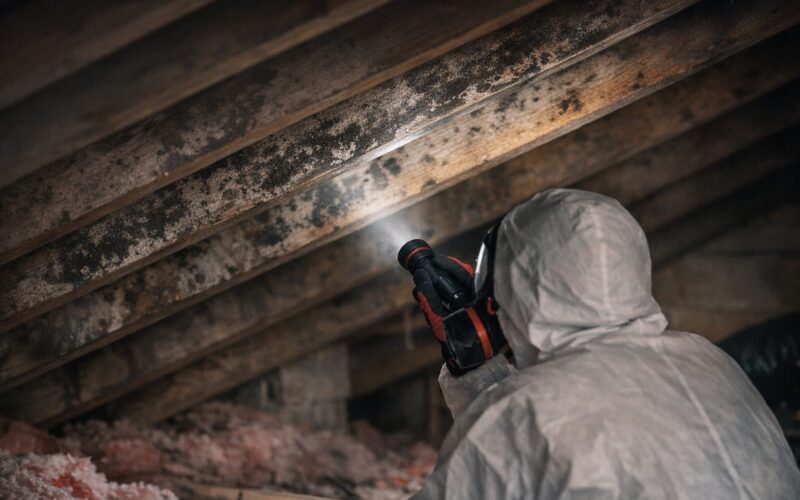
Mold requires moisture to grow, and in Florida’s subtropical climate, that moisture is everywhere. The single most effective strategy for preventing mold in your home is maintaining indoor relative humidity below 60 percent — and ideally between 45 and 55 percent. Above 60 percent, mold spores that are naturally present in every home begin to germinate and grow on virtually any organic surface: drywall paper, wood, carpet, fabric, dust, and even paint.
The challenge for Florida homeowners is that outdoor humidity regularly exceeds 80 to 90 percent, and that moisture constantly tries to work its way into your home through every opening, gap, and permeable surface. Keeping indoor humidity controlled requires a deliberate strategy that combines your HVAC system, supplemental equipment, and smart habits.
Understanding Humidity in Florida Homes
Before diving into solutions, it helps to understand how moisture enters and behaves in a Florida home.
How Moisture Gets In
- Air infiltration: Every time a door or window opens, humid outdoor air rushes in. Gaps around windows, doors, pipes, and electrical penetrations allow continuous air exchange.
- Slab moisture: In slab-on-grade construction (standard in Florida), moisture migrates through the concrete from the soil below, especially after heavy rains.
- Cooking, bathing, and breathing: A family of four generates 2 to 3 gallons of water vapor per day through normal activities.
- Laundry: Dryers that vent improperly or are not vented at all release significant moisture indoors.
- Vapor drive: In summer, the hot, humid outdoor air pushes moisture through exterior walls toward the cooler, drier interior.
Why Florida’s Climate Is Uniquely Challenging
Unlike northern states where heating season dries out indoor air (creating the opposite problem), Florida homes need active dehumidification year-round. Even during our “cooler” months (December through February), outdoor humidity in Southwest Florida frequently exceeds 70 percent. The mild winter temperatures mean the AC runs less, which means less dehumidification is occurring — a period when many homes actually experience their worst humidity problems.
Your AC System: The Primary Dehumidifier
Your air conditioning system is your first line of defense against indoor humidity. When the AC runs, warm humid air passes over the cold evaporator coil, and moisture condenses out of the air and drains away. A properly functioning AC system can remove 5 to 20 gallons of water from your indoor air per day.
Optimizing Your AC for Humidity Control
- Set the thermostat to 76-78 degrees in summer. Lower settings increase dehumidification but also increase energy costs. The key is to keep the system running long enough to pull moisture out of the air.
- Use the AUTO fan setting, not ON. When the fan is set to ON, it runs continuously — even when the compressor is off. This blows un-dehumidified air through the house and re-evaporates moisture from the wet evaporator coil back into your air. AUTO ensures the fan only runs during cooling cycles.
- Never turn off the AC entirely. When leaving for vacation or extended periods, set the thermostat to 78-80 degrees rather than turning it off. A home without AC in Florida will reach dangerous humidity levels within 24-48 hours.
- Ensure proper system sizing. An oversized AC unit short-cycles — it cools the air quickly but shuts off before running long enough to adequately dehumidify. If your home feels clammy even when the AC is running, oversizing may be the issue.
- Maintain the system. Dirty coils, clogged filters, and low refrigerant all reduce dehumidification capacity. Schedule biannual maintenance.
When Your AC Is Not Enough: Supplemental Dehumidification
In many Florida homes, the AC alone cannot maintain humidity below 60 percent year-round, especially during:
- Mild winter months when the AC runs infrequently
- Rainy season (June through October) when outdoor humidity peaks
- Periods when doors are opened frequently
- Homes with older, less efficient HVAC systems
- Homes with significant air infiltration (older construction, poor sealing)
Whole-House Dehumidifiers
A whole-house dehumidifier integrates with your HVAC system and treats all the air in your home. It operates independently of the AC, so it dehumidifies even when the thermostat is not calling for cooling. For Florida homes, this is the most effective supplemental solution.
- Capacity: 70 to 130 pints per day for most residential units
- Installation: Connected to the HVAC ductwork by an HVAC technician
- Cost: $1,500 to $3,000 installed, depending on capacity and configuration
- Benefit: Set-and-forget humidity control that maintains your target level regardless of AC cycling
Portable Dehumidifiers
Portable units work well for targeted applications — a problem room, closet, garage, or enclosed area. They are less effective than whole-house systems for managing humidity across an entire home but can be a useful supplement.
- Place units in areas with the highest humidity (bathrooms, laundry rooms, enclosed spaces)
- Empty the collection tank regularly or connect a continuous drain hose
- Clean the filter monthly to maintain efficiency
- Choose a unit rated for the room size — undersized units run continuously without reaching the target
Room-by-Room Humidity Management
Licensed mold remediation with containment, HEPA filtration, and clearance-ready documentation. Get a real price range before anyone starts cutting drywall.
Some areas of your home are more vulnerable to humidity problems than others. Targeted strategies for each can make a significant difference.
Bathrooms
- Run the exhaust fan during every shower and for 20-30 minutes after
- Verify the exhaust fan vents to the outdoors, not into the attic
- Consider upgrading to a humidity-sensing fan that runs automatically when moisture levels rise
- Squeegee shower walls after use to reduce evaporation moisture
Kitchen
- Use the range hood exhaust fan when cooking, especially when boiling water
- Run the dishwasher’s full dry cycle rather than opening the door to air-dry
- Fix any slow drips under the sink promptly
Closets and Cabinets
- Leave closet doors slightly open to allow air circulation from the HVAC system
- Use moisture-absorbing products (calcium chloride, silica gel) in enclosed spaces
- Do not pack closets so tightly that air cannot circulate around contents
- Install a small fan or vent in closets on exterior walls
Garage
- If your garage is attached and insulated, consider extending HVAC to the space or using a portable dehumidifier
- Seal the door between the garage and the house to prevent humid garage air from entering living spaces
- Avoid storing cardboard boxes directly on the concrete floor — use plastic bins on shelves
Building Envelope Improvements
Reducing the amount of moisture that enters your home in the first place makes humidity control easier and more energy-efficient.
- Seal air leaks around windows, doors, plumbing penetrations, and electrical outlets on exterior walls
- Ensure proper attic insulation to reduce condensation on ceiling surfaces
- Verify dryer vent integrity — a disconnected or damaged dryer vent dumps moisture directly into the home or wall cavity
- Inspect weather stripping on all exterior doors and replace when worn
- Check window seals for gaps or failed glazing seals
Monitoring Your Indoor Humidity
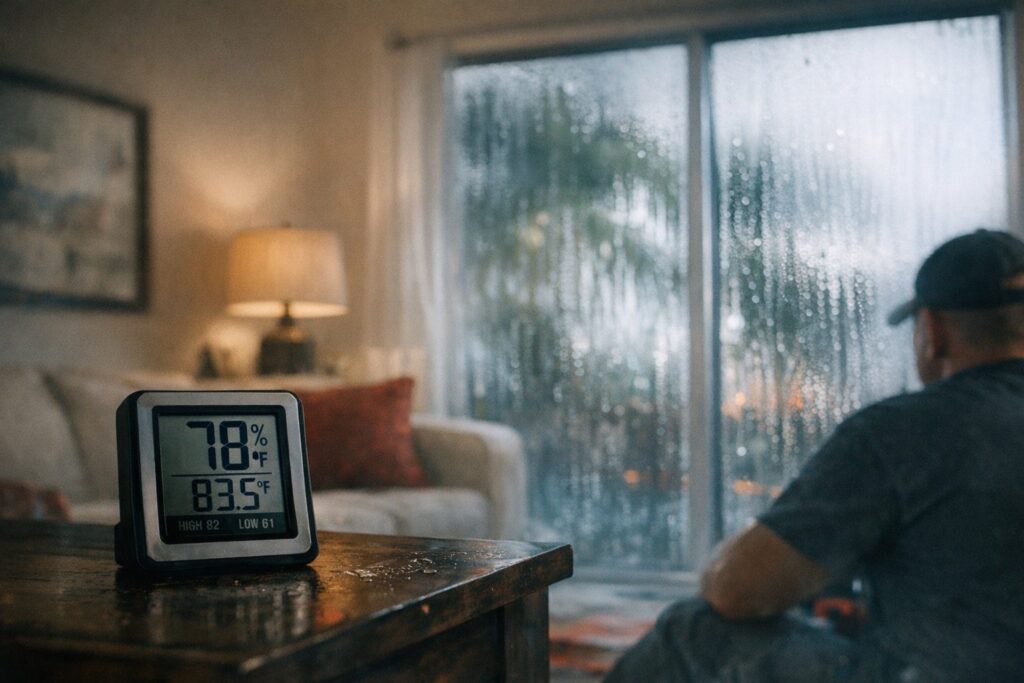
You cannot manage what you do not measure. Invest in one or more digital hygrometers to monitor indoor humidity levels in real time.
- Place hygrometers in the main living area, the master bedroom, and any problem areas
- Check readings at different times of day — humidity often rises overnight when the AC runs less
- If readings consistently exceed 60 percent, take action with the strategies outlined above
- Smart hygrometers with phone alerts can notify you of humidity spikes when you are away from home
Need Help? Call WrightWay
If your Florida home has persistent humidity problems that you cannot resolve with AC adjustments and basic strategies, or if high humidity has already led to mold growth, WrightWay Emergency Services can help. We provide mold testing, remediation, and guidance on humidity control solutions for homeowners across Sarasota, Fort Myers, Naples, and all of Southwest Florida.
Call us at (941) 379-8669 to discuss your humidity concerns or schedule a mold inspection. Controlling moisture is the best investment you can make to protect your Florida home.
WrightWay handles every restoration job from emergency response through licensed reconstruction.
One IICRC-certified team, one project manager, one phone call. Available 24/7 across Sarasota, Manatee, Charlotte, Lee, and Collier counties.
Add us as a preferred source and our storm updates, claim guides and restoration answers show up higher when you search.