

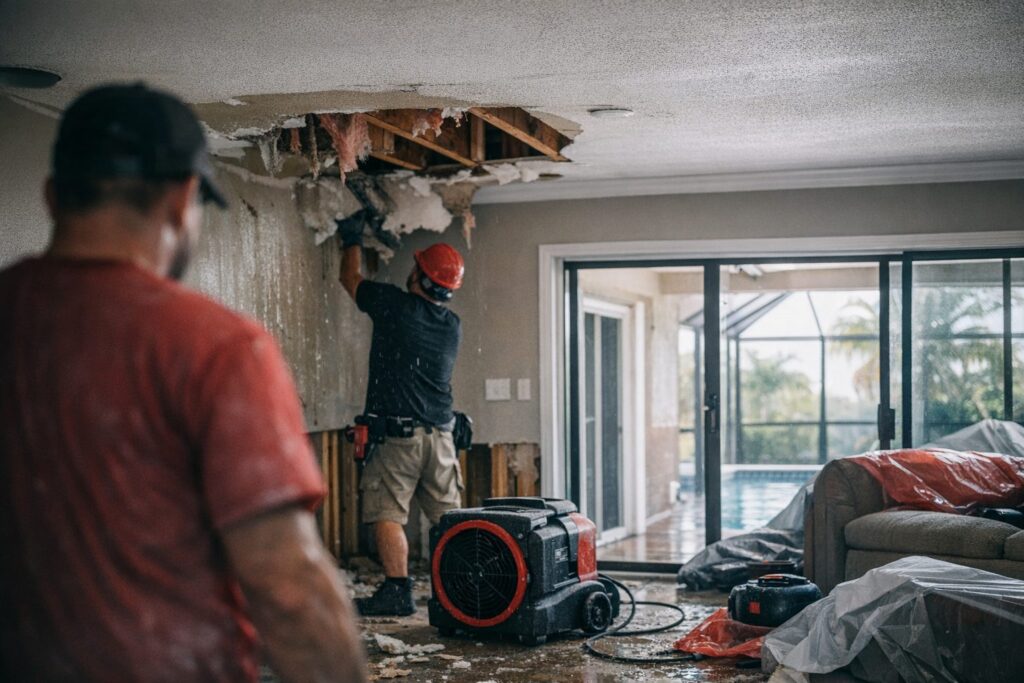
Why Water Category Matters More Than Water Volume
When homeowners discover water damage, the first thing they focus on is how much water is in their home. And while volume certainly matters, the factor that has the biggest impact on your restoration cost, the scope of work required, and the health risks to your family is something most people never think about: the category of the water.
The Institute of Inspection, Cleaning and Restoration Certification (IICRC) — the governing body that sets standards for the restoration industry — classifies water damage into three categories based on the level of contamination. Each category requires different safety protocols, equipment, demolition standards, and treatment methods. Understanding these categories helps you understand your restoration estimate and why two floods of similar size can have dramatically different price tags.
Category 1: Clean Water
Definition: Water from a sanitary source that poses no significant health risk from contact or ingestion.
Common Sources
- Burst supply line (hot or cold water pipe)
- Water heater tank failure (if the water is from the supply, not backflow)
- Rainwater through a roof leak (with no contact with insulation or other contaminants)
- Toilet tank overflow (tank water only, not bowl water)
- Ice maker supply line failure
- Faucet or fixture malfunction
Restoration Approach
Category 1 is the most straightforward and least expensive to restore. Because the water is clean, many materials can be dried in place rather than removed:
- Carpet and pad can often be dried in place if extraction begins within 24 to 48 hours
- Drywall can sometimes be dried without removal if caught early and moisture is limited to the lower 12 to 18 inches
- Hardwood floors are candidates for in-place drying with specialty mat systems
- Standard antimicrobial treatment is applied as a preventive measure
Typical Cost Range (Florida)
$1,500 to $5,000 for a single-room event with 3 to 5 days of drying. Multi-room events: $3,000 to $10,000+.
Important Caveat: Category 1 Does Not Stay Category 1
This is a critical point that catches many homeowners off guard. Clean water that sits for more than 48 hours in Florida’s warm temperatures will degrade to Category 2 as bacteria, fungi, and other microorganisms colonize the stagnant water and saturated materials. After 72 hours, especially in summer, it can reach Category 3. This is why emergency response time matters so much — the same broken pipe that costs $2,000 to mitigate on day one can cost $8,000 to mitigate on day three because the water category has changed.
Category 2: Gray Water
Definition: Water that contains significant levels of chemical, biological, or physical contaminants that can cause illness or discomfort if contacted or ingested.
Common Sources
- Washing machine discharge or overflow
- Dishwasher discharge
- Toilet overflow with urine (no feces)
- Aquarium or waterbed failure
- Sump pump discharge
- AC condensate overflow (depending on how long it has been stagnant)
- Category 1 water that has been standing for 48+ hours
Restoration Approach
Category 2 requires more aggressive demolition and treatment than Category 1:
- Carpet pad must be discarded and replaced (it cannot be effectively decontaminated). Carpet itself may be salvageable if cleaned and treated with antimicrobials.
- Drywall in contact with gray water is typically removed to at least 12 inches above the waterline — standard practice is a 2-foot flood cut.
- All affected porous materials (insulation, particleboard, some types of padding) are removed and replaced.
- Enhanced antimicrobial treatment is applied to all exposed surfaces.
- Personal protective equipment (PPE) requirements increase for restoration workers.
Typical Cost Range (Florida)
$3,000 to $10,000 for a single-room event. Multi-room: $7,000 to $20,000+. The increased cost comes from greater demolition scope, more materials requiring replacement, enhanced antimicrobial treatment, and additional safety protocols.
Category 3: Black Water
Definition: Water that is grossly contaminated with pathogenic, toxigenic, or other harmful agents and can cause serious illness or death if ingested or contacted.
Common Sources
- Sewage backup or overflow (the most common Category 3 source in residential settings)
- Storm surge and floodwater (classified as Category 3 regardless of appearance because it contacts soil, chemicals, and sewage systems)
- Rising groundwater containing sewage
- Water from rivers, streams, or standing outdoor water
- Category 1 or 2 water that has been standing for 72+ hours in warm conditions
Restoration Approach
Category 3 is the most aggressive, most expensive, and most hazardous restoration scenario:
- All porous materials contacted by the water must be removed. This includes carpet, pad, drywall (typically removed 2 to 4 feet above the waterline), insulation, baseboards, and any other absorbent material. There is no option to dry in place.
- Hard, non-porous surfaces (concrete, metal, sealed tile) can be decontaminated with biocide treatment but must be cleaned thoroughly.
- Contents contacted by black water are often total losses. Upholstered furniture, mattresses, pillows, and similar items cannot be adequately decontaminated.
- Full PPE required — Tyvek suits, respirators, gloves, eye protection. Work areas are contained with negative air pressure to prevent cross-contamination.
- Post-cleaning verification — ATP testing or other biological testing confirms surfaces are decontaminated before reconstruction begins.
Typical Cost Range (Florida)
$7,000 to $25,000+ for mitigation alone. Complete restoration including reconstruction can reach $30,000 to $75,000+ for significant events. The cost increase over Category 1 comes from mandatory material removal, biohazard safety protocols, enhanced PPE, decontamination procedures, and higher disposal costs for contaminated materials.
Cost Comparison Summary
Need restoration help in Southwest Florida right now? WrightWay dispatches in 60 to 90 minutes from three Florida offices, and we answer with a live human.
| Factor | Category 1 | Category 2 | Category 3 |
|---|---|---|---|
| Carpet pad | Dry in place (usually) | Remove and replace | Remove and replace |
| Carpet | Dry in place (usually) | Clean, treat, or replace | Remove and replace |
| Drywall | Dry in place (often) | Remove 2 ft above waterline | Remove 2-4 ft above waterline |
| Insulation | Dry in place (sometimes) | Remove and replace | Remove and replace |
| Antimicrobial treatment | Standard (preventive) | Enhanced | Biocide + verification |
| PPE level | Basic | Moderate | Full biohazard |
| Average cost multiplier | 1x (baseline) | 2 to 3x | 4 to 7x |
How Water Category Affects Your Insurance Claim
Insurance adjusters and restoration companies use the same IICRC category system. Your insurance claim documentation will include the water category determination, which directly justifies the scope of work and cost. If a restoration company removes drywall and carpet for a Category 1 event that could have been dried in place, the insurer may push back. Conversely, if Category 3 protocols are not followed for a sewage backup, the insurer — and your family’s health — are at risk.
This is one of the most important reasons to work with a certified, reputable restoration company that follows IICRC standards and documents the water category properly.
The Bottom Line: Speed Determines Category, Category Determines Cost
The single most impactful thing you can do to control restoration costs is respond fast. A clean-water pipe burst mitigated within hours stays Category 1 and costs the least. The same event discovered three days later becomes Category 2 or 3 and costs three to five times more.
WrightWay Emergency Services responds 24/7 across Sarasota, Bradenton, Fort Myers, Cape Coral, Naples, and all of Southwest Florida. Call (941) 379-8669 the moment you discover water. The faster we arrive, the lower the category stays, the less we have to remove, and the less the entire project costs.
WrightWay handles every restoration job from emergency response through licensed reconstruction.
One IICRC-certified team, one project manager, one phone call. Available 24/7 across Sarasota, Manatee, Charlotte, Lee, and Collier counties.


