The Two Words That Decide Your Water Damage Claim
If you file a water damage insurance claim in Florida, there are two words that will likely determine whether your claim is approved or denied: sudden and accidental. This phrase appears throughout standard homeowners insurance policies and serves as the dividing line between damage your insurer will cover and damage they will not.
Understanding what “sudden and accidental” actually means, how insurance companies interpret it, and how to position your claim around it can be the difference between a fully covered restoration and an expensive out-of-pocket repair.
Where “Sudden and Accidental” Appears in Your Policy
Most Florida homeowners policies do not cover water damage as a blanket peril. Instead, they cover water damage that results from a sudden and accidental event. You will find this language in several places:
- Covered perils section: Lists events that trigger coverage, many of which require the damage to be sudden and accidental
- Water damage exclusion with exception: The policy may exclude water damage broadly, then add back coverage for water damage that is sudden and accidental
- Plumbing endorsements: Additional coverage for plumbing failures, limited to sudden and accidental discharge
What “Sudden” Really Means
The word “sudden” has been the subject of extensive legal debate in Florida courts. Insurers and policyholders often disagree on its definition:
The Insurance Company’s Interpretation
Insurance companies typically argue that “sudden” means abrupt, happening without warning, and taking place over a very short period. Under this interpretation, a pipe that bursts in an instant is sudden, but a pipe that develops a slow leak over weeks or months is not.
The Policyholder’s Interpretation
Policyholders and their attorneys often argue that “sudden” can also mean unexpected or unforeseen, regardless of the timeframe. Under this interpretation, even a slow leak that was unknown to the homeowner could qualify as sudden because its discovery was unexpected.
How Florida Courts Have Ruled
Florida courts have generally sided with a temporal interpretation of “sudden,” requiring the event to occur quickly rather than gradually. However, the specific facts of each case matter. Courts consider:
- How quickly the damaging event developed
- Whether the homeowner knew or should have known about the problem
- Whether the damage was caused by a specific, identifiable event
- The specific policy language at issue
What “Accidental” Really Means
“Accidental” is generally more straightforward. It means the damage was not intentional, not expected, and not the natural result of normal wear and tear. The key distinctions:
| Accidental (Typically Covered) | Not Accidental (Typically Excluded) |
|---|---|
| A supply line fails unexpectedly | A known dripping faucet finally causes rot |
| A washing machine hose bursts during a cycle | A corroded pipe you were warned about finally gives way |
| A water heater tank ruptures without warning | Damage from a roof you knew needed replacement |
| Wind drives rain through storm damage | Rain enters through cracks you have been meaning to seal |
| A toilet supply valve fails | Chronic condensation damage you ignored |
Common Water Damage Scenarios: Covered or Not?
Here is how “sudden and accidental” applies to real-world situations Florida homeowners encounter:
Typically Covered
- Burst pipe: A supply line or fitting fails without warning, flooding the home. This is the textbook sudden and accidental event.
- Appliance malfunction: A washing machine, dishwasher, or water heater fails and discharges water. If the failure was unexpected, it qualifies.
- Accidental overflow: A bathtub or sink overflows because someone forgot to turn off the faucet. The overflow itself is the sudden event.
- Storm-driven rain: Wind damages the roof or walls, and rain enters through the new opening. The wind damage is sudden and accidental.
Typically Not Covered
- Slow, hidden leaks: A supply line under the bathroom vanity has been dripping for months, causing rot and mold. This is gradual, not sudden.
- Seepage: Groundwater slowly entering through the foundation is not sudden or accidental.
- Condensation damage: Long-term moisture accumulation from HVAC issues or poor ventilation is gradual.
- Deferred maintenance: Damage resulting from failure to maintain plumbing, roofing, or appliances is not accidental because it was foreseeable.
How to Strengthen Your “Sudden and Accidental” Claim
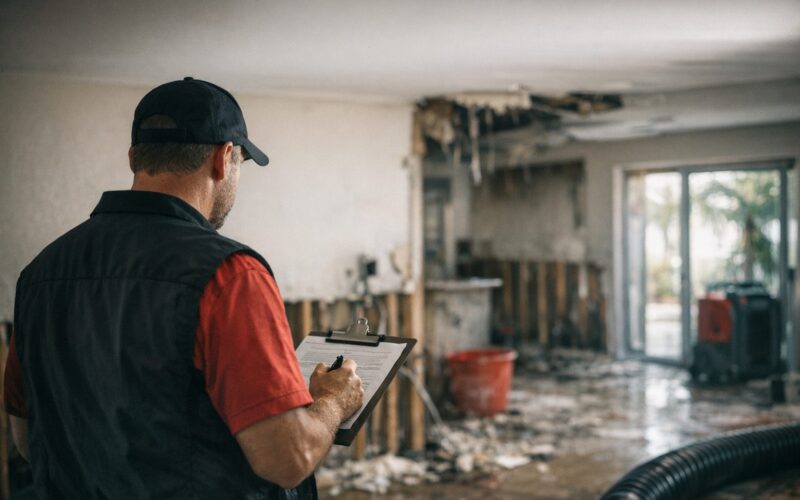
WrightWay documents every loss to insurance standards, photos, moisture logs, and itemized scopes your adjuster can approve without back-and-forth.
If you are filing a water damage claim, these steps help demonstrate that the event meets the sudden and accidental standard:
- Document the source immediately. Photograph the failed pipe, burst fitting, or malfunctioning appliance before any repairs are made. The physical evidence tells the story of what happened.
- Preserve the failed component. If a supply line burst, keep the damaged section. Physical evidence of the failure supports your claim.
- Act quickly. Reporting the damage promptly and beginning emergency mitigation immediately reinforces that the event was unexpected. Delays suggest you may have known about the problem before it became catastrophic.
- Maintain your home. Regular maintenance records, plumbing inspections, and appliance service history demonstrate that you took reasonable care of your property. This undermines any argument that the damage resulted from neglect.
- Get a professional assessment. A licensed plumber or restoration professional can inspect the failed component and provide an opinion on whether the failure was sudden or gradual. This expert opinion carries significant weight in disputes.
What If Your Insurer Says It Was Not Sudden and Accidental?
If your insurance company denies your claim on the grounds that the damage was not sudden and accidental, you have options:
- Request the denial in writing with specific policy language cited
- Obtain an independent plumbing or engineering assessment that addresses the cause and timing of the failure
- Provide your restoration company’s documentation showing the nature of the damage is consistent with a sudden event
- File a complaint with the Florida Department of Financial Services if you believe the denial is in bad faith
- Consult a property insurance attorney who can evaluate whether the denial has merit under Florida law
WrightWay Documents the Facts That Support Your Claim
When WrightWay Emergency Services responds to your water damage emergency, our technicians document the cause and origin of the damage as part of our standard process. We photograph the failed component, record the conditions we find, and create detailed reports that establish the timeline and nature of the event. This documentation helps demonstrate that the damage was sudden and accidental when that is in fact the case.
If you are dealing with water damage in Southwest Florida, call (941) 379-8669 for immediate response. We document the damage correctly from day one so your insurance claim is built on a solid foundation.
WrightWay handles every restoration job from emergency response through licensed reconstruction.
One IICRC-certified team, one project manager, one phone call. Available 24/7 across Sarasota, Manatee, Charlotte, Lee, and Collier counties.
Add us as a preferred source and our storm updates, claim guides and restoration answers show up higher when you search.