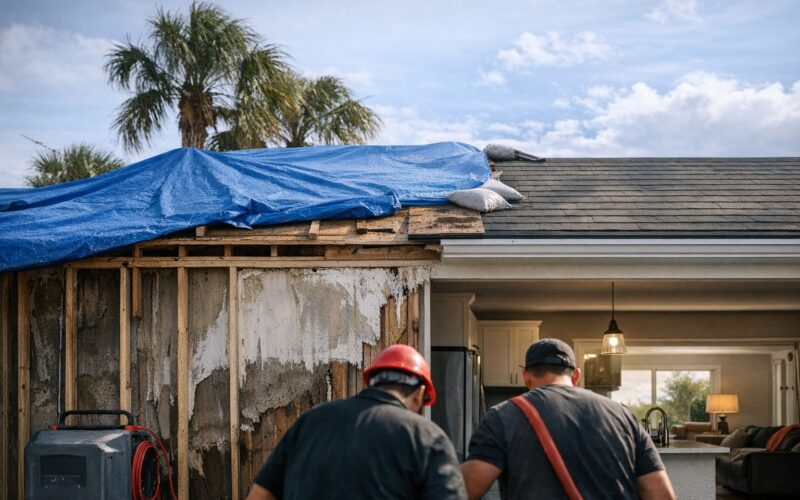
Naples Property Damage 2026: What Collier County Homeowners Need to Know This Hurricane Season
As we head into the 2026 hurricane season, homeowners and property managers in Naples, Marco Island, Bonita Springs, and the broader Collier County area need to be informed and prepared. Collier County has been struck repeatedly by major storms – Hurricane Ian in 2022, Irma in 2017, and Wilma in 2005 – and the damage totals tell the real story. Hurricane Ian caused an estimated $2.2 billion in property damage in Collier County alone, with more than 3,500 buildings suffering major damage. That figure is a reminder of what a single storm can do to one of Florida’s most valuable real estate markets.
2026 Atlantic Hurricane Season Forecast: What NOAA Is Saying
If you’ve seen alarming headlines about the 2026 season, it’s worth reading the official data carefully. NOAA’s official 2026 Atlantic hurricane season outlook forecasts a below-normal season, with a 55% probability of below-normal activity. The agency is projecting 8 to 14 named storms, of which 3 to 6 are expected to become hurricanes and 1 to 3 could reach major hurricane strength (Category 3 or higher).
The primary driver of reduced activity is El Nino. NOAA’s Climate Prediction Center notes a 98% probability of El Nino conditions during peak hurricane months (August through October), which typically increases upper-level wind shear over the Atlantic and suppresses tropical development. That said, “below-normal” does not mean “no storms.” Ian was a below-average season statistic – and it still devastated Southwest Florida. One landfalling major hurricane is all it takes.
High-Risk Zones in Collier County
Collier County’s geography makes it disproportionately vulnerable to storm surge and flooding. Collier County Emergency Management identifies Zone A and Zone B as the highest-priority evacuation areas, generally covering properties west of Airport Pulling Road and south of US-41 Tamiami Trail East. This includes:
- Marco Island – a barrier island with full exposure to Gulf storm surge from any southwest approach
- Coastal Naples – low-lying waterfront neighborhoods with direct surge exposure
- Everglades City and Goodland – extremely low elevation with limited egress
- Golden Gate Estates – inland flooding risk during heavy rainfall events
- Immokalee – agricultural area susceptible to prolonged flooding from slow-moving systems
You can look up your specific evacuation zone at Collier County’s online evacuation zone lookup tool. Know your zone before a storm watch is posted – not the night a mandatory evacuation order is issued.
Property Values and Why Restoration Matters More Than Ever
Collier County property values fell by approximately $13 billion in 2025 compared to the prior year, according to WGCU reporting on the Southwest Florida real estate market. The county still holds a cumulative assessed value exceeding $106 billion across more than 207,000 properties, making it one of Florida’s most significant real estate markets.
In a declining or flat market, storm damage hits equity especially hard. A home that suffers water intrusion or roof damage that goes unmitigated for even 48 to 72 hours can see costs escalate rapidly as mold sets in and structural materials degrade. Timely, professional restoration is not just about repairs – it is about protecting whatever equity remains in a softening market.
Peak Hurricane Season: August 15 Through October 15
The peak of the Atlantic hurricane season falls between August 15 and October 15, with September 10 historically the single most active date. Even with El Nino suppressing overall season activity, the Gulf of Mexico’s warm waters can intensify storms rapidly once they enter the basin. Property owners in Naples and throughout Collier County should treat the period from late July through mid-October as elevated-risk time.
Use the months before peak season to:
- Inspect your roof for loose or missing tiles, cracked flashing, and deteriorated sealant around penetrations
- Clear gutters and downspouts to direct water away from the foundation
- Photograph your property’s exterior and document interior contents with video for insurance purposes
- Confirm your hurricane impact windows and doors are properly sealed and hardware is functioning
- Know your flood insurance policy’s waiting period (typically 30 days from purchase before coverage activates)
Flood Insurance: A Separate Policy That Cannot Wait
Standard homeowners insurance does not cover flood damage. In Collier County, this distinction is critical because storm surge – not wind – was responsible for the most catastrophic property losses during Ian. The FEMA Flood Map Service Center allows you to look up your property’s flood zone designation, which determines whether flood insurance is required by your lender and what your base flood elevation is.
If you do not currently carry a National Flood Insurance Program (NFIP) policy, the 30-day waiting period means you cannot wait for a storm to be named before purchasing one. Homeowners in high-risk flood zones (Zone AE, Zone VE) should carry both NFIP coverage and a private flood policy if available to fill coverage gaps above NFIP’s limits.
Emergency Response Program (ERP): Pre-Loss Documentation That Saves You Time and Money
An Emergency Response Program is a pre-arranged plan between a property owner and a restoration contractor that is activated the moment damage occurs. For commercial properties and rental portfolios in Collier County, ERPs are increasingly standard practice. For individual homeowners, the same principles apply.
Your ERP documentation should include:
- A full photographic and video record of your property’s current condition, room by room
- A copy of your insurance declarations page and your insurer’s 24-hour claims line
- Documentation of any pre-existing conditions (roof age, prior repairs, window ratings)
- A written agreement with a licensed restoration contractor establishing priority response
- A utility shutoff guide and emergency contact list for family, neighbors, and your HOA if applicable
WrightWay Emergency Services can walk you through setting up an ERP at no cost. Call (941) 379-8669 before storm season peaks.
Insurance Coverage Checklist for Naples-Area Homeowners
- Wind coverage: Confirm your policy covers named storm wind damage. Citizens Property Insurance Corporation policyholders should verify their coverage limits have not been reduced at recent renewal.
- Flood policy: Standard homeowners insurance excludes flooding. Obtain an NFIP or private flood policy now, before the 30-day waiting period becomes a problem.
- Ordinance or law coverage: In older Naples neighborhoods subject to updated building codes, this coverage pays for the cost of bringing repairs up to current code – which can add tens of thousands of dollars to a restoration project.
- Loss of use: If you cannot occupy your home after a storm, this coverage pays for temporary housing during restoration.
- Documented replacement value: Make sure your policy reflects current replacement costs, not 2019 or 2021 values. Construction costs in SW Florida have increased significantly since Ian.
Collier County Building Codes and Licensed Contractors
After any declared emergency in Collier County, all permitted structural repair work must be performed by a licensed general contractor. Florida Statute requires contractors performing restoration work to hold a valid license. You can verify any Florida contractor’s license status through the Department of Business and Professional Regulation’s online lookup.
WrightWay Emergency Services holds general contractor license CBC1253650, is IICRC certified for water, fire, and mold restoration, and operates under proper insurance. When contractor demand surges after a regional storm event – as it did dramatically following Ian – homeowners with a pre-established relationship with a licensed contractor get prioritized scheduling. Those who call around after the fact often wait weeks.
Response Time from WrightWay’s Fort Myers Office to Naples
WrightWay’s Fort Myers office typically responds to emergencies in Naples within 45 to 60 minutes under normal conditions. Immediately following a storm with road closures or debris, our team coordinates closely with Collier County emergency management to stage resources as close to the impact area as safely possible. We are available 24 hours a day, 7 days a week at (941) 379-8669.
Marco Island Specific Considerations
Marco Island presents unique logistical challenges in storm recovery. As a barrier island accessible via a limited number of bridges, post-storm access can be restricted by Collier County Emergency Management until structural assessments are completed. Elevated building requirements apply throughout the island, and FEMA flood zone designations for most Marco Island properties require careful documentation of any storm surge intrusion.
Marco Island residents should plan for the possibility of delayed return access after a major storm and ensure their insurance policies address loss of use during restricted-access periods. Pre-storm documentation of your property’s interior is especially valuable when re-entry permits are required before residents can assess damage.
The Post-Ian Contractor Lesson: Pre-Arrange Before You Need It
Hurricane Ian’s aftermath produced a severe and prolonged contractor shortage throughout Lee and Collier Counties. Homeowners who had no prior relationship with a licensed restoration contractor found themselves on waiting lists stretching weeks. Unlicensed contractors flooded the market, and fraud cases involving upfront deposits for work never completed were widely reported by the Florida Attorney General’s office.
The lesson is straightforward: establish a relationship with a licensed contractor during the off-season. Ask for their license number, verify it, and save their emergency line. When the call matters, you won’t be searching from scratch.
For 24/7 emergency restoration across SW Florida, call WrightWay at (941) 379-8669.
Frequently Asked Questions
WrightWay documents every loss to insurance standards, photos, moisture logs, and itemized scopes your adjuster can approve without back-and-forth.
What should I include in my Emergency Response Program documentation?
Your ERP documentation should include a full photographic and video record of your property’s current condition, copies of your insurance declarations and your insurer’s 24-hour claims line, documentation of pre-existing conditions such as roof age and prior repairs, and a pre-arranged agreement with a licensed restoration contractor. This documentation is critical for expediting insurance claims and ensuring restoration begins without delay after a storm.
How can I ensure my insurance covers all potential hurricane damage?
Review your policy carefully to confirm wind coverage, and obtain a separate flood policy through NFIP or a private insurer before storm season – the 30-day waiting period means you cannot wait. Consider ordinance or law coverage if your home is in an older neighborhood subject to updated building codes. Verify that your policy’s replacement value reflects current SW Florida construction costs, which have risen substantially since 2022.
What are the building code requirements for post-storm repairs in Collier County?
Collier County requires that all permitted structural repair work be performed by a licensed general contractor. Verify your contractor holds a valid CBC license using the Florida DBPR online lookup before signing any contract. WrightWay Emergency Services holds license CBC1253650 and is available to assess and restore your property following storm damage.
How quickly can WrightWay respond to an emergency in Naples?
WrightWay’s Fort Myers office typically responds to emergencies in Naples within 45 to 60 minutes under normal road conditions. We operate 24 hours a day, 7 days a week. Following a major storm, our team stages resources proactively to respond as quickly as access permits.
Why is it important to have a pre-arranged relationship with a contractor?
Hurricane Ian demonstrated that contractor availability collapses within days of a major storm in SW Florida. Homeowners with a pre-established relationship with a licensed contractor receive priority scheduling, avoid the surge in unlicensed operators that follows every major storm, and start the restoration process sooner – which directly limits secondary damage from mold and continued water intrusion. Call WrightWay at (941) 379-8669 to set up an ERP before you need one.
WrightWay handles every restoration job from emergency response through licensed reconstruction.
One IICRC-certified team, one project manager, one phone call. Available 24/7 across Sarasota, Manatee, Charlotte, Lee, and Collier counties.
Add us as a preferred source and our storm updates, claim guides and restoration answers show up higher when you search.