Setting Realistic Expectations for Reconstruction
After a disaster damages your home, one of the first questions you ask is: “How long will this take?” It is a reasonable question with an unfortunately complex answer. Reconstruction timelines depend on the severity of the damage, your insurance company’s responsiveness, local permitting timelines, material availability, trade contractor scheduling, and weather — every one of which varies from project to project.
What we can provide are realistic ranges based on years of experience completing post-disaster reconstructions across Southwest Florida. At WrightWay Emergency Services, we track every project from emergency response through final walkthrough, and these timelines reflect what actually happens — not what anyone wishes would happen.
Phase-by-Phase Timeline Breakdown
Phase 1: Emergency Mitigation — 1 to 7 Days
This begins the moment you call for help and includes:
- Emergency board-up and tarping: Same day
- Water extraction: 1-2 days
- Structural drying: 3-7 days (longer for slab drying, up to 14-21 days)
- Contents packout: 1-3 days (concurrent with drying)
- Smoke and soot cleaning (fire damage): 3-7 days
This phase moves quickly because every hour counts for preventing secondary damage (primarily mold). Restoration companies prioritize mitigation above all other work.
Phase 2: Insurance and Scope Agreement — 2 to 8 Weeks
This is the phase that frustrates homeowners the most because it involves waiting:
- Initial adjuster inspection: 3-14 days after filing the claim. After a major storm event, this can extend to 4-8 weeks as adjusters are overwhelmed with claims.
- Scope development: 1-2 weeks for your contractor to develop the detailed scope of work
- Scope review and negotiation: 1-4 weeks for the adjuster to review, respond, and negotiate line items
- Supplement processing: If additional damage is discovered or scope items are disputed, supplements can add 2-4 weeks each
In normal circumstances, the insurance process takes 3 to 6 weeks. After a major hurricane or widespread storm event, this phase can extend to 3 to 6 months due to adjuster backlogs, insurer staffing shortages, and the sheer volume of claims.
Phase 3: Permitting — 2 to 6 Weeks
Building permits are required for structural reconstruction in every Florida jurisdiction. Permit timelines vary by county:
- Sarasota County: 2-4 weeks for standard residential permits
- Manatee County: 2-3 weeks typically
- Charlotte County: 2-4 weeks
- Lee County: 3-6 weeks (longer backlogs, especially post-Ian)
- Collier County: 3-5 weeks
If the project triggers the substantial damage/improvement threshold (50 percent rule), additional engineering, flood compliance documentation, and review steps can add 2-4 weeks to the permitting process.
Permits can often be submitted while the insurance scope is being finalized, overlapping these two phases to save time.
Phase 4: Construction — 6 to 26 Weeks
The actual construction timeline depends on the scope:
| Project Type | Typical Duration | Example |
|---|---|---|
| Single-room rebuild (kitchen or bathroom) | 4-8 weeks | Kitchen fire, contained water damage |
| Partial home (2-4 rooms, no structural) | 8-12 weeks | Moderate water damage, no load-bearing changes |
| Partial home with structural work | 10-16 weeks | Storm damage with roof and wall repair |
| Full interior reconstruction | 14-20 weeks | Ground floor flood requiring complete rebuild |
| Full reconstruction with code upgrades | 18-26+ weeks | Substantially damaged home, wind/flood code compliance |
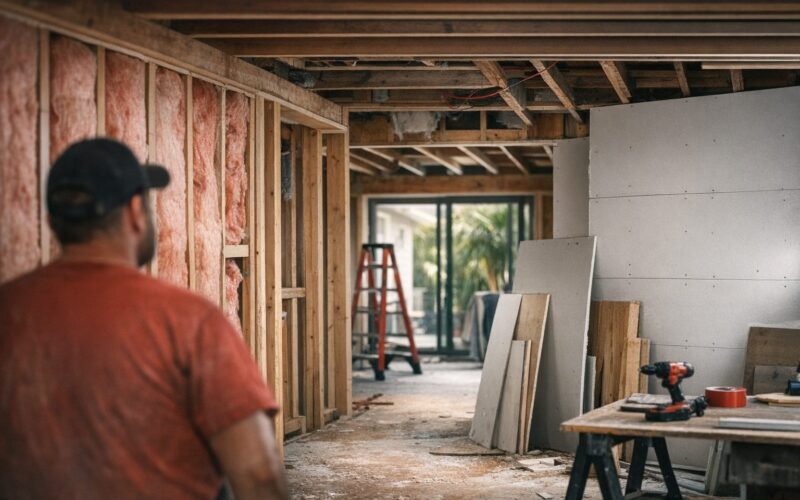
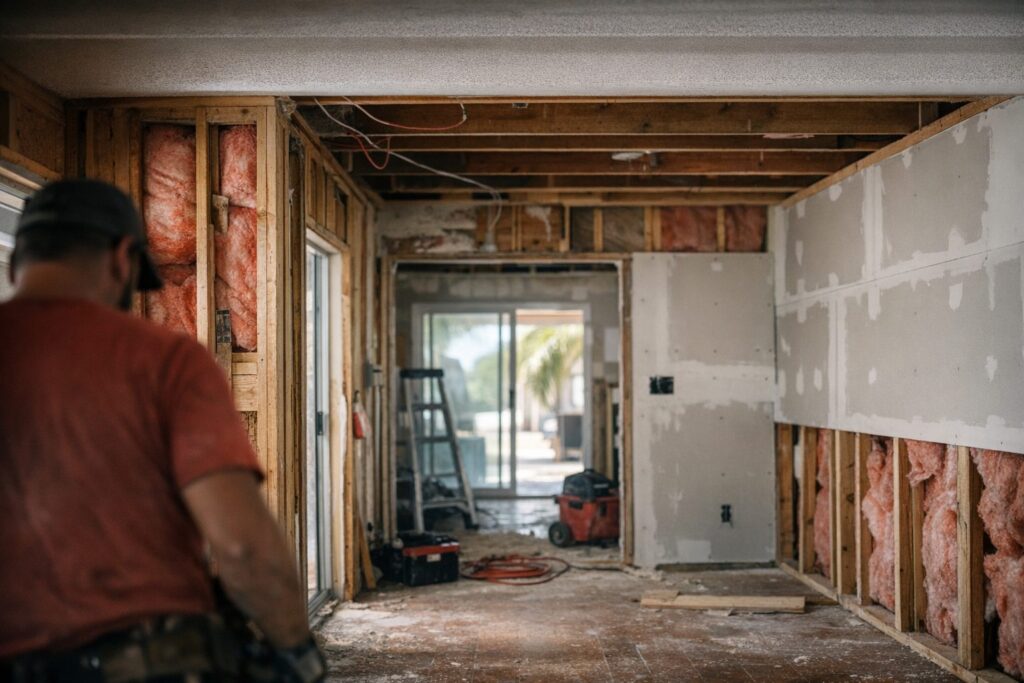
Construction includes demolition, structural work, rough-in trades (electrical, plumbing, HVAC), insulation, drywall, finish trades (cabinets, flooring, trim, paint), fixtures, and final inspections. Each trade must be scheduled sequentially, and inspections must be passed between phases.
Phase 5: Inspections and Punch List — 1 to 3 Weeks
- Final building inspections: 3-7 days to schedule and pass all required inspections
- Homeowner walkthrough and punch list: 1-2 days
- Punch list completion: 3-10 days depending on the number and complexity of items
- Final cleaning and contents return: 2-5 days
Total Timeline Summary
| Damage Severity | Best Case | Typical | Post-Major Storm |
|---|---|---|---|
| Minor (single room) | 6 weeks | 8-12 weeks | 12-20 weeks |
| Moderate (several rooms) | 10 weeks | 14-20 weeks | 20-32 weeks |
| Major (full home) | 16 weeks | 24-32 weeks | 32-52+ weeks |
What Causes Delays
Need restoration help in Southwest Florida right now? WrightWay dispatches in 60 to 90 minutes from three Florida offices, and we answer with a live human.
Understanding the most common delay factors helps you plan and advocate for your project:
Insurance Delays
The single biggest source of delay in most reconstructions. Slow adjuster response, disputed line items, inadequate initial payment, and protracted supplement negotiations can push the insurance phase from 4 weeks to 4 months. Working with a restoration company experienced in insurance claims management helps minimize these delays.
Permit Backlogs
After a major storm event, building departments are flooded with permit applications. Lee County’s permitting timeline after Hurricane Ian extended to 8-12 weeks for standard residential permits. Some jurisdictions offer expedited permitting for disaster reconstruction — ask your contractor if this option is available.
Material Shortages
After major storms, demand for building materials spikes while supply chains struggle. Impact windows (6-12 week lead times normally, extending to 16-24+ weeks after storms), specific roofing materials, HVAC equipment, and custom cabinetry are common bottleneck items. Early ordering — even before permits are issued — can prevent weeks of delay.
Trade Contractor Availability
Electricians, plumbers, HVAC technicians, and other specialized trades are in high demand after storm events. A restoration company with established trade relationships has priority scheduling that individual homeowners cannot access.
Weather
Florida’s wet season (June-October) can delay exterior work — roofing, stucco, painting — by days or weeks when afternoon thunderstorms are frequent. Interior work continues regardless of weather once the building is weather-tight.
How to Minimize Your Reconstruction Timeline
- File your insurance claim immediately. Every day of delay in filing pushes the entire timeline back.
- Choose a restoration company that handles both mitigation and reconstruction. Handoff between separate mitigation and construction companies adds weeks of transition time.
- Provide timely decisions on material selections. When your contractor needs you to choose flooring, cabinets, paint colors, or fixtures, respond quickly. Each week of indecision pushes the completion date.
- Authorize supplement claims promptly. When additional damage is discovered, approve the supplement filing immediately so the insurance process does not stall.
- Maintain communication with your project manager. Regular check-ins keep the project visible and prevent it from falling behind schedule.
WrightWay Keeps Your Project on Track
WrightWay Emergency Services assigns a dedicated project manager to every reconstruction project. From the initial emergency call through the final walkthrough, one person is accountable for your timeline, your budget, and your communication. We overlap phases where possible (submitting permits while finalizing insurance, ordering long-lead materials during the permitting phase) to compress the overall timeline without cutting corners.
Call (941) 379-8669 for emergency response and reconstruction across Southwest Florida. The sooner you call, the sooner your timeline starts — and finishes.
WrightWay handles every restoration job from emergency response through licensed reconstruction.
One IICRC-certified team, one project manager, one phone call. Available 24/7 across Sarasota, Manatee, Charlotte, Lee, and Collier counties.
Add us as a preferred source and our storm updates, claim guides and restoration answers show up higher when you search.