Why Slab Foundations Dominate Florida Construction
The vast majority of homes in Southwest Florida are built on concrete slab-on-grade foundations. Unlike regions where basements and crawl spaces are common, Florida’s high water table, sandy soil, and limestone bedrock make slab construction the practical and economical choice. A typical Florida slab is 4 to 6 inches of reinforced concrete poured over a compacted fill layer, with a vapor barrier (polyethylene sheeting) between the fill and the concrete.
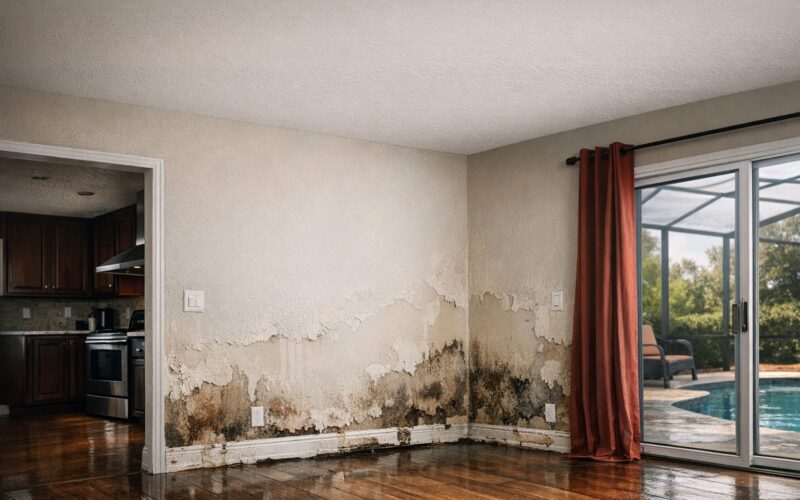
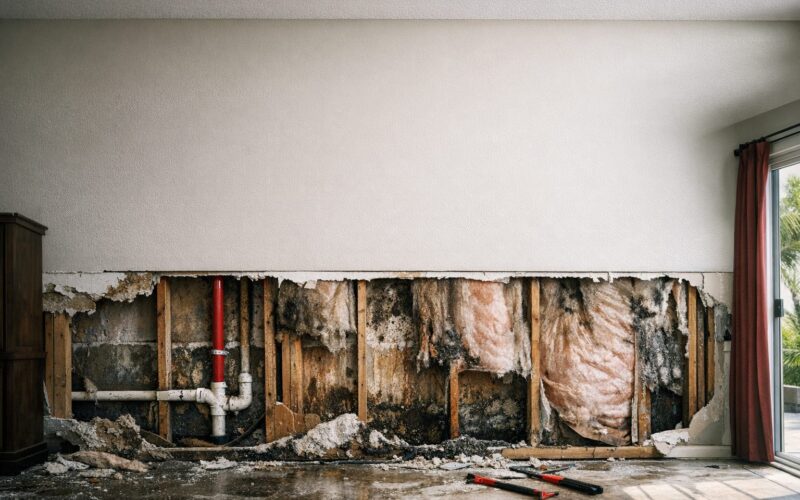
Slab foundations are durable, but they are not immune to flood damage. When floodwater surrounds and saturates a slab, the damage occurs in ways that homeowners often do not recognize — and that can cause serious long-term problems if not properly addressed.
How Flooding Affects Concrete Slab Foundations
Moisture Absorption and Migration
Concrete is porous. Despite appearing solid, concrete absorbs water through its network of microscopic capillaries. When a slab is surrounded by floodwater for hours or days, moisture migrates into the concrete from the bottom and edges. This moisture then moves upward through the slab via capillary action — a process called moisture vapor transmission.
In normal conditions, the vapor barrier beneath the slab blocks most ground moisture. But flooding can damage, shift, or overwhelm the vapor barrier, allowing far more moisture into the slab than the design intended. This excess moisture affects everything above the slab: flooring adhesives, flooring materials, and the indoor environment.
Soil Erosion and Settlement
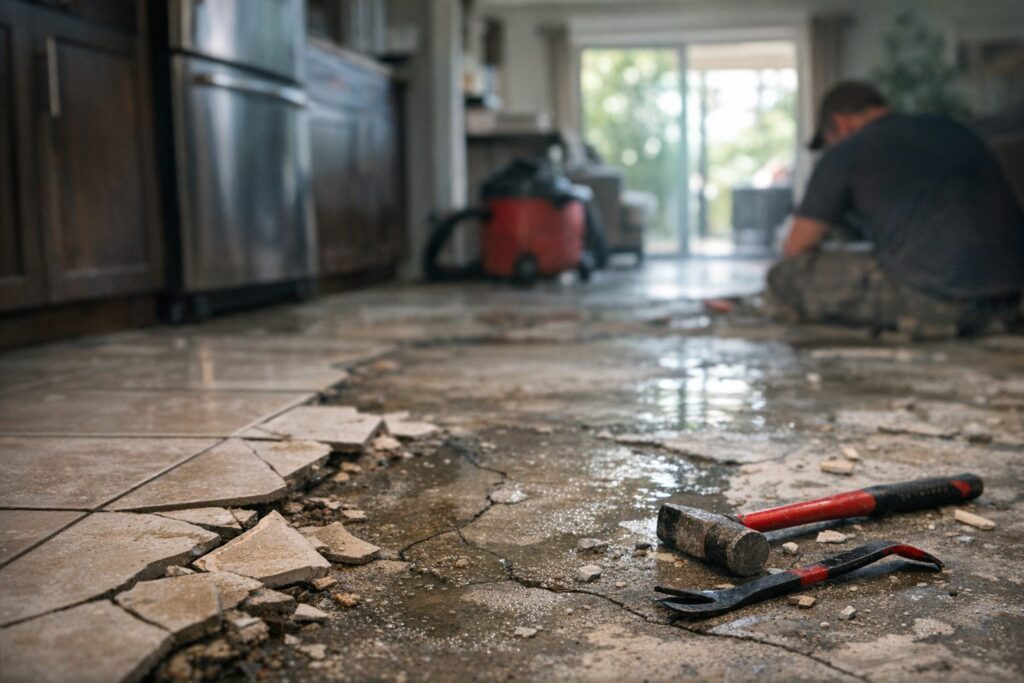
Floodwater moving across and around a slab can erode the compacted fill and native soil that supports the foundation. Florida’s sandy soils are particularly vulnerable to erosion. When supporting soil washes out from beneath a slab, the unsupported sections can crack and settle, creating:
- Visible cracks in the slab surface
- Uneven floors that slope or dip in affected areas
- Gaps between the slab edge and exterior walls
- Stress on plumbing lines that run through or beneath the slab
Plumbing Damage Beneath the Slab
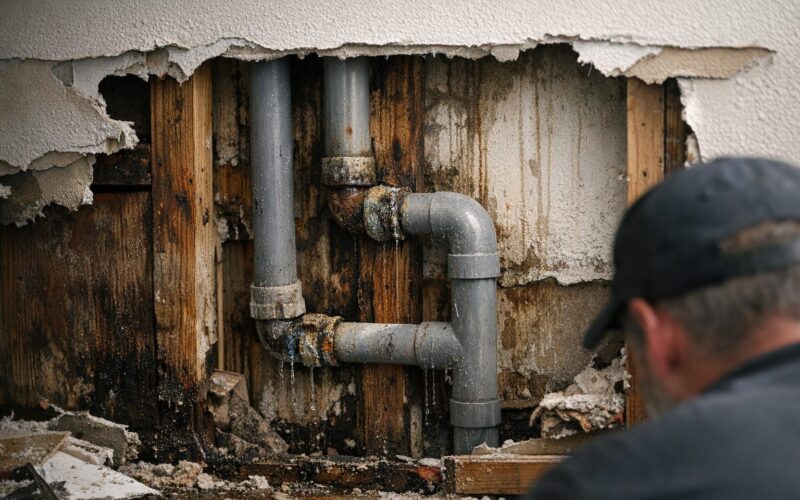
Florida homes have supply lines, drain lines, and sometimes radiant cooling loops running through or beneath the slab. Flood-related soil movement can stress these pipes, causing leaks that are extremely difficult to detect. A post-flood plumbing pressure test is essential to identify under-slab leaks before new flooring is installed over the slab.
Contamination Retention
When Category 3 floodwater saturates a concrete slab, the contaminants — sewage, chemicals, biological material — are absorbed along with the water. Concrete’s porous structure retains these contaminants even after the surface dries. Without proper treatment, contaminants can continue to off-gas (release volatile compounds) and create odor and air quality problems for months after the flood.
Signs of Slab Damage After Flooding
After floodwaters recede, watch for these indicators of slab foundation damage:
- New cracks in the slab: Hairline cracks are normal in concrete, but new cracks that appear after flooding — especially those wider than 1/8 inch or that are accompanied by vertical displacement — indicate potential settlement
- Flooring adhesive failure: Tile popping loose, vinyl plank edges curling, or hardwood cupping — all signs of excessive moisture rising through the slab
- Efflorescence: White crystalline deposits on the slab surface where moisture evaporates and leaves dissolved minerals behind
- Persistent musty odor: Moisture trapped in the slab creates conditions for mold growth on and beneath flooring materials
- Elevated moisture readings: A professional moisture test (ASTM F2170 in-situ relative humidity test) reveals moisture levels inside the slab that surface observation cannot detect
- Doors and windows sticking or not closing properly: Indicates possible slab movement affecting the structure above
The Professional Slab Drying Process
Drying a flood-saturated concrete slab is one of the most time-consuming aspects of flood restoration. Concrete gives up moisture slowly — far more slowly than wood, drywall, or carpet. The professional approach involves:
Step 1: Remove All Flooring and Coverings
All flooring materials, adhesive, underlayment, and baseboards must be removed to expose the slab surface. You cannot dry a slab through flooring — the covering traps moisture and prevents evaporation.
Step 2: Clean and Treat the Slab Surface
The exposed slab is cleaned of all debris and treated with an antimicrobial solution to address contamination from floodwater. This is especially important for Category 3 water events.
Step 3: Deploy Drying Equipment
Commercial dehumidifiers and air movers are positioned to maximize evaporation from the slab surface. In some cases, specialty slab drying systems are used — these create a sealed chamber over the slab surface and use heat and vacuum to draw moisture out of the concrete more rapidly than ambient drying alone.
Step 4: Monitor Moisture Levels
ASTM F2170 in-situ relative humidity probes are installed in the slab at multiple locations to track moisture levels inside the concrete — not just on the surface. Surface readings can be misleading because the top of the slab dries first while the core and bottom retain significant moisture.
Step 5: Verify Dry Standard
The slab is considered dry when in-situ RH readings fall below the threshold specified by the flooring manufacturer — typically 75 percent RH for most flooring products, though some require 80 percent or lower. This process can take 14 to 21 days or longer depending on slab thickness, moisture content, and environmental conditions.
Why Rushing Slab Drying Causes Expensive Failures
Need restoration help in Southwest Florida right now? WrightWay dispatches in 60 to 90 minutes from three Florida offices, and we answer with a live human.
One of the most costly mistakes in post-flood restoration is installing new flooring before the slab is adequately dry. When flooring is installed over a wet slab:
- Tile: Adhesive fails, tiles pop loose, and grout cracks as moisture migrates through
- LVP/vinyl: Adhesive breaks down, planks curl at edges, and mold grows between the flooring and slab
- Hardwood: Wood absorbs moisture from the slab, cups, buckles, and develops mold on the underside
- Carpet: Pad absorbs moisture, creating mold conditions and odor — exactly the problem you just paid to fix
Replacing failed flooring due to premature installation costs just as much as the first installation — plus additional drying time and potential mold remediation. Getting it right the first time is always more economical.
Structural Assessment After Flooding
If you observe cracking, settlement, or other signs of structural slab damage, a structural engineer’s assessment is recommended before reconstruction begins. The engineer can determine whether:
- The slab is still structurally sound
- Soil stabilization (grouting or compaction) is needed beneath the slab
- Crack repair with epoxy injection is sufficient
- More extensive foundation repair is required
Structural engineering assessments are typically covered under your flood insurance policy and are documented by your restoration company as part of the claim.
Trust WrightWay for Complete Flood and Slab Restoration
WrightWay Emergency Services understands the unique challenges of restoring flood-damaged slab foundations in Florida. Our process includes proper slab drying protocols, ASTM F2170 moisture verification, contamination treatment, and coordination with structural engineers when needed. We handle everything from emergency flood cleanup through complete reconstruction, ensuring your slab is verified dry before new flooring is installed.
Call (941) 379-8669 for 24/7 flood damage response across Southwest Florida.
WrightWay handles every restoration job from emergency response through licensed reconstruction.
One IICRC-certified team, one project manager, one phone call. Available 24/7 across Sarasota, Manatee, Charlotte, Lee, and Collier counties.
Add us as a preferred source and our storm updates, claim guides and restoration answers show up higher when you search.