Can You Make Repairs Before the Insurance Adjuster Inspects?
Your roof is leaking, water is pooling on the floor, or a broken window has left your home exposed to the elements. You know you need to file an insurance claim, but the adjuster cannot come for several days. So you face a question that worries nearly every homeowner: can you make repairs before the adjuster sees the damage?
The short answer is yes. Not only are you allowed to make emergency repairs, your insurance policy almost certainly requires you to take reasonable steps to prevent further damage. But there are important rules about what qualifies as an emergency repair, how to document everything, and what to avoid doing before the inspection.
Your Duty to Mitigate: A Policy Requirement
Every standard homeowners insurance policy in Florida includes a duty to mitigate clause. This provision requires you to take reasonable steps to protect your property from additional damage after a covered event. If you fail to mitigate and the damage worsens, your insurer can reduce or deny the portion of the claim attributable to your inaction.
What the Duty to Mitigate Means in Practice
Your obligation is to act as a reasonable homeowner would under the circumstances. You are not expected to perform professional-grade repairs or put yourself in danger. You are expected to take common-sense steps to prevent a bad situation from becoming worse.
Examples of reasonable mitigation include:
- Tarping a damaged roof to prevent rain from entering the home
- Shutting off the water supply when a pipe bursts or an appliance leaks
- Boarding up broken windows or doors to secure the property
- Removing standing water with a wet vacuum, mop, or pump
- Moving undamaged belongings away from the affected area
- Placing buckets under active leaks
- Running fans or your air conditioner to begin reducing moisture levels
- Calling a restoration company for professional emergency mitigation
Emergency Repairs vs. Permanent Repairs: The Critical Distinction
Insurance companies draw a clear line between emergency (temporary) repairs and permanent repairs. Understanding this distinction is essential to protecting your claim.
| Emergency/Temporary Repairs | Permanent Repairs |
|---|---|
| Tarping a damaged roof | Replacing the roof |
| Boarding up a broken window | Installing a new window |
| Extracting standing water | Replacing water-damaged flooring |
| Placing a pipe clamp on a burst pipe | Replumbing the affected line |
| Setting up drying equipment | Rebuilding drywall and painting |
| Removing saturated carpet to prevent mold | Installing new carpet and pad |
Emergency repairs are encouraged and reimbursable. They prevent further damage without eliminating evidence of the original loss. Permanent repairs should generally wait until the adjuster has inspected and agreed on the scope of damage, unless waiting would cause additional harm to the property.
How to Document Emergency Repairs for Your Claim
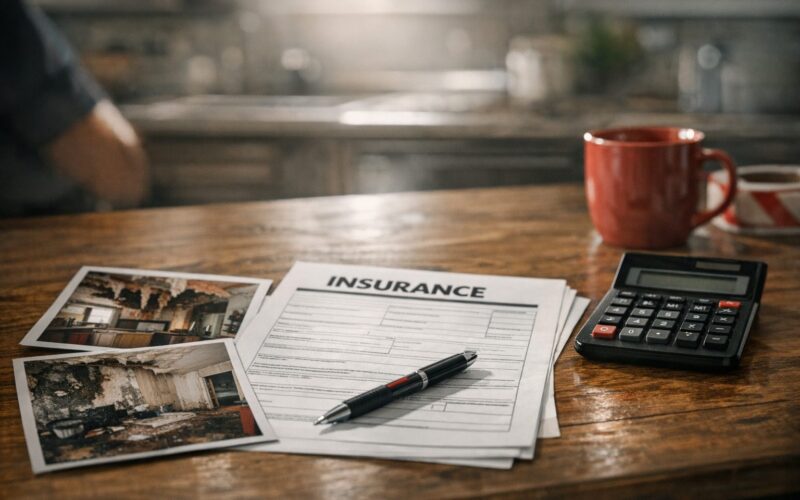
The golden rule for emergency repairs is: document everything, throw away nothing. Your documentation serves as proof of the damage’s severity and the reasonableness of your actions.
Before You Start Any Repairs
- Photograph and video the damage from multiple angles, capturing the full extent of the problem
- Photograph the source of the damage (the burst pipe, the hole in the roof, the broken appliance)
- Document water levels by placing a ruler or tape measure in standing water and photographing it
- Capture timestamps by ensuring your phone’s date/time stamp is enabled
During and After Emergency Repairs
- Photograph each step of the repair process
- Save all damaged materials if possible. Do not haul water-damaged drywall, flooring, or insulation to the curb until the adjuster has seen it or you have documented it thoroughly with photos and measurements
- Keep every receipt for supplies purchased (tarps, plywood, buckets, cleaning supplies, fans)
- Get written invoices from any contractors or service providers who perform emergency work
- Create a written log of what you did, when you did it, and why it was necessary
What NOT to Do Before the Adjuster Arrives
While emergency mitigation is required, certain actions can harm your claim:
- Do not begin permanent reconstruction. Replacing drywall, installing new flooring, or repainting before the adjuster sees the damage eliminates evidence of the loss and can result in the insurer refusing to pay for those repairs.
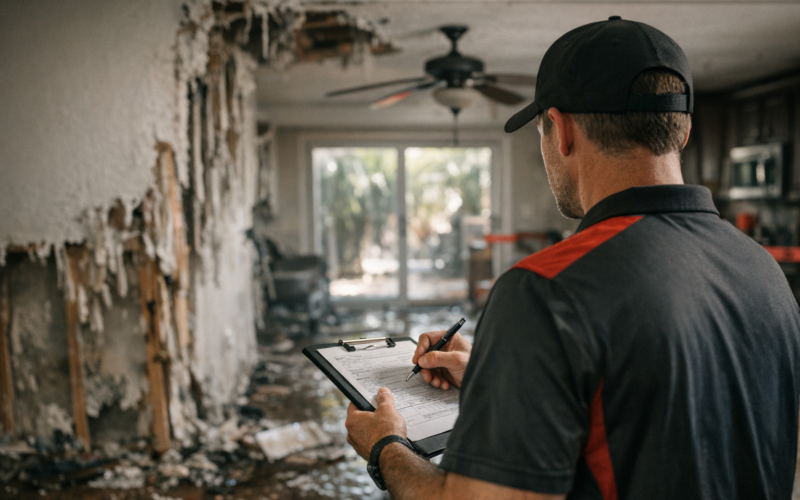
- Do not discard damaged materials without documentation. If you must remove saturated drywall or carpet for health reasons (mold risk in Florida’s humidity is real), photograph every piece before removal, measure the affected areas, and keep samples if possible.
- Do not hire someone to make permanent repairs without approval. Emergency mitigation by a restoration company is standard and expected. Signing a contract for full reconstruction before the adjuster inspects is premature.
- Do not exaggerate the damage. Document what exists accurately. Misrepresenting the extent of damage is insurance fraud and can void your entire policy.
- Do not sign a contract that includes an Assignment of Benefits (AOB) without understanding the implications, as Florida law has significantly changed how AOB agreements work in recent years.
Professional Mitigation: Your Strongest Move
Need restoration help in Southwest Florida right now? WrightWay dispatches in 60 to 90 minutes from three Florida offices, and we answer with a live human.
Hiring a professional restoration company for emergency mitigation is the single best step you can take between discovering damage and the adjuster’s arrival. Here is why:
- Professional documentation: Restoration companies create detailed reports with moisture readings, photos, and damage assessments that become part of your claim file
- Proper equipment: Commercial dehumidifiers, air movers, and extraction units are far more effective than consumer-grade products
- Mold prevention: In Florida’s climate, mold can begin growing within 24 to 48 hours. Professional drying prevents a water damage claim from becoming a much more complicated mold claim
- Insurance familiarity: Experienced restoration companies know what adjusters look for and document accordingly
- Cost coverage: Emergency mitigation costs are almost always covered by your homeowners policy as part of the claim
At WrightWay Emergency Services, we begin documenting damage from the moment we arrive. Our technicians take comprehensive photos, perform moisture mapping with calibrated instruments, and categorize the water loss. This documentation is shared with the adjuster and often becomes the foundation for an accurate scope of repairs.
What If the Adjuster Takes Too Long?
In Florida, your insurer must acknowledge your claim within 14 days and begin investigating within 14 days after that. However, after a major storm, adjuster inspections can be delayed for weeks or even months due to the volume of claims. If the adjuster is delayed:
- Continue with all necessary emergency mitigation and drying
- Remove materials that pose a health risk (sewage-contaminated items, mold-affected materials) after thorough documentation
- Contact your insurance company in writing to note the delay and request expedited service
- Consider requesting a reinspection or independent adjuster if the delays are unreasonable
You should not allow your home to sustain further damage simply because an adjuster has not arrived. Your duty to mitigate overrides the adjuster’s convenience.
The Bottom Line: Act Fast, Document Everything
Emergency repairs before the adjuster arrives are not just allowed in Florida, they are required under your policy’s duty to mitigate. The key is to focus on temporary, preventive measures while preserving evidence of the damage through thorough documentation. Leave permanent repairs for after the adjuster has inspected and a scope of work has been agreed upon.
Need emergency mitigation in Southwest Florida? WrightWay Emergency Services responds 24/7 with professional crews who know how to protect both your property and your claim. Call (941) 379-8669 now.
WrightWay handles every restoration job from emergency response through licensed reconstruction.
One IICRC-certified team, one project manager, one phone call. Available 24/7 across Sarasota, Manatee, Charlotte, Lee, and Collier counties.
Add us as a preferred source and our storm updates, claim guides and restoration answers show up higher when you search.