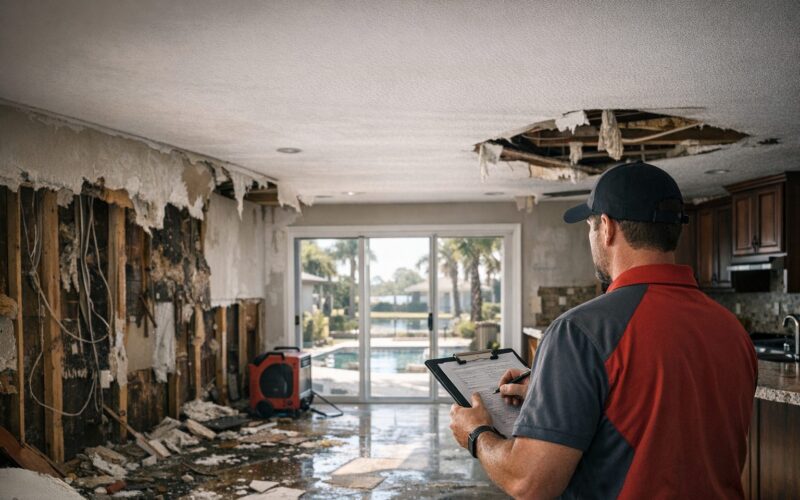
You did the hard part — pre-application during the May 1 – June 30, 2026 window, full application, documentation, damage assessment. Now your Manatee County Home Recovery Program funding has been approved and you’re at the contractor selection step. The HRP design says homeowners may choose from County-screened contractors — meaning your choice is bounded by the county’s approved list, but you still have one. Here’s how to pick well.
See the Home Recovery Program overview →
1. The contractor must be on Manatee County’s approved/screened list
HRP funding is a 5-year forgivable loan and the County pays the contractor directly — that means the County controls who can do the work. Verify before signing: is the contractor on Manatee County’s approved/screened HRP contractor list? If not, the program won’t pay them and the project doesn’t proceed.
The County’s contractor list is maintained as part of the procurement process; Lasting Manatee or your case manager can confirm the current list.
2. Verify the Florida contractor’s license
Florida is a licensed-contractor state. The contractor must hold an active state license appropriate to the scope of work — typically a Certified General Contractor (CGC), Certified Building Contractor (CBC), or Certified Residential Contractor (CRC).
Verify the license at the Florida DBPR Licensee Search: myfloridalicense.com. Look for:
- License status: Active
- License class appropriate for residential reconstruction
- No open complaints or disciplinary actions
- License has been active for several years (not freshly issued)
For reference, WrightWay’s license number is CBC1253650 — Certified General Contractor.
3. Confirm IICRC certifications for restoration work
Hurricane recovery work usually combines restoration (water extraction, drying, mold remediation, smoke cleanup) and reconstruction. Restoration work has its own certification body — the Institute of Inspection, Cleaning and Restoration Certification (IICRC). Look for certifications including:
- WRT — Water Damage Restoration Technician
- ASD — Applied Structural Drying
- AMRT — Applied Microbial Remediation Technician
- FSRT — Fire & Smoke Restoration Technician
Certified-firm status (not just individual technician certs) is the strongest signal.
4. Confirm general liability and workers’ comp insurance
Ask for current Certificates of Insurance (COI) for both general liability ($1M+ coverage) and workers’ compensation. Have the contractor’s insurance broker email the COI directly to you — copies provided by the contractor themselves can be falsified. Both policies must be active for the duration of the project.
5. Check for CDBG-DR / Xactimate experience
CDBG-DR program scopes are written in a specific format — line-item Xactimate scopes that match HUD’s documentation requirements. Contractors who are unfamiliar with this format may struggle to execute or seek change orders mid-project. Ask:
- Have you worked under a HUD CDBG-DR or similar federally-funded program before?
- Do you produce Xactimate documentation as part of your standard workflow?
- Can you provide references from federally-funded recovery projects?
6. Get the warranty in writing
Florida law and Florida Building Code dictate minimum warranty terms, but professional contractors offer additional written warranties. Ask for:
- Workmanship warranty: minimum 1 year
- Material warranties: passed through from manufacturers
- Specific written warranty terms in the contract — not just verbal promises
7. Understand who pays the contractor (and what happens out-of-scope)
Under the Manatee County Home Recovery Program, the County pays the contractor directly — you don’t write a check and wait for reimbursement. That’s a key advantage of this program over a typical insurance claim, but it also means:
- The contractor is paid against an approved scope of work — the line items the program agreed to fund.
- Out-of-scope work is your responsibility unless you secure a change order through the program.
- Florida’s 2023 AOB reform (SB 2A) significantly tightened Assignment of Benefits rules. AOB is generally not used in CDBG-DR funded work — the program already pays the contractor directly.
For other (non-CDBG-DR) restoration work — like a current insurance claim outside this program — WrightWay’s standard model is to bill homeowners directly and provide all documentation to support the insurance claim filing. We do not use AOB.
8. Beware of contractor red flags
Need restoration help in Southwest Florida right now? WrightWay dispatches in 60 to 90 minutes from three Florida offices, and we answer with a live human.
- Demands a large deposit before any work begins (irrelevant under HRP since the county pays — but a sign of bad practices)
- Asks you to sign blank or incomplete contracts
- Cannot provide a Florida license number you can verify
- Goes door-to-door pitching unsolicited recovery work
- Pressures you to sign quickly
- Wants to negotiate directly with the program administrator without you in the loop
- Is not on Manatee County’s approved/screened HRP contractor list
What WrightWay brings to the table
If you would like to interview WrightWay for your funded repair work:
- Licensed Florida General Contractor (CBC1253650) — verifiable at myfloridalicense.com
- IICRC certified firm with WRT, ASD, AMRT, FSRT
- Same-firm execution from emergency mitigation through final reconstruction — one contract, one warranty, one point of contact
- Xactimate documentation matching CDBG-DR scope-of-work format
- 3D documentation — Matterport scans and drone surveys before, during, and after
Call (941) 379-8669 for a free consultation. Our service area covers Manatee, Sarasota, Charlotte, Lee, Collier, DeSoto, Hardee, Hillsborough, and Pinellas counties.
Florida contractor licensing rules and program billing requirements may evolve; verify current rules at myfloridalicense.com and the current HRP Program Guide at lastingmanatee.org/pages/documents.
WrightWay handles every restoration job from emergency response through licensed reconstruction.
One IICRC-certified team, one project manager, one phone call. Available 24/7 across Sarasota, Manatee, Charlotte, Lee, and Collier counties.