

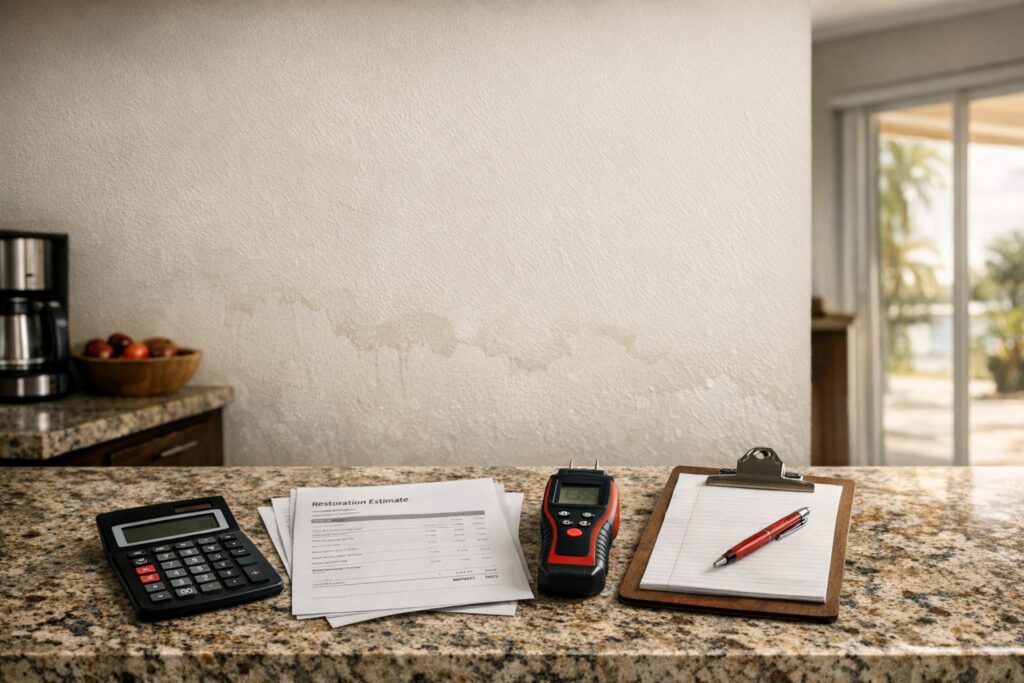
If you just typed “water damage restoration cost Sarasota” into Google, you are in one of two situations. Either you have water on your floor right now and you want to know what this is going to cost before you call anybody, or you are a few days into a claim and a contractor handed you a number that does not feel right. Either way, you deserve a straight answer rather than a sales-funnel landing page.
A quick note: WrightWay Emergency Services is a Florida-licensed restoration contractor (CBC1253650 / MRSR1433), not an insurance adjuster, public adjuster, or law firm. We document the loss and perform the mitigation and reconstruction work. For any question about what your policy covers, what your deductible is, how your claim is being handled, or what to sign — talk to your insurance agent, your insurance company’s adjuster, or a Florida-licensed public adjuster of your choice. This article is general information about Florida law and the restoration process, not coverage advice on your specific policy.
This is the realistic 2026 pricing breakdown for water damage restoration in Sarasota and Manatee counties, drawn from WrightWay Emergency Services’ actual field experience since 2004. The ranges below are typical of the Southwest Florida market for the loss types described. They are not quotes. Final pricing always depends on the IICRC water category, the IICRC class of loss, the affected square footage, the materials involved, and access conditions. Anyone who promises you a fixed price over the phone before scoping the loss is guessing — and guessing in their favor, not yours.
How professional water damage pricing actually works
Most legitimate Florida restoration companies bill water mitigation using industry-standard line-item pricing (commonly the Xactimate database used by insurance carriers). That means you are not paying a flat “$X per day for a fan.” You are paying line items for: emergency service callout, water extraction by category, controlled demolition by material type and quantity, anti-microbial application where indicated, equipment rental per day per unit, monitoring visits, and PPE and consumables.
Insurance carriers expect this pricing format. Cash-pay customers can request it. Either way, the invoice should let you trace every dollar to a specific service or piece of equipment.
Category and class: the two words that change the price
Two IICRC concepts drive most of the pricing variance:
- Category describes the water itself. Category 1 is clean water from a sanitary source (supply line, ice maker, refrigerator). Category 2 (gray water) is contaminated and contains significant biological, chemical, or physical impurities (dishwasher overflow, washing machine discharge, aquarium leak). Category 3 (black water) is grossly contaminated (sewage, ground-surface water intrusion, long-standing standing water). Category jumps the price because Category 2 and 3 require more aggressive antimicrobial treatment, more aggressive material removal, and more stringent containment.
- Class describes the evaporation load — how much water is in how many materials over how much area. Class 1 (small area, low porosity) dries fast and cheap. Class 4 (deeply saturated assemblies like hardwood floors, concrete, plaster) requires specialty equipment and longer dry times.
For more on how category and class drive the entire restoration process, see our process overview.
Typical 2026 ranges in Sarasota and Manatee
Based on WrightWay’s experience in Sarasota and Manatee counties, here are typical ranges for common loss profiles. Treat these as planning numbers, not quotes.
Small Category 1 loss (~$1,200 to $4,500)
Example profile: supply-line burst under a single bathroom vanity caught within a few hours. Less than 200 square feet of affected area. Drywall not yet saturated above 12 inches. Tile flooring or vinyl plank that may be salvageable.
Typical scope: emergency dispatch, extraction, 2 to 4 air movers, 1 dehumidifier, baseboard removal, monitoring visits over 3 to 5 days. Most small losses fall in this range. If your loss is in this range and you have a $1,000 or $2,500 deductible, sometimes a cash-pay path makes more sense than filing a claim — talk to your agent before you decide.
Mid-size Category 1 or contained Category 2 loss (~$5,000 to $15,000)
Example profile: dishwasher supply line that ran for several hours into a kitchen, with migration into adjacent dining room and a bathroom on a shared wall. 400 to 800 square feet affected. Cabinetry impact. Flooring removal likely. Possible insulation removal in interior walls.
Typical scope: extraction, controlled demolition including flood-cut drywall and cabinet kick removal, 6 to 12 air movers, 2 to 3 dehumidifiers, antimicrobial application, content manipulation and pack-out of a few rooms, 5 to 7 days of drying with monitoring, basic reconstruction planning. This is the most common range for Sarasota single-family homes with a typical kitchen or laundry loss.
Large or Category 2/3 loss ($20,000+)
Example profile: long-running leak discovered after the fact, with mold growth already established. Or sewer backup affecting multiple rooms. Or wind-driven rain saturating multiple wall assemblies after a tropical storm. 1,000+ square feet affected, multiple rooms, multiple floors, or significant Category 3 contamination.
Typical scope: aggressive controlled demolition, full pack-out of contents, structural drying with specialty equipment, mold remediation under an IICRC S520 protocol, possible HVAC remediation, and reconstruction that may run weeks. Large losses can easily exceed $50,000 or $100,000 depending on finishes. We have scoped losses well into six figures after major storms. There is no honest upper bound number here — only honest scoping.
What drives prices up in Sarasota and Manatee specifically
A few SW Florida realities push costs above the national average:
- Humidity. Higher dewpoints mean longer dry times and bigger dehumidifiers. A 5-day dry-out in Phoenix is often a 7-day dry-out here.
- Block construction. Concrete block exterior walls hold moisture differently than frame walls. Class 4 specialty drying shows up more often.
- Tile-over-slab flooring. Common in Florida and tricky to dry once water gets under tile and into the slab.
- Post-storm demand surges. After Hurricane Ian, Helene, and Milton, equipment availability and labor pricing in SW Florida tightened. Pricing during major-event periods runs higher than during normal months — that is supply and demand, not gouging.
What insurance typically covers (and what it does not)
If water reached walls, flooring seams, or sat overnight, fans alone rarely save the materials. A free moisture inspection tells you exactly what is wet and what it costs to fix.
Most Florida HO-3 and HO-6 policies cover the full mitigation cost of a sudden, accidental, covered water loss, less your deductible. That includes emergency dispatch, extraction, drying, demolition required to access water, and reasonable reconstruction. Mold remediation is usually covered only up to a sublimit and only when triggered by a covered peril — see our deep dive on Florida property damage insurance claims for the post-reform landscape.
What is usually not covered: long-term seepage, deferred maintenance, ground-water flooding (you need separate flood coverage for that), and damage to materials excluded by your specific endorsement. Consult your policy — every carrier is different.
Where homeowners overpay (and how to avoid it)
From our experience, the most common overpayment patterns we see are:
- Equipment left running longer than needed. A reputable company remeters every 24 hours and pulls equipment as materials reach dry standard. If equipment is sitting in your home with no daily monitoring, that is a billing problem.
- Demolition without containment. Aggressive demo without proper containment creates a mold cleanup invoice on top of the water invoice.
- Double scope from a separate rebuild contractor. When mitigation and reconstruction are bid separately, scope overlap and finger-pointing inflate cost. Our single-source model — same Florida General Contractor license (CBC1253650) handles mitigation, mold remediation (MRSR1433), and rebuild — eliminates that overlap.
- Hidden subcontractor markups. Ask for a line-item invoice. If a company will not produce one, you are paying for something they do not want you to see.
How to get a real number for your loss
The only way to get a real price for water damage restoration in Sarasota is an on-site scope by a licensed contractor. That scope is free in most cases, takes 30 to 60 minutes, and produces a documented estimate you can share with your carrier. We provide that scope as part of every dispatch.
Get help fast
If you have a water loss now, call WrightWay Emergency Services at (941) 379-8669 or report a loss online. We dispatch 24/7 across Sarasota, Manatee, Charlotte, Lee, Collier, DeSoto, Hardee, Hillsborough, and Pinellas counties, and we will scope the loss, document with photos and 3D scans where appropriate, and give you a real number — not a sales-pitch number. For the full picture, see our water damage restoration guide.
Frequently asked questions
Will I have to pay anything out of pocket for water damage restoration in Sarasota?
For a covered loss, your out-of-pocket is typically limited to your policy deductible. We bill the carrier directly for the rest in most cases. If the loss is not covered, or if you choose a cash-pay path, we provide a line-item estimate up front.
Is it cheaper to do water damage restoration myself?
For a very small, Category 1 spill caught within an hour or two, DIY is sometimes reasonable — pull standing water, run fans, and verify dryness with a moisture meter. For anything that has saturated drywall, flooring, or insulation, DIY is almost always more expensive in the long run because Florida humidity will produce mold before the materials fully dry without commercial dehumidification.
How long does water damage restoration usually take in a Sarasota home?
Typical Category 1 small losses dry in 3 to 5 days. Mid-size losses run 5 to 10 days for the dry-out phase, plus reconstruction time that depends on scope and material lead times. Large or Category 3 losses can extend several weeks. Any honest estimate is a range, not a fixed end-date.
WrightWay handles every restoration job from emergency response through licensed reconstruction.
One IICRC-certified team, one project manager, one phone call. Available 24/7 across Sarasota, Manatee, Charlotte, Lee, and Collier counties.
Add us as a preferred source and our storm updates, claim guides and restoration answers show up higher when you search.


