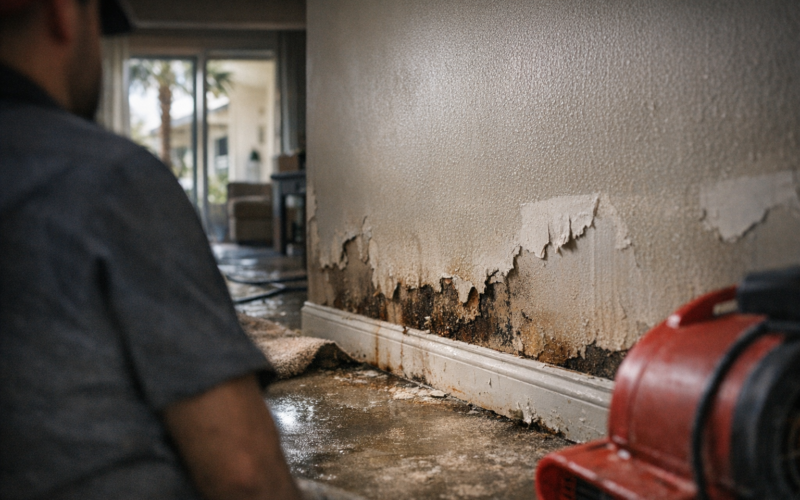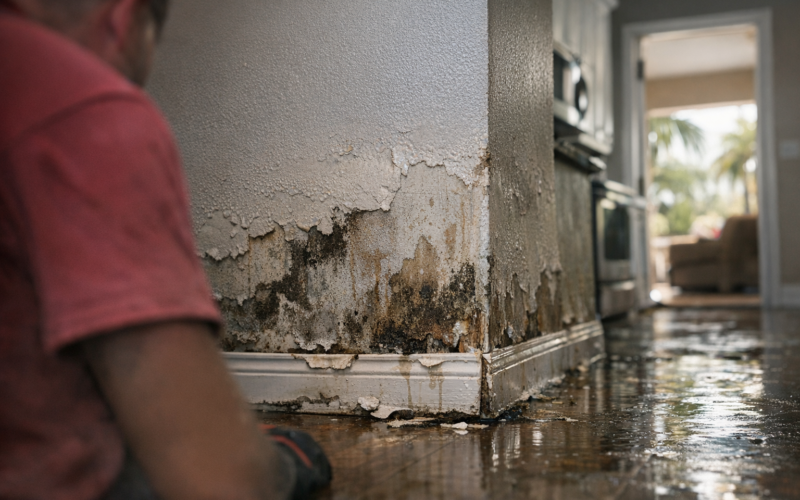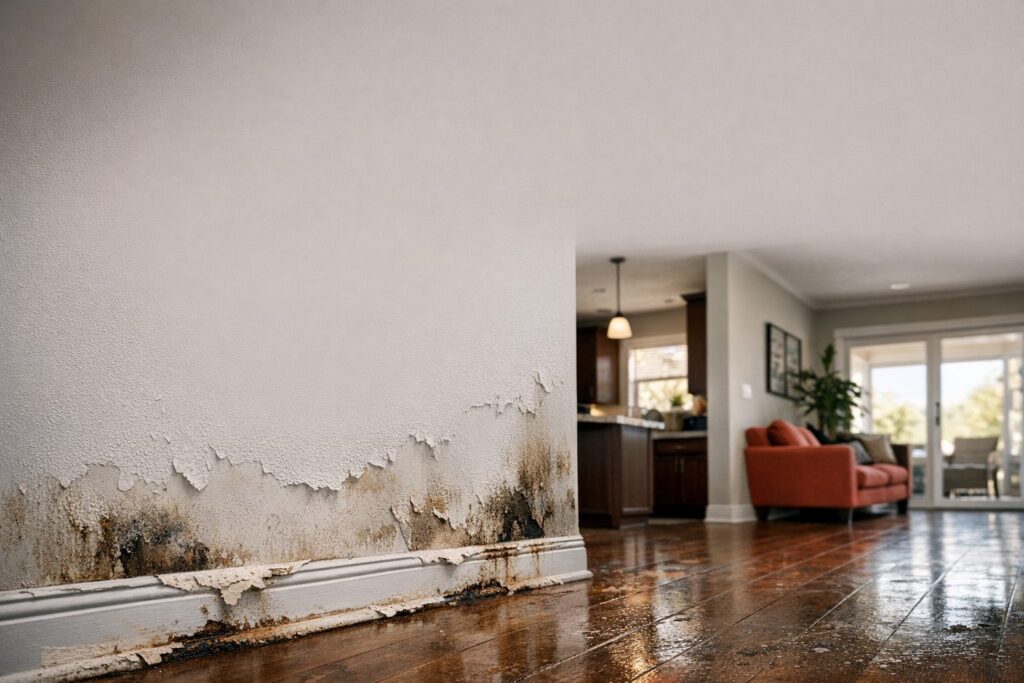
When a water loss happens in your home or commercial property, the restoration contractor’s first job is to classify it. The IICRC S500 Standard for Professional Water Damage Restoration defines two classification systems that every certified restorer uses: category (how contaminated the water source is) and class (how much material has been saturated and how difficult it will be to dry). These two numbers drive every decision in the restoration process – what equipment gets placed, which materials get saved vs. removed, what safety protocols apply, how long drying takes, and what your insurance carrier expects to see in the claim file.
This guide explains both systems in the depth that actually matters when you are managing a real loss.
Water Damage Categories: Contamination Level
The category system describes the contamination level of the water source at the time of the loss. It is not a description of how the water looks – it is a classification of the health risk posed by the microorganisms and chemicals present.
Category 1: Clean Water
Category 1 water originates from a sanitary source and poses no meaningful health risk at the time of the loss. Common sources include:
- Broken or leaking supply lines (toilet supply, washing machine hose, refrigerator ice maker line)
- Sink or bathtub overflow from a clean supply source
- Failed water heater (clean supply side only)
- Rainwater intrusion through a roof or window that has not been sitting
- Melting ice or snow (rarely relevant in Southwest Florida)
Material decisions: Most non-porous and semi-porous materials that contacted Category 1 water can be dried in place if drying begins promptly. Drywall, structural framing, and hardwood flooring are candidates for in-place drying when moisture content is not severely elevated and the timeline is short.
Safety requirements: Standard work precautions. No specialized PPE required beyond what the work itself demands.
The critical caveat: Category 1 classification is time-sensitive. Clean water that sits undisturbed in a Florida home for more than 24-48 hours will begin supporting bacterial growth due to ambient temperature and nutrient load in building materials. At that point, it escalates to Category 2 regardless of its original source. This is one of the most important reasons response speed matters in Florida’s climate.
Category 2: Gray Water
Category 2 water contains chemical or biological contamination at a level that can cause discomfort or illness if ingested or if a person is exposed to it. Sources include:
- Dishwasher overflow or drain line failure
- Washing machine drain or overflow
- Toilet overflow containing urine only (no feces)
- Aquarium water
- Sump pump failure (groundwater)
- Clean-source water that has been sitting for 24-48 hours or has contacted building materials with biological load
- Hydrostatic seepage through foundation walls or slabs
Material decisions: Porous materials that have absorbed Category 2 water and cannot be adequately cleaned and dried are typically removed. This commonly includes carpet and pad, drywall that is saturated to mid-cavity, and insulation. Semi-porous materials like wood framing can sometimes be treated and dried in place with antimicrobial application, depending on the extent and duration of contact.
Safety requirements: Technicians use PPE appropriate for biological hazard work. Affected areas are treated with EPA-registered antimicrobials as part of the remediation process. Occupants and especially immunocompromised individuals should avoid the affected area during remediation.
Category 3: Black Water
Category 3 water is grossly contaminated and contains pathogenic agents at levels that can cause serious illness. This is the highest contamination classification. Sources include:
- Sewage backup (any toilet overflow containing feces)
- Rising floodwater from rivers, streams, or storm surge
- Seawater intrusion
- Any standing water that has been sitting for more than 72 hours in warm conditions
- Water that has contacted known biohazard materials
- Wind-driven rain that has entered through a compromised roof over an extended storm period
Material decisions: All porous materials that have contacted Category 3 water must be removed. This is not a judgment call – it is a firm standard. Carpet, pad, drywall, insulation, and any other porous materials are removed regardless of whether they appear visually contaminated. Semi-porous materials (framing lumber, OSB) are evaluated individually; those with significant absorption are removed, while those with surface contact only may be treated and retained.
Safety requirements: Full PPE is required: Tyvek suits, N-95 or P-100 respirators, gloves, and eye protection. The work area is contained to prevent cross-contamination to clean areas of the structure. EPA-registered biocides and antimicrobials are applied to all structural surfaces after removal of contaminated materials. Waste is handled and disposed of according to applicable regulations.
Health risk note: Category 3 water exposure is a genuine health hazard. Common pathogens present in sewage backups and floodwater include E. coli, Salmonella, Hepatitis A, Giardia, Cryptosporidium, and Leptospira, among others. DIY cleanup of Category 3 losses without proper PPE and biocide treatment puts occupants at serious risk and typically results in scope that does not satisfy insurance carrier documentation requirements.
Why Category Matters for Your Claim
Insurance carriers use the IICRC category classification to evaluate the scope of work in a water damage claim. A Category 3 loss carries a materially different scope than a Category 1 loss of the same physical size – more removal, more antimicrobial treatment, more contained work area, higher equipment and labor cost. Carriers with experienced adjusters expect to see the category documented in the claim file along with the rationale for the determination.
WrightWay is a licensed restoration contractor and cannot advise you on what your specific policy covers. Your adjuster and your policy language determine that. What we can do is provide complete documentation of the category determination and the scope it drives, so your adjuster has the information needed to evaluate the claim.
Water Damage Classes: Saturation Extent and Drying Difficulty
Where category describes contamination, class describes how much material is saturated and how difficult that saturation will be to reverse. Class is the primary driver of equipment quantity, equipment placement, and drying duration.
Class 1: Minimal Saturation
Class 1 losses affect a small area and involve materials with relatively low porosity. The moisture has not wicked significantly into surrounding materials.
Characteristics:
- Affects less than 5% of the floor, wall, and ceiling surfaces in a room
- Water absorbed primarily into low-porosity materials (concrete slab, ceramic tile, hardwood with surface contact only)
- Little to no moisture wicking into walls above floor level
- Minimal moisture in structural cavities
Equipment and timeline: Class 1 losses typically require minimal drying equipment – often a single dehumidifier and one or two air movers. Drying is typically achieved in 2-3 days under normal conditions. These losses tend to be the least disruptive and least costly.
Example: A supply line under a bathroom sink drips for a few hours and wets a small area of vinyl flooring. The water has not reached the subfloor, and wall materials show no moisture elevation. The affected area is contained, the source is repaired, and drying equipment is placed on the affected flooring section.
Class 2: Significant Saturation
Class 2 losses affect an entire room or multiple rooms, with water absorption into carpet, pad, and structural materials. Moisture has wicked upward into walls.
Characteristics:
- Affects the entire floor of a room
- Water has wicked up walls 12 to 24 inches above the floor line
- Carpet, pad, and subfloor show measurable moisture elevation
- Moisture present in wall cavities but not yet throughout ceiling materials
Equipment and timeline: Class 2 losses require substantially more equipment than Class 1. Multiple LGR dehumidifiers sized to the moisture load, numerous air movers arranged to promote evaporation from walls and flooring, and daily monitoring to track the drying curve. Typical drying time is 3-5 days. Carpet and pad are frequently removed in Class 2 losses because they hold moisture against the subfloor and impede drying of structural materials beneath them.
Example: A toilet supply line fails during the night and floods a bathroom and the adjacent hallway. By the time it is discovered in the morning, carpet in the hallway is saturated, moisture is wicking up the lower 18 inches of drywall in both rooms, and the subfloor is wet throughout.
Class 3: Maximum Saturation
Class 3 is the most common class for significant residential losses. Water has come from overhead (roof leak, upstairs plumbing failure, sprinkler activation) or has saturated the greatest amount of material in a space. Ceilings, walls, insulation, and floors are all affected.
Characteristics:
- Water source was overhead, or the loss has saturated the greatest amount of material possible
- Ceiling drywall, wall drywall, insulation, and flooring are all wet
- Moisture present throughout wall cavities
- Structural framing shows elevated moisture content
Equipment and timeline: Class 3 losses require aggressive equipment placement with attention to ceiling and wall cavity drying. Drying wall cavities often requires drilling small access holes to allow air circulation inside the cavity, or removing drywall to expose framing directly to the drying air mass. Insulation in walls and ceilings is typically removed because saturated insulation cannot be effectively dried and holds moisture against structural materials. Typical drying time is 4-7 days. These are the most labor and equipment intensive losses.
Example: A roof leak during a significant rain event allows water to penetrate an attic space, soak through the ceiling drywall of a bedroom below, saturate the insulation, and run down interior wall cavities. The bedroom ceiling, all four walls, and the flooring are wet.
Class 4: Specialty Drying
Class 4 is reserved for losses involving materials with very low permeance – materials that absorb moisture but release it very slowly. Standard drying equipment and techniques are insufficient. Specialty equipment and extended drying periods are required.
Materials commonly involved:
- Hardwood flooring (especially site-finished solid wood)
- Plaster walls and ceilings (older construction)
- Concrete slabs, block walls, brick
- Saturated crawl space soil
- Thick dimensional lumber (6×6, engineered beams)
Equipment and timeline: Class 4 drying requires specialty equipment designed to create the low humidity conditions and air movement necessary to pull moisture from dense materials. Desiccant dehumidifiers, floor mat systems for hardwood, and negative pressure drying systems may be deployed depending on the material. Drying timelines for Class 4 losses can extend to 7-14 days or longer. The extended timeline and specialized equipment make these among the most technically demanding – and most expensive – losses to restore.
Example: A long-duration slow leak under a hardwood floor in a kitchen has saturated the solid oak flooring and the concrete subfloor beneath it. The flooring is cupping severely. Conventional air movers cannot create the localized drying conditions necessary at the wood surface. Floor mat systems with a dedicated desiccant dehumidifier are required to pull moisture from the wood over an extended period while the slab dries independently.
How Category and Class Work Together
Every water loss has both a category and a class. These two designations combine to define the full scope of the restoration project. A few real-world examples:
- Category 1 / Class 2: A washing machine supply hose fails and floods a laundry room and adjacent bedroom. The water source is clean, but a full room is saturated. Carpet and pad are removed (Class 2 scope), but no biohazard protocols are needed (Category 1).
- Category 3 / Class 2: A toilet in an upstairs bathroom overflows for an extended period, soaking the bathroom floor and wicking through the ceiling below into a first-floor room. All porous materials that contacted the water are removed (Category 3), and the loss affects both floors with significant wall wicking (Class 2). Biohazard containment, PPE, and antimicrobial treatment are required in addition to the drying scope.
- Category 1 / Class 4: A refrigerator ice maker line leaks slowly over weeks, saturating a large area of solid hardwood flooring before discovery. The water source is clean (Category 1), but the hardwood and concrete subfloor require specialty drying (Class 4). No biohazard protocols, but extended specialty drying and potentially floor mat systems.
- Category 3 / Class 3: Storm surge enters a first-floor home, saturating all floor, wall, and ceiling materials throughout the affected area. Maximum removal scope (all porous materials), biohazard protocols, overhead saturation scope – the most intensive and costly combination in residential restoration.
Florida-Specific Factors That Affect Classification
If water reached walls, flooring seams, or sat overnight, fans alone rarely save the materials. A free moisture inspection tells you exactly what is wet and what it costs to fix.
Several conditions specific to Southwest Florida regularly affect how losses are classified and how they are restored:
- Ambient temperature and category escalation: Florida’s year-round warm temperatures mean that bacterial growth in water-affected materials happens faster than in cooler climates. A Category 1 loss left unaddressed for 24-36 hours in summer conditions will often show enough bacterial load to warrant Category 2 protocols. This makes rapid response more critical here than in most of the country.
- Slab construction: Most Southwest Florida residential construction sits on concrete slabs with no crawl space. Concrete slabs are Class 4 materials. Any significant water loss that reaches the slab requires accounting for the moisture absorbed into the concrete, which can take weeks to fully release even after surface materials are dry.
- Stucco and concrete block: Common in Florida construction. Both absorb moisture and require extended drying relative to frame construction. Stucco exterior walls with moisture intrusion can trap water behind the stucco layer for extended periods, creating conditions for mold growth before the moisture is detectable from inside.
- Hurricane and storm losses: Storm surge and wind-driven rain are automatically Category 3 by IICRC classification. Losses from standing floodwater that has entered a structure from outside are treated as Category 3 regardless of how clean the water appears. This affects the full scope of material removal.
Psychrometrics: The Science Behind Drying
The drying process is not simply placing fans in a room. Effective structural drying uses psychrometrics – the science of air and its relationship to moisture – to create conditions that move moisture from wet materials into the air and then remove that moisture-laden air via dehumidification.
Three variables control the drying rate:
- Temperature: Warmer air holds more moisture and accelerates evaporation from materials. WrightWay maintains elevated temperatures in the drying zone when possible.
- Relative humidity: Air must be kept below roughly 50-55% relative humidity to continue accepting moisture from wet materials. Our LGR dehumidifiers are sized to keep the drying zone in this range throughout the drying period.
- Air movement: Directional air movers create laminar airflow across wet surfaces, disrupting the boundary layer of saturated air that would otherwise inhibit evaporation.
Our technicians record temperature, relative humidity, and specific humidity (the actual grain weight of moisture per pound of dry air) at each monitoring visit. This psychrometric data is included in the claim documentation and shows the drying curve from initial conditions to the documented dry standard.
Documentation WrightWay Provides
For every water loss, our claim file includes:
- Category and class determination with supporting rationale
- Moisture mapping diagrams with meter readings at each test point (pre- and post-drying)
- Psychrometric logs showing temperature, relative humidity, and specific humidity at each monitoring visit
- Equipment placement records with model, capacity, and runtime
- Photo documentation of affected materials before, during, and after drying
- Xactimate-formatted scope of work for materials removed or damaged
This documentation format matches what Florida’s major carriers – Citizens, State Farm, Universal, Heritage, Tower Hill, and others – expect to receive in a residential water damage claim file.
Frequently Asked Questions
Can my contractor change the water damage category after the initial assessment?
Yes. Water damage category can be upgraded based on findings during the restoration process. If laboratory testing of a sample reveals contamination not apparent at initial assessment, or if the timeline of the loss indicates that Category 1 water has been sitting long enough to support bacterial growth, the contractor may document an upgraded category. Category can only escalate, not de-escalate. The documentation of any category change and the rationale for it belongs in the claim file.
Does a higher class always mean a more expensive restoration?
Generally yes, because higher classes involve more saturated material, more equipment, more monitoring visits, and longer drying timelines. Class 4 losses involving hardwood floors or concrete can be particularly expensive because of the specialty equipment required and the extended drying period. However, class alone does not determine cost – category has a significant cost impact as well, since Category 2 and 3 losses require additional safety protocols, antimicrobial treatment, and mandatory material removal that Category 1 losses do not.
How long does the drying process take?
Drying duration depends on both class and the specific materials involved. Class 1 losses often dry in 2-3 days. Class 2 and 3 losses typically take 3-5 days under normal conditions. Class 4 losses involving hardwood, concrete, or plaster can take 7-14 days or longer. WrightWay does not pull equipment on a fixed schedule – we monitor moisture readings daily and pull equipment when materials reach the documented dry standard, not before. Pulling equipment early to save cost leaves elevated moisture in materials and creates conditions for mold growth.
What is the dry standard that restorers use?
The dry standard is a target moisture content for each affected material type, based on what is normal for similar unaffected materials in the same structure. Rather than drying to an absolute number, certified restorers compare the moisture content of affected materials to unaffected reference materials of the same type in the same building. When the affected materials reach equilibrium with the reference materials, the drying goal is achieved. This comparative approach is required by the IICRC S500 standard and is what insurance carriers expect to see documented in the claim file.
If you have a water loss and need IICRC-certified restoration in Southwest Florida, call WrightWay Emergency Services at (941) 379-8669, 24 hours a day. We classify every loss to standard, document completely for your claim, and dry to a measured endpoint – not a calendar.
WrightWay handles every restoration job from emergency response through licensed reconstruction.
One IICRC-certified team, one project manager, one phone call. Available 24/7 across Sarasota, Manatee, Charlotte, Lee, and Collier counties.
Add us as a preferred source and our storm updates, claim guides and restoration answers show up higher when you search.