

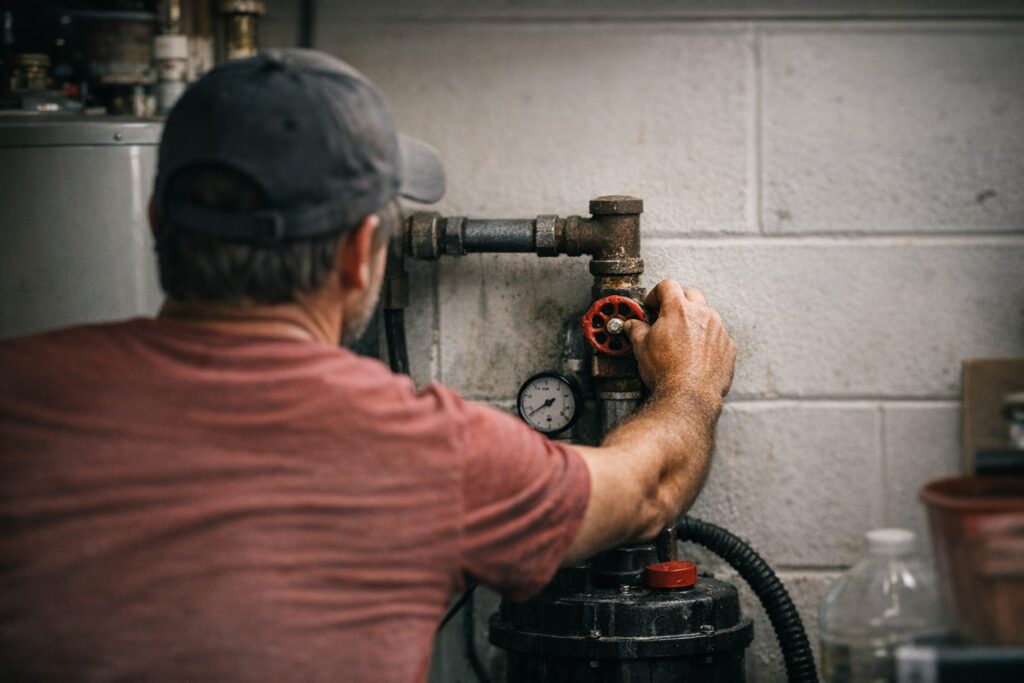
Why Every Florida Homeowner Needs to Know Their Water Shutoff
A burst pipe, a failed water heater, or a cracked supply line can release hundreds of gallons of water into your home in under an hour. The single most effective thing you can do to limit the damage is shut off the water supply immediately. Yet most homeowners have never located their shutoff valve, let alone practiced turning it off under pressure.
In Southwest Florida, where homes sit on concrete slabs and plumbing runs through hot attics and exterior walls, supply line failures are a year-round risk. This guide from WrightWay Emergency Services walks you through every shutoff point in your home so you are ready when seconds count.
Locating Your Main Water Shutoff Valve
Every home has a main shutoff valve that stops all water flow into the building. In Florida, the location depends on your home’s construction:
Typical Locations in Florida Homes
- Near the water meter at the street: Most municipal water connections in Sarasota, Manatee, Lee, and Charlotte counties have a meter box near the curb. Inside the box, you will find a valve on the house side of the meter. This is your primary emergency shutoff.
- Exterior wall near the water heater: Many Florida homes have a secondary shutoff valve where the main supply line enters the house, usually on the garage wall or an exterior wall near the water heater.
- Inside the garage: In newer construction, the main shutoff may be mounted on the garage wall with a ball valve handle.
- Near the pressure regulator: If your home has a pressure reducing valve (PRV), the main shutoff is typically within a few feet of it.
How to Identify Your Valve Type
| Valve Type | Appearance | How to Close |
|---|---|---|
| Ball valve | Lever handle | Turn handle 90 degrees so it is perpendicular to the pipe |
| Gate valve | Round wheel handle | Turn clockwise several full rotations until tight |
| Meter valve | Recessed fitting in meter box | Use a meter key or adjustable wrench to turn 90 degrees |
Pro tip: Ball valves are far more reliable than gate valves. Gate valves that have not been turned in years often seize, corrode, or fail to seal completely. If your home has an old gate valve, consider having a plumber replace it with a quarter-turn ball valve before you need it in an emergency.
Individual Appliance Shutoff Valves
You do not always need to shut off the entire house. If the leak is coming from a specific fixture or appliance, closing the local shutoff valve is faster and lets you keep water running in the rest of the home.
Where to Find Each Shutoff
- Toilets: Oval or football-shaped valve on the wall behind the toilet, near the floor. Turn clockwise to close.
- Sinks: Under the sink cabinet, you will find two valves (hot and cold) on the supply lines coming from the wall. Turn both clockwise.
- Washing machine: Two valves (hot and cold) on the wall behind the machine, or a single lever-type shutoff box. Turn clockwise or push the lever to the off position.
- Dishwasher: Usually under the kitchen sink, a small valve on the hot water line branches off to the dishwasher. Turn clockwise.
- Water heater: A valve on the cold water inlet pipe on top of the unit. Turn the lever perpendicular to the pipe (ball valve) or turn the wheel clockwise (gate valve).
- Refrigerator ice maker: A small saddle valve or quarter-turn valve on the supply line, usually behind the refrigerator or under the kitchen sink.
Step-by-Step Emergency Shutoff Procedure
When you discover a water emergency in your home, follow these steps in order:
- Assess safety first. If water is near electrical outlets, appliances, or your breaker panel, do not step into the water. Turn off electricity at the breaker panel if you can reach it safely, or call your utility company.
- Identify the source. Can you see where the water is coming from? If it is a specific appliance or fixture, go directly to that shutoff valve.
- Close the local shutoff valve. Turn the valve clockwise (gate valve) or perpendicular to the pipe (ball valve). Verify the water stops flowing.
- If the local valve fails or you cannot find it, shut off the main. Go to your main shutoff valve and close it. This stops all water to the entire house.
- Open a faucet to relieve pressure. After closing the main valve, open a faucet at the lowest point in your home to drain remaining water from the pipes and relieve pressure.
- Call for help. Contact a professional restoration company to begin emergency water cleanup before moisture causes secondary damage.
What to Do If Your Shutoff Valve Is Stuck
Shutoff valves that have not been operated in years : which is most of them in Florida homes : frequently seize due to mineral buildup, corrosion, or sediment. If your valve will not turn:
- Do not force it. Applying excessive force to a corroded gate valve can snap the stem, turning a leak into a flood.
- Try penetrating lubricant. Spray WD-40 or a similar penetrant around the valve stem, wait two to three minutes, then try again with gentle, steady pressure.
- Use the meter shutoff. If your interior valve is stuck, go to the water meter at the street. Use a meter key (available at hardware stores for under ten dollars) to close the valve on the house side of the meter.
- Call your water utility. If you cannot close any valve, call your municipal water provider and request an emergency shutoff. Sarasota County Utilities, City of Sarasota, and Lee County Utilities all have 24-hour emergency lines.
Preventive Steps Every Florida Homeowner Should Take
If water reached walls, flooring seams, or sat overnight, fans alone rarely save the materials. A free moisture inspection tells you exactly what is wet and what it costs to fix.
Do not wait for an emergency to figure out your plumbing. Take these steps now while conditions are calm:
- Locate every shutoff valve in your home today. Walk through the house and find the main shutoff, the water heater shutoff, and every fixture valve. Tag them with bright-colored labels if needed.
- Test your main shutoff valve. Turn it off and on once a year to prevent it from seizing. If it is difficult to turn or does not fully stop the water, have it replaced.
- Keep a meter key accessible. Store one in your garage near the door so you can reach it quickly.
- Show every household member. Make sure your spouse, older children, and any regular housesitters know where the main shutoff is and how to operate it.
- Consider a smart water shutoff valve. Automatic shutoff systems like Flo by Moen or Phyn detect abnormal flow and shut off the water automatically, even when you are not home. These are especially valuable for Florida vacation homes that sit unoccupied for weeks at a time.
After the Water Is Off: What Happens Next
Shutting off the water stops the source, but the damage already done requires immediate professional attention. Standing water and saturated building materials in Florida’s humid climate create ideal conditions for mold growth within 24 to 48 hours.
A professional restoration company will:
- Extract standing water using truck-mounted equipment
- Set up commercial structural drying systems (air movers and dehumidifiers)
- Monitor moisture levels daily until the structure reaches dry standard
- Document everything for your insurance claim
Be Ready Before the Emergency Happens
Water damage emergencies do not announce themselves. A supply line can burst at 3 AM on a Saturday, a water heater can fail while you are at work, and a washing machine hose can blow while you are on vacation. The homeowners who minimize damage are the ones who prepared in advance.
If you are dealing with a water emergency right now, call WrightWay Emergency Services at (941) 379-8669 : 24 hours a day, 7 days a week. We respond across Sarasota, Bradenton, Fort Myers, Cape Coral, Naples, and all of Southwest Florida with an average response time of 60 to 90 minutes. The faster we arrive, the more we can save.
WrightWay handles every restoration job from emergency response through licensed reconstruction.
One IICRC-certified team, one project manager, one phone call. Available 24/7 across Sarasota, Manatee, Charlotte, Lee, and Collier counties.


