ICRA Compliance in Healthcare Facility Restoration
Need restoration help in Southwest Florida right now? WrightWay dispatches in 60 to 90 minutes from three Florida offices, and we answer with a live human.
Restoration work in hospitals, clinics, assisted living facilities, and other healthcare settings introduces risks that simply do not exist in residential or standard commercial projects. The Infection Control Risk Assessment (ICRA) is a structured process that identifies potential infection hazards created by construction and restoration activities and establishes protocols to protect patients and staff. At WrightWay Emergency Services, our commercial restoration team is trained in ICRA protocols and works alongside infection preventionists to maintain compliance throughout every healthcare project.
What Is an ICRA?
An Infection Control Risk Assessment evaluates the type of restoration or construction activity being performed, the patient population near the work area, and the resulting risk level. The ICRA matrix classifies activities and patient risk groups to determine the appropriate level of containment and infection prevention measures required.
The ICRA process involves four key components:
- Activity type classification (Type A through D): Ranges from inspection-only activities (Type A) to major demolition and reconstruction (Type D)
- Patient risk group identification: From lowest risk (office areas) to highest risk (operating rooms, ICU, immunocompromised patient areas)
- ICRA matrix class determination: Combines activity type and risk group to determine the required infection control class (I through IV)
- Control measures implementation: Specific containment, ventilation, and monitoring requirements based on the ICRA class
Containment Requirements by ICRA Class
Each ICRA class requires increasingly rigorous containment:
- Class I: Minimize dust generation, replace ceiling tiles immediately, wet-mop work area at completion
- Class II: Seal unused doors and HVAC openings, use misting to suppress dust, HEPA vacuum at completion, maintain negative pressure if near patient areas
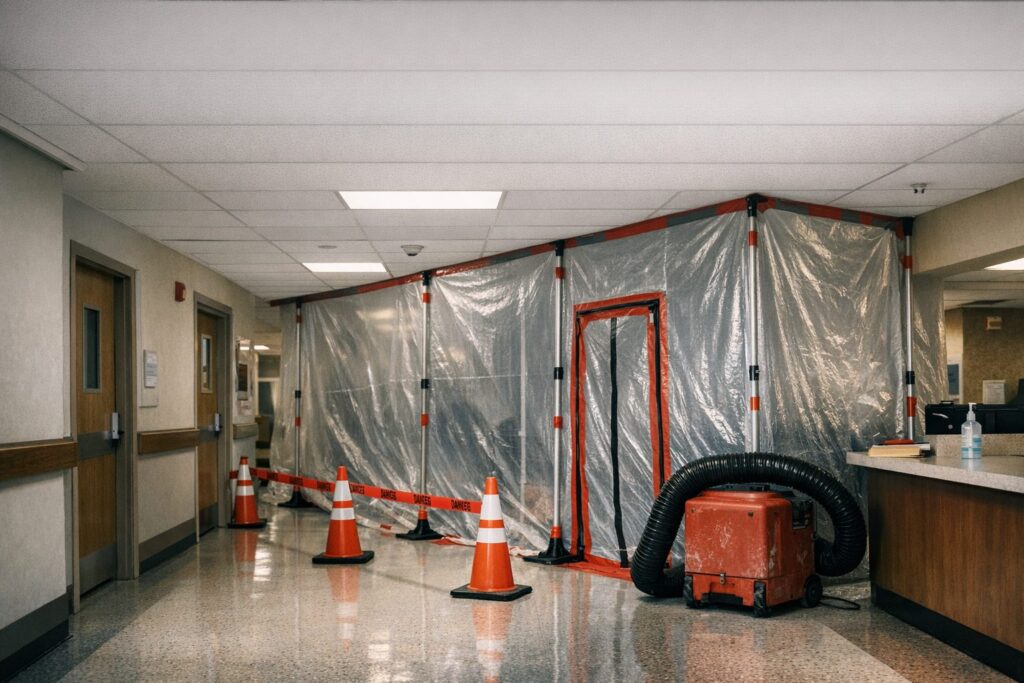
- Class III: Construct hard-wall containment barriers floor to deck, maintain negative air pressure with HEPA-filtered air machines, all workers enter and exit through a designated anteroom, daily monitoring of negative pressure
- Class IV: All Class III measures plus sealed and caulked containment barriers, continuous negative pressure monitoring with alarms, air sampling before, during, and after work, and infection preventionist approval before barrier removal
Special Considerations for Water Damage in Healthcare Settings
Water damage in healthcare facilities requires an accelerated response because stagnant moisture creates an immediate infection risk in an environment with vulnerable patients. In our experience restoring healthcare facilities across Sarasota, Manatee, and Lee counties, the response window is dramatically shorter than in residential or standard commercial settings:
- Aspergillus spores can become airborne within hours of water damage, posing critical risk to immunocompromised patients : including those in oncology, transplant, and neonatal units
- Ceiling tiles and insulation above patient areas must be addressed immediately : even minor leaks can release contaminated particles into sterile environments
- HVAC systems serving patient care areas must be isolated if water has entered the ductwork. Restoration crews must coordinate with facility engineering to prevent cross-contamination through the building’s air handling systems.
- All removed materials must be bagged and sealed within the containment area before transport through the facility : materials cannot be carried through patient corridors or common areas unsealed
- Work schedules must account for patient activity patterns : noisy demolition near patient rooms may need to be scheduled during specific hours coordinated with nursing leadership
Joint Commission and CMS Compliance
Hospitals and healthcare facilities accredited by The Joint Commission or certified by the Centers for Medicare and Medicaid Services (CMS) face additional scrutiny regarding construction and restoration activities. Non-compliance with ICRA protocols during restoration can result in citations during surveys and, in serious cases, jeopardize the facility’s accreditation or certification. Our commercial restoration team understands these stakes and ensures that every project meets or exceeds Joint Commission Environment of Care standards.
Documentation and Communication
Healthcare facility restoration requires meticulous documentation that goes well beyond what is needed for residential or standard commercial projects:
- Completed ICRA matrix signed by the infection preventionist before work begins
- Daily containment integrity logs including negative pressure readings taken at specified intervals
- Worker sign-in sheets and PPE compliance records : every person entering the containment must be documented
- Air sampling results if required by the ICRA class : baseline samples before work begins, periodic samples during work, and clearance samples before barrier removal
- Communication logs between the restoration team, facility management, and infection prevention
- Photographic documentation of containment setup, daily conditions, and completed work
Training Requirements for Healthcare Restoration Workers
Restoration technicians working in healthcare facilities require training beyond standard IICRC certifications. At WrightWay, our healthcare restoration crews complete additional preparation that ensures compliance with facility-specific protocols:
- Bloodborne pathogen training: OSHA-mandated training for any worker who may encounter blood or other potentially infectious materials during restoration in patient care areas
- HIPAA awareness: Restoration workers may inadvertently access patient information during their work. Our crews are trained in HIPAA privacy requirements and understand the obligation to protect any patient information they may encounter : whether on paper records, computer screens, or verbal communications overheard in clinical settings
- Facility-specific orientation: Before entering the work area, each crew member receives orientation from the facility’s infection preventionist or designee covering the specific patient populations nearby, emergency procedures, PPE requirements, and communication protocols for that particular project
- Background screening: Most healthcare facilities require background checks for all restoration workers who will be on-site, especially in areas near patient care. We maintain current background screening for our healthcare restoration team to avoid project delays.
The combination of IICRC restoration expertise and healthcare-specific training is what separates qualified healthcare restoration from general commercial work. Facilities that hire general restoration companies without healthcare experience risk Joint Commission citations, infection control breaches, and patient safety incidents that carry far greater consequences than the restoration work itself.
WrightWay Emergency Services provides ICRA-compliant restoration for healthcare facilities throughout SW Florida, including hospitals, surgical centers, assisted living facilities, and medical offices in Sarasota, Lee, Charlotte, Manatee, and Collier counties. Our IICRC-certified commercial team coordinates with your infection preventionist and facility management to maintain patient safety throughout the restoration process. Call (941) 379-8669 for healthcare facility restoration services.
WrightWay handles every restoration job from emergency response through licensed reconstruction.
One IICRC-certified team, one project manager, one phone call. Available 24/7 across Sarasota, Manatee, Charlotte, Lee, and Collier counties.