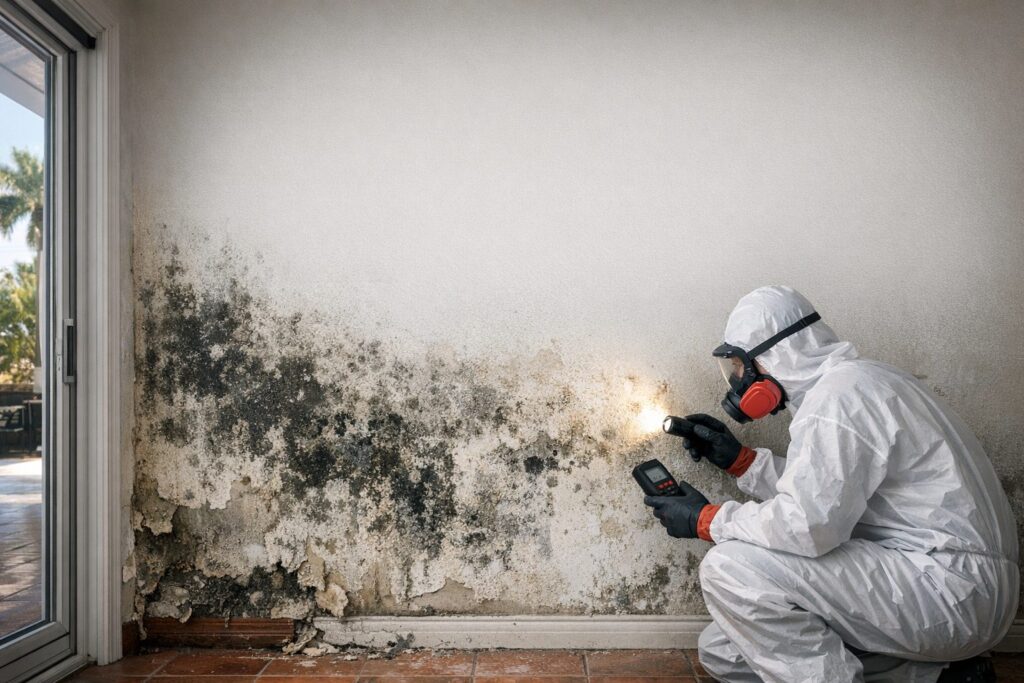
Understanding Mold Coverage in Florida Homeowners Insurance
Mold is one of the most common and most misunderstood issues in Florida homeowners insurance. If you have discovered mold in your home, the first question on your mind is almost certainly whether your insurance will pay to remove it. The short answer is: it depends on what caused the mold. Florida has specific statutes that govern mold coverage, and understanding them can mean the difference between a fully covered claim and thousands of dollars out of pocket.
At WrightWay Emergency Services, we handle mold remediation projects across Southwest Florida every week, and we help homeowners navigate the insurance process from the initial discovery through the final repair. Here is what you need to know about mold coverage in the state of Florida.
Florida’s Statutory Mold Coverage Limit
Under Florida Statute 627.706, residential property insurance policies are required to provide coverage for mold damage, but the legislature allows insurers to cap that coverage. Most standard Florida homeowners policies include a $10,000 mold coverage limit. This is the maximum the insurer will pay for mold-related testing, remediation, and repairs : regardless of how much the actual work costs.
Some policies offer even less. It is critical that you review your declarations page to confirm your specific mold coverage limit. Look for language referencing “fungi, wet rot, dry rot, or bacteria” in the special limits or sublimits section of your policy.
When Mold Removal IS Covered by Insurance
Florida insurance policies generally cover mold removal when the mold results from a sudden and accidental covered peril. This means the water event that caused the mold must itself be a covered loss under your policy. Common covered scenarios include:
- Burst or broken pipes : A supply line fails suddenly and water saturates the wall cavity, leading to mold growth within days
- Appliance malfunctions : Your water heater, washing machine, or dishwasher fails and causes water damage that goes unnoticed behind or under the unit
- Accidental overflow : A bathtub or sink overflows and water seeps into flooring and subfloor
- Storm damage : A hurricane or severe storm breaches your roof and wind-driven rain enters the structure, creating conditions for mold
- Fire suppression : Water used to extinguish a fire saturates materials that later develop mold
In each of these cases, the mold is a direct consequence of a covered water damage event. If you file a water damage claim promptly and the insurer accepts it, the mold remediation that follows is typically covered : up to your policy’s mold sublimit.
When Mold Removal Is NOT Covered
Insurance companies routinely deny mold claims when the cause falls outside covered perils or when the homeowner’s actions (or inaction) contributed to the mold growth. Common exclusions include:
- Neglect or lack of maintenance : If a slow drip under a sink goes unrepaired for months and mold develops, insurers argue the homeowner failed to maintain the property. Florida courts have upheld these denials.
- Gradual or long-term leaks : A pipe that has been seeping slowly for an extended period is typically classified as a maintenance issue rather than a sudden event
- Humidity and condensation : Mold caused by poor ventilation, inadequate air conditioning, or general Florida humidity is considered a maintenance and habitability issue, not an insurable event
- Flooding without flood insurance : Standard homeowners policies exclude flood damage entirely. If your home floods and mold develops, your homeowners policy will not cover the mold. You would need a separate flood insurance policy to have any coverage
- Pre-existing mold : Mold that existed before the policy was written or before a covered event is excluded
- Construction defects : Mold resulting from improper building envelope installation, missing vapor barriers, or other construction deficiencies is generally excluded from standard policies
How to Check Your Mold Coverage
Do not wait until you find mold to understand your coverage. Take these steps now:
- Read your declarations page. Look for the mold, fungi, or bacteria sublimit. It is usually listed alongside other special limits like ordinance and law coverage or sinkhole coverage.
- Review the exclusions section. Search for “fungi,” “mold,” “wet rot,” “dry rot,” and “bacteria.” Pay attention to whether coverage is limited to mold resulting from a covered water loss.
- Call your agent. Ask specifically: “What is my mold coverage limit?” and “Under what circumstances is mold covered?” Get the answer in writing if possible.
- Ask about additional mold coverage riders. Some Florida insurers offer supplemental mold coverage endorsements that increase your limit from $10,000 to $25,000, $50,000, or even $100,000. The additional premium is typically $100 to $500 per year : a fraction of what a major mold remediation project costs.
Additional Mold Coverage Riders
Need restoration help in Southwest Florida right now? WrightWay dispatches in 60 to 90 minutes from three Florida offices, and we answer with a live human.
If you live in Southwest Florida : where humidity regularly exceeds 70 percent and afternoon rain showers are a daily occurrence from June through October : an additional mold coverage endorsement is one of the smartest insurance investments you can make. A full-house mold remediation project can easily cost $15,000 to $30,000 or more, far exceeding the standard $10,000 sublimit.
When shopping for additional mold coverage, ask about:
- Whether the additional coverage applies per occurrence or as an aggregate annual limit
- Whether the rider covers testing and assessment costs or only remediation
- Whether the deductible for mold claims differs from your standard property deductible
Why Documentation Matters for Mold Claims
The single most important factor in getting a mold claim approved is proving that the mold resulted from a sudden, accidental covered event : not from neglect or gradual deterioration. Documentation is your evidence. Here is what you need:
- Photographs and video of the initial water event : Document the source, the extent of water intrusion, and the timeline
- Proof of prompt response : Show that you called for help quickly, did not let water sit, and took reasonable steps to mitigate damage. This is where calling a professional restoration company immediately pays off.
- Moisture readings and drying logs : Professional restoration companies like WrightWay document daily moisture readings that prove exactly when and where water was present
- Mold testing results : Laboratory analysis from an accredited lab that identifies the species and confirms active growth
- Repair records : Documentation showing you fixed the source of the water to prevent recurrence
Insurance adjusters look for gaps in the timeline. If there is a long delay between the water event and the mold claim, or if you cannot prove the mold’s origin, the claim is far more likely to be denied.
How WrightWay Helps With Mold Insurance Claims
At WrightWay Emergency Services, we understand that mold remediation is only half the battle : getting it covered is the other half. Here is how we support your claim:
- Thorough documentation from day one. Our technicians photograph and log every finding, from initial moisture readings to final clearance testing. We create a clear, timestamped record that connects the mold to its water source.
- Xactimate estimates. We write our remediation estimates using Xactimate, the same software your insurance company uses. This eliminates pricing disputes and speeds up approval.
- Direct communication with adjusters. We work with your adjuster to provide the documentation they need, answer technical questions, and ensure nothing falls through the cracks.
- Proper remediation protocols. We follow IICRC S520 standards for mold remediation, which insurers recognize as the industry standard. Work performed outside these protocols can be grounds for claim disputes.
If you suspect mold in your home, do not wait. Every day of delay gives insurers more ammunition to argue neglect. Call WrightWay Emergency Services at (941) 379-8669 for professional mold remediation. We serve Sarasota, Fort Myers, Naples, Bradenton, and all surrounding Southwest Florida communities. You can also report a loss online or visit our mold remediation services page to learn more about our process.
WrightWay handles every restoration job from emergency response through licensed reconstruction.
One IICRC-certified team, one project manager, one phone call. Available 24/7 across Sarasota, Manatee, Charlotte, Lee, and Collier counties.