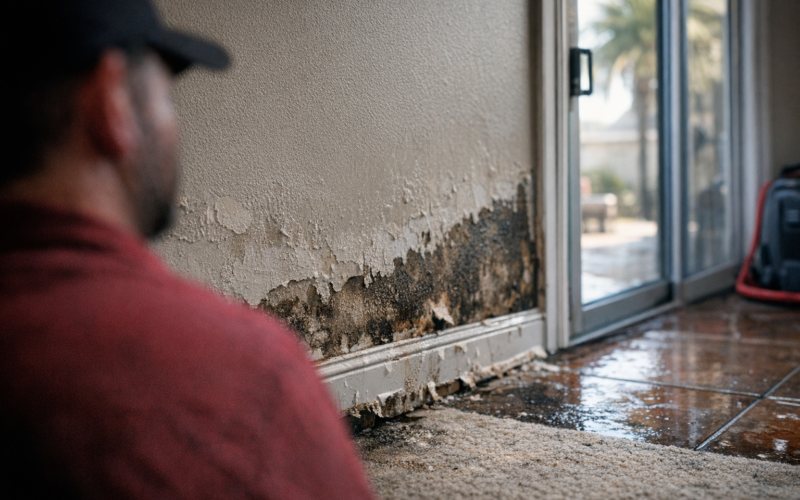
Why Documentation Makes or Breaks Your Insurance Claim
Your insurance claim is only as strong as your documentation. Insurance adjusters make coverage decisions based on evidence : photographs, videos, written inventories, moisture readings, and professional reports. Without thorough documentation, you are asking the insurer to take your word for it, and that rarely works in your favor.
At WrightWay Emergency Services, we have seen well-documented claims get approved quickly and fully, while poorly documented claims of equal severity get denied or significantly underpaid. This guide walks you through exactly how to document property damage : whether from water, fire, storm, or mold : to give your claim the best chance of success.
Step 1: Ensure Your Safety First
Before you pick up your phone to start photographing, make sure the area is safe to enter:
- If there is standing water near electrical outlets or panels, do not enter until power is disconnected
- If the structure has been through a fire, wait for the fire department to confirm it is safe
- If there is visible mold growth across a large area, limit your exposure time and avoid disturbing it
- If ceilings are sagging or floors feel spongy, the structure may be compromised : stay out
Your safety is always more important than documentation. If you cannot safely enter the property, call professionals to handle both the documentation and the emergency response.
Step 2: Photograph Everything
Photographs are the foundation of your claim documentation. Take far more photos than you think you need : insurance adjusters cannot visit your property every day, so your photos tell the story for them.
Wide Shots
Start with wide-angle photos that show the overall scope of damage. Stand in doorways and corners to capture entire rooms. These establish context and show the adjuster how much of the space is affected.
Medium Shots
Move closer and photograph each damaged area from a distance of three to six feet. Include reference points like door frames, furniture, or light switches that help the adjuster understand the scale.
Close-Up Shots
Photograph specific damage in detail : peeling paint, water stains, mold growth, charred materials, cracked tile, and warped flooring. Get close enough to show texture and detail.
What Specifically to Photograph
- The water or damage source : the broken pipe, the hole in the roof, the failed appliance
- Water lines on walls : these high-water marks prove the depth and extent of flooding
- Damaged flooring, walls, and ceilings : every room, every angle
- Damaged personal belongings : furniture, electronics, clothing, documents
- Serial numbers and labels on damaged appliances and electronics
- Receipts and product packaging if available
- Your HVAC system and ductwork if water or fire reached them
- The exterior : roof damage, siding damage, window damage, landscaping damage
Photo Tips
- Make sure your phone’s date and time stamp setting is enabled : metadata proves when photos were taken
- Use natural light when possible, or turn on all available lights for indoor shots
- Include a ruler, tape measure, or common object (like a coin) next to damage to show scale
- Do not edit, filter, or crop photos : insurers may question altered images
Step 3: Capture Video
Video provides context that photos cannot. Walk through each affected area slowly, narrating what you see:
- State the date and time at the beginning of the video
- Describe the damage as you move through each room
- Point out the water source or damage origin
- Show the extent of water, smoke, or mold spread
- Open cabinets and closets to reveal hidden damage
- Pan slowly : rapid movement creates blurry, unusable footage
A three to five minute walkthrough video is one of the most powerful pieces of evidence you can provide to an adjuster.
Step 4: Create a Written Inventory
List every damaged item with as much detail as possible. For each item, document:
- Description (brand, model, color, size)
- Approximate date of purchase
- Original purchase price (check credit card or bank statements, online order history, or retailer websites for current pricing)
- Current condition
- Whether the item is repairable or a total loss
Start with the most valuable items and work your way down. Use a spreadsheet or the insurance inventory apps offered by carriers like State Farm, Allstate, and others. Attach photos of each item to your inventory entry when possible.
Step 5: Document the Timeline
Your insurance company will want to understand exactly when events occurred. Keep a written log that includes:
- When you discovered the damage (date and time)
- What you did immediately (shut off water, called 911, moved valuables)
- When you notified your insurance company
- When the restoration company arrived
- Daily updates on the restoration process
- Any conversations with adjusters, agents, or contractors (note the date, time, who you spoke with, and what was discussed)
Step 6: Preserve Evidence
Do not throw away damaged materials until your insurance adjuster has inspected them or given you written authorization to dispose of them. If materials must be removed for safety or to prevent further damage (like sewage-contaminated drywall), photograph them thoroughly before disposal and save a sample if possible.
Common Documentation Mistakes
WrightWay documents every loss to insurance standards, photos, moisture logs, and itemized scopes your adjuster can approve without back-and-forth.
Avoid these errors that can weaken your claim:
- Waiting too long to document. Conditions change rapidly : water recedes, surfaces dry, and evidence disappears. Document as soon as it is safe to do so.
- Cleaning up before photographing. Your instinct is to start mopping and clearing debris. Resist that urge until you have thoroughly documented the as-found condition.
- Incomplete room coverage. Do not skip rooms that appear undamaged. Water travels through wall cavities and can damage rooms that look fine on the surface.
- Not documenting undamaged areas. Baseline photos of unaffected rooms help adjusters understand the normal condition of your home and the contrast with damaged areas.
- Discarding receipts and records. If you spend money on emergency repairs, hotel stays, meals, or temporary necessities, save every receipt. These expenses may be covered under your policy’s additional living expenses (ALE) provision.
How WrightWay’s Professional Documentation Supports Your Claim
When WrightWay Emergency Services responds to your property damage, we bring documentation tools and processes that go far beyond what a homeowner can do with a cell phone:
Timestamped Professional Photography
Our technicians take hundreds of georeferenced, timestamped photographs documenting every aspect of the loss : from initial conditions through each phase of restoration to final completion.
Moisture Mapping and Logs
Using calibrated moisture meters and thermal imaging cameras, we create detailed moisture maps showing exactly where water has migrated and daily logs tracking the drying progress. These readings are the scientific evidence that proves the scope of water damage.
Thermal Imaging
Infrared cameras detect temperature differentials caused by hidden moisture behind walls, above ceilings, and under floors : damage that is invisible to the naked eye but clearly documented in thermal images that adjusters accept as evidence.
Xactimate Estimates
We prepare our damage estimates using Xactimate, the same estimating platform used by virtually every insurance company in the country. This ensures our scope and pricing align with what the insurer expects, reducing disputes and speeding up approval.
Matterport 3D Scans
For significant losses, we create Matterport 3D virtual tours of the property that allow adjusters, underwriters, and other stakeholders to virtually walk through the damage from anywhere. These immersive scans capture dimensions, conditions, and spatial relationships that flat photographs cannot convey.
Do not let poor documentation cost you thousands on your insurance claim. Call WrightWay Emergency Services at (941) 379-8669 for professional damage response and documentation across Sarasota, Fort Myers, Naples, Bradenton, and all of Southwest Florida. Learn more about our insurance claims assistance or report a loss online.
WrightWay handles every restoration job from emergency response through licensed reconstruction.
One IICRC-certified team, one project manager, one phone call. Available 24/7 across Sarasota, Manatee, Charlotte, Lee, and Collier counties.
Add us as a preferred source and our storm updates, claim guides and restoration answers show up higher when you search.