Behind the Scenes of a Middle-of-the-Night Emergency Call
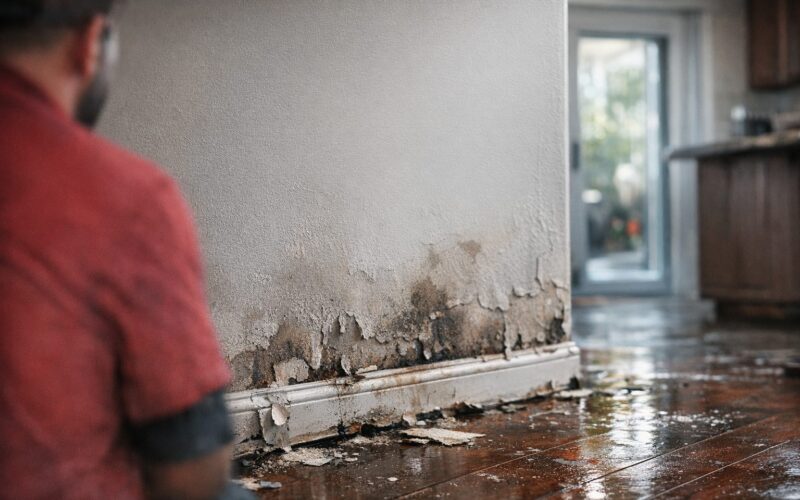
It is 3 AM. You wake up to the sound of water. Or maybe you smell something burning. Or maybe the storm that rolled through an hour ago just put a tree branch through your roof and rain is pouring into your living room. Your heart is pounding, your family is awake and scared, and you need help right now.
You search your phone for a restoration company and find one that says “24/7 emergency service.” But what does that actually mean? Is someone really answering the phone at 3 AM, or will you get a voicemail and a callback in the morning? Will a crew actually show up in the middle of the night?
At WrightWay Emergency Services, 24/7 means exactly what it says. Here is a detailed walkthrough of what happens from the moment you dial our number to the moment our crew arrives at your property.
Step 1: Your Call Is Answered by a Real Person
When you call WrightWay at 3 AM, a real person answers the phone. Not a voicemail. Not an answering service reading from a script. Our after-hours calls are handled by trained team members who understand restoration and can begin the triage process immediately.
The person on the phone will ask you a series of questions designed to assess the situation:
- What type of damage are you experiencing (water, fire, storm, sewage)?
- Is everyone in the household safe?
- Is the water source stopped, or is water still flowing?
- Is the electricity turned off in the affected area?
- How many rooms or areas are affected?
- Is there any contamination (sewage, chemicals)?
- What is your address and the best way to reach you?
Based on your answers, the team member determines the severity level and the resources needed for the response.
Step 2: The On-Call Crew Is Dispatched
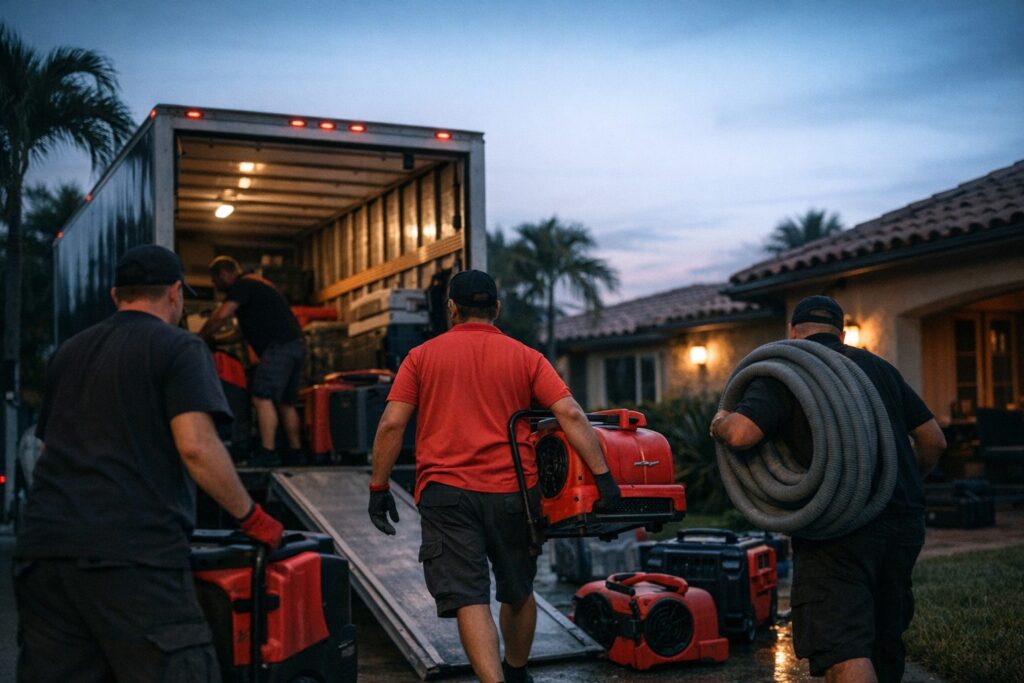
WrightWay maintains on-call crews specifically for after-hours emergencies. These are not technicians who get woken up and groggily stumble to their trucks. Our on-call rotation is structured so that crew members are rested, equipped, and ready to respond. The on-call team has a fully loaded response vehicle with extraction equipment, moisture meters, thermal imaging cameras, personal protective equipment, and board-up materials.
Within minutes of your call, the crew receives the dispatch with your address, the nature of the emergency, and any safety considerations. They are typically rolling within 15 to 20 minutes of the call.
Step 3: Response Time and What Affects It
Our target response time across SW Florida is 60 to 90 minutes. Response time depends on several factors:
- Location: If you are in Sarasota or Manatee County, response is typically faster. For Charlotte, Lee, or Collier County properties, travel time may add 20 to 30 minutes.
- Weather conditions: During active storms or hurricanes, response times may increase due to road conditions and the volume of simultaneous emergencies.
- Scope of the emergency: A large-scale commercial loss may require additional equipment or personnel, which can take time to mobilize.
While you wait, the team member on the phone will walk you through immediate steps you can take to protect yourself and minimize damage, such as shutting off water, turning off electricity, and moving valuables to dry areas.
Step 4: The Crew Arrives and Assesses the Scene
When the crew arrives, their first action is always a safety assessment. They check for electrical hazards, structural instability, slip-and-fall risks, and contamination. Only after confirming the scene is safe do they begin work.
The lead technician performs a rapid assessment that includes:
- Identifying the water source and confirming it is stopped
- Classifying the water category: Category 1 (clean), Category 2 (gray water), or Category 3 (black water/sewage)
- Determining the water class: Class 1 through Class 4, based on how much material is wet and how much evaporation is needed
- Mapping the affected area using moisture meters and thermal imaging
- Documenting the damage with photographs and notes for insurance purposes
Step 5: Emergency Mitigation Begins Immediately
The goal of a 3 AM response is not to complete the entire restoration overnight. It is to stop the damage from getting worse, a process called mitigation. Here is what happens:
Water Extraction
Commercial-grade extractors remove standing water rapidly. Truck-mounted units can extract 25 to 50 gallons per minute, clearing a flooded room in a fraction of the time a shop vac would take. Portable extractors handle hard-to-reach areas, closets, and spaces where the truck line cannot reach.
Emergency Demolition
When drywall, insulation, or other porous materials are saturated or contaminated, they are removed to allow the structural components behind them to dry. This is not a full reconstruction teardown; it is a targeted removal of materials that cannot be saved and would trap moisture if left in place.
Board-Up and Tarping
If the building envelope is compromised — a broken window, a hole in the roof, a damaged door — the crew secures the opening with plywood, tarps, or temporary barriers. This prevents further water intrusion, keeps animals and intruders out, and stabilizes the environment for drying. Learn more about our emergency board-up services.
Initial Drying Equipment Setup
Even at 3 AM, getting drying equipment in place and running is critical. Commercial dehumidifiers and air movers are positioned based on the moisture map to begin pulling moisture from the air and accelerating evaporation from wet materials. Every hour of drying that begins tonight is an hour less of damage progression.
Step 6: Documentation and Communication
Need restoration help in Southwest Florida right now? WrightWay dispatches in 60 to 90 minutes from three Florida offices, and we answer with a live human.
Before the crew leaves, the lead technician reviews the situation with you, explains what was done and why, and outlines the next steps. You receive:
- A summary of the damage assessment
- Photos documenting the initial conditions and all work performed
- Information for filing your insurance claim
- A schedule for the next monitoring visit, typically the following morning
- Emergency contact information if anything changes before the next visit
What Sets a Professional 3 AM Response Apart
Many companies claim 24/7 availability. The difference between a professional response and a basic one comes down to equipment, training, and process:
- IICRC-certified technicians who understand the science of drying, contamination categories, and structural behavior
- Commercial-grade equipment that can extract water, measure moisture, and create drying conditions that consumer products cannot match
- Insurance-grade documentation from the very first visit, so your claim is supported from day one
- Safety-first approach that protects both your family and the crew in hazardous conditions
When You Need Help at Any Hour, Call WrightWay
Emergencies do not wait for business hours, and neither do we. Whether it is 3 AM on a Tuesday or noon on a holiday, WrightWay Emergency Services answers the phone and dispatches crews across Sarasota, Manatee, Charlotte, Lee, and Collier counties.
Save our number in your phone now so you have it when you need it: (941) 379-8669. When disaster strikes in the middle of the night, you want a team that is already ready to roll.
WrightWay handles every restoration job from emergency response through licensed reconstruction.
One IICRC-certified team, one project manager, one phone call. Available 24/7 across Sarasota, Manatee, Charlotte, Lee, and Collier counties.
Add us as a preferred source and our storm updates, claim guides and restoration answers show up higher when you search.